

After beating Aggies and Frogs, Rice women 7-0 for first time
The Rice women’s basketball team scored a pair of victories over major conference foes
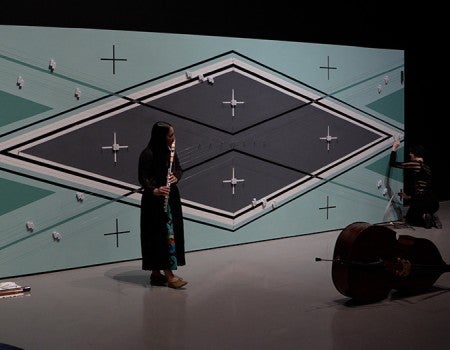
Nameless Sound musicians performed an original score on Nanibah Chacon’s interactive installation following Danza Azteca Macuilxochitl's activation of...
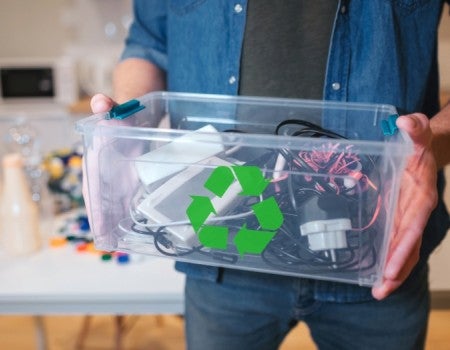
Rice’s James Tour recently published an improved method to recover antimony from this electronic waste stream. ...

Three Rice faculty members from the Department of Earth, Environmental and Planetary Sciences have recently been honored with career awards, showcasin...

The Adventurous Electric Guitar Festival gathered players, composers and scholars to test the instrument’s next act....
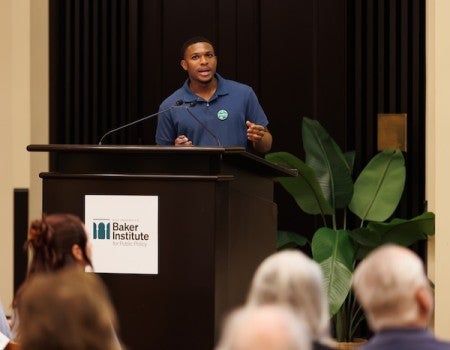
The Science and Technology Policy Program at Rice’s Baker Institute for Public Policy hosted a “science cafe” Oct. 13 to bring research to reality and...

The Doerr Institute for New Leaders at Rice has launched CoachRICE: Team Coaching, a new professional education program designed to help coaches, mana...
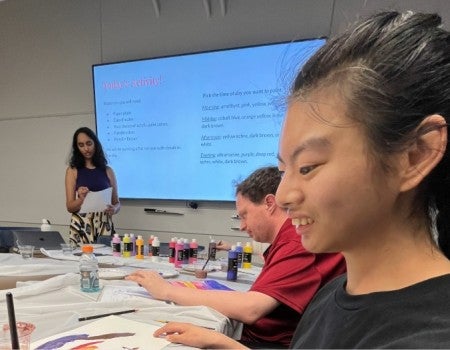
Graduate student Sayuri Jayawardena has started a Rice chapter of Lifelong Learning with Friends. ...
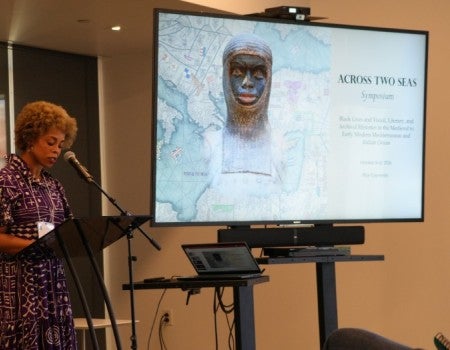
Scholars, curators and filmmaker Daphne Di Cinto gather at Rice to explore Black histories from Renaissance Italy to medieval Africa and Islamic world...
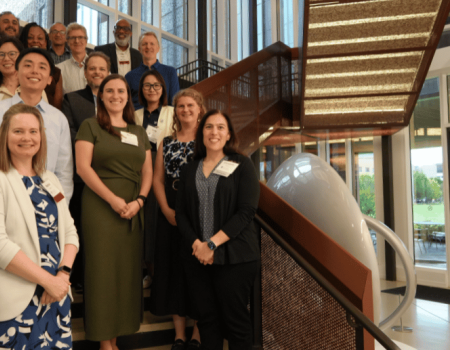
For the sixth fall in a row, Rice welcomed a new group of researchers to STaRT@Rice, giving emerging researchers both the skills and the support to gr...

Rice and the Houston Methodist Research Institute have signed a memorandum of understanding with LSE Health at the London School of Economics and Poli...

As the 2026-27 Aleko Endowed Artist, Julia Bullock curated an evening of song, chamber music and poetry celebrating the Harlem Renaissance....

Rice’s Yonglong Xie is one of 20 early-career scientists, mathematicians and engineers to receive a 2026 Packard Fellowship. ...
After beating Aggies and Frogs, Rice women 7-0 for first time
The Rice women’s basketball team scored a pair of victories over major conference foes
Comic Art Teaching & Study Workshop receives original comic art gift worth six figures
A rare art collection featuring some of the most famous cartoon characters in American history has been acquired by Rice University’s Comic Art Teaching and Study Workshop (CATS) within the School of Humanities’ Department of Visual and Dramatic Arts.

Rice volleyball team bows out in second round of NCAA Tournament
Rice’s volleyball team dominated the final two sets to claim a 3-1 victory (26-24, 24-26, 25-16, 25-14) over the University of Colorado Boulder in the first round of the NCAA Tournament Dec. 1 in Waco, Texas, before dropping a five-set battle with Baylor University (16-25, 25-22, 25-23, 14-25, 15-11) in the second round Dec. 2.

Fear of hate crime looms especially large in the minds of Jews and Muslims, even if they have never been personally targeted, according to a new study from Rice University and West Virginia University.
Rice organizes drive to house, assist international students over winter break
Hosted by the Office of International Students and Scholars — International Connections (OISS), the International Holiday Hospitality Help Program aims to provide amenities such as low-cost/no-cost housing accommodations, meals and gift cards/cash to international undergraduate students who cannot return to their home this holiday season.

Owls land in LendingTree Bowl, will face Southern Miss
Rice is headed to a bowl game for the first time since 2014. The LendingTree Bowl will pit the Owls (5-7) against the University of Southern Mississippi (6-6) Dec. 17 in Mobile, Alabama. The 4:45 p.m. game between the former Conference USA foes will be televised by ESPN.

Debt-ceiling decision could complicate foreign policy, Baker Institute diplomacy expert argues
Joe Barnes, the Bonner Means Baker Fellow, argues in a new issue brief that a Republican-led House could complicate President Biden’s ability to achieve his goals regarding China and the Russia-Ukraine war.

Evelyn Tang, an assistant professor of physics and astronomy and a member of Rice University’s Center for Theoretical Biological Physics, has won a prestigious National Science Foundation CAREER Award.

HIV ‘drug factory’ implant promises once-a-year therapy
A Rice University lab is developing encapsulated cellular “drug factories” to treat patients with HIV through a once-a-year implant.

The Texas Library Coalition for United Action (TLCUA), a coalition of 44 Texas university libraries chaired by Rice University Vice Provost and University Librarian Sara Lowman, recently reached an agreement with leading science research publisher Elsevier to receive a significant discount on journal subscriptions and to revamp policies around open access and copyright ownership of research.