
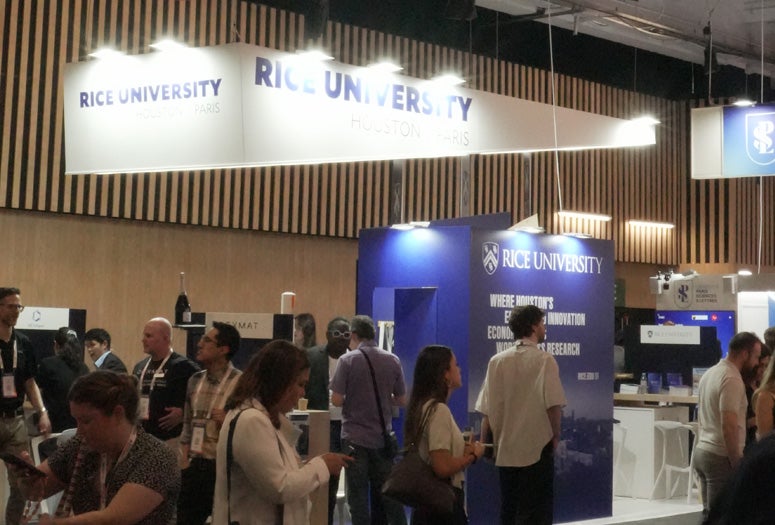
When Rice University President Reginald DesRoches took the Purple Stage and Caroline Levander, the university’s vice president for global strategy, spoke at the Business Redefined Arena, the crowds they drew to VivaTech came for the same reason: to hear how a leading research university is approaching artificial intelligence.
Those talks anchored Rice’s second appearance at Europe’s largest technology event held June 17-20 at Paris Expo Porte de Versailles. Now a fixture of the European innovation calendar, the 10th anniversary of VivaTech drew startups, investors and government leaders from more than 160 countries. From its booth in Pavilion 7, Rice introduced seven startups from its innovation ecosystem, unveiled new research partnerships with French and German institutions and reinforced the role of the Rice Global Paris Center, its hub in the French capital since 2023.
“We’re focused on solving some of the most pressing global challenges and to do that we have to partner with the best talent from all over the globe, including the talent here in Paris and across Europe,” DesRoches said.
The booth gave that ambition a physical form. Throughout the week, founders fielded questions from investors, corporations and fellow researchers a few steps from the main stages. The seven companies span green hydrogen, sustainable aviation fuel, energy-efficient buildings, advanced materials, semiconductor cooling, sustainable AI and low-carbon chemistry. Rice, ranked No. 1 in the United States for graduate entrepreneurship by the Princeton Review, has supported more than 3,700 startups through the Rice Alliance, companies that have together raised more than $31 billion.
“For Rice to be here and to have a primary spot is a huge identity boost for the university and for the city of Houston,” Levander said.
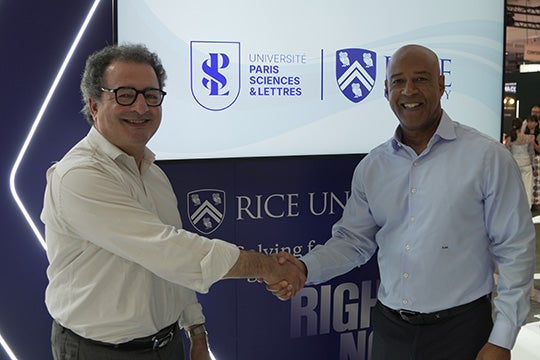
The week’s marquee announcements began June 18 when DesRoches and El-Mouhoub Mouhoud, the president of Université Paris Sciences & Lettres, unveiled “Frontiers of Knowledge,” a new international symposium that builds on years of collaboration between the two universities. Its inaugural edition, set for spring 2027, will focus on the frontiers of quantum physics and technologies, with particular attention to cavity quantum electrodynamics.
Rice extended that push into materials science through the Rice-Max Planck Partnership in Quantum Materials, a collaboration with one of the continent’s most prominent research organizations.
“This marks a signal moment in our research network expansion and it happens with European leaders,” Levander said. “We are honored and privileged to call these institutions our neighbors.”
The week also delivered a measure of validation for the founders themselves. Helix Earth is commercializing NASA-derived cooling technology that co-founder and CEO Rawand Rasheed first developed during his doctoral research at Rice. At VivaTech, he announced the company would bring it back to campus.
“It was wonderful to make the announcement that we’re going to be at Rice, bringing the technology home to where it really started,” Rasheed said. “It’s a full-circle moment. We get to come back and help solve some of the problems the campus faces around humidity, which anyone in Houston knows well.”
The breadth of the ecosystem was visible across the booth. Solidec builds generators that produce essential chemicals such as hydrogen peroxide on site from air, water and electricity. HEXASpec engineers materials that draw heat away from electronic chips, a growing constraint for AI computing. MCatalysis and DirectH2, both led by cofounder Michael Irwin, turn to microwave catalysis and solar-driven panels, respectively, to make cleaner fuels and hydrogen on demand.
The startups also competed for attention on VivaTech’s stages. At the June 19 Rice Pitch Session, DexMat won the audience vote for Galvorn, the advanced carbon material the company positions as a lightweight, conductive alternative to metals such as steel.
“We’ve been inundated here with interesting corporate customers, partners and potential investors,” said DexMat CEO and Rice alum Bryan Guido Hassin. “We have a growing customer base in Europe, and this was a great chance to connect in person with people we usually only see by Zoom.”
Rice’s youngest competitor made the largest individual mark. Rising junior Sasha Ovalle won the Next Startupper Award for AssisTech SmartShower, a voice-controlled system that adapts standard showers for older adults and people with disabilities or reduced mobility. The honor carried a 5,000-euro prize and a guaranteed spot at next year’s VivaTech.
The Rice booth doubled as a stage of its own across the four days. Founders joined panels on how university research becomes deeptech, including sessions held alongside PSL, while DesRoches and Levander sat for interviews with VivaTech News about Rice’s research-driven model.
Syzygy Plasmonics co-founder and chief technology officer Suman Khatiwada, whose company is building a fully electric reactor to produce low-carbon jet fuel, was one of several Rice alumni working the booth.
“It feels like I’m doing service to my alma mater by being here, showcasing what we’re building from Rice technology,” Khatiwada said.
That is the link Rice came to Paris to strengthen, connecting Houston, the Rice Global Paris Center and Europe’s innovation community with ideas that began on campus now drawing attention from around the world.