
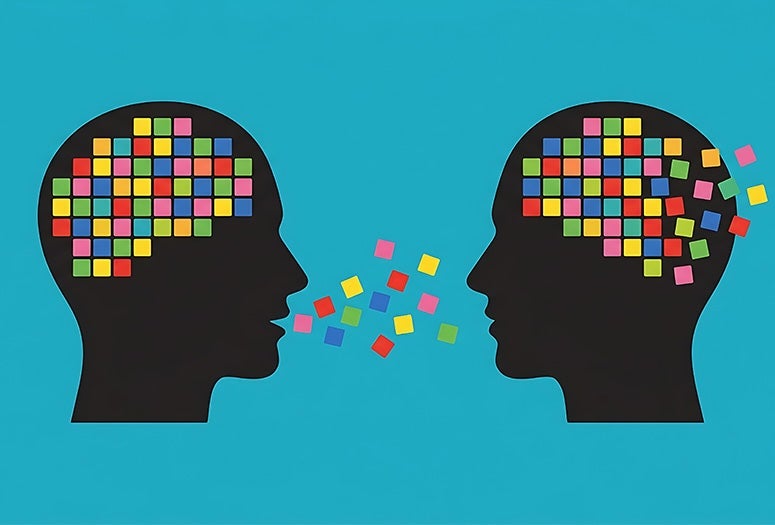
Anyone who speaks more than one language knows the feeling of expressing the same thought through entirely different linguistic lenses. A new study by researchers at Rice University and Baylor College of Medicine reveals that the key to this translation ability is a shared geometric map of neural responses in the hippocampus.
The research, published today in the journal Cell, shows that most individual neurons respond differently to different languages, even though there are also a small number of cross-language neurons, i.e., cells whose responses to equivalent words like the Spanish “tierra” and the English “Earth” are correlated. However, for the most part, neurons tune themselves differently for each language, but they preserve a shared overall geometric organization: The spatial relationship between concepts is relatively stable in neural space across languages.
The findings provide one of the most detailed looks yet at how the brain supports bilingualism and may help explain how people can effortlessly translate thoughts between languages without confusing them.
Researchers studied four fully bilingual English-Spanish speakers undergoing neurosurgical procedures for epilepsy treatment. Using ultra-high-resolution recording technologies, including microelectrodes and Neuropixels probes, the team measured the activity of hundreds of individual neurons in the hippocampus while participants listened to stories, read phrases aloud and engaged in spontaneous conversations in both English and Spanish.
“Our findings suggest that the brain may store meaning in a language-independent format,” said Dr. Sameer Sheth, professor of neurosurgery, McNair Scholar and Cullen Foundation Endowed Chair at Baylor College of Medicine, and co-senior author of the study. “Different languages appear to access a shared conceptual map rather than creating entirely separate representations of the world.”
The researchers describe this phenomenon as a “shared semantic geometry.” Instead of using identical neurons for each language, the brain appears to preserve the relationships between concepts across languages while allowing each language to use its own neural “readout axes.”
“This helps explain how bilingual people can switch between languages so fluidly,” said Benjamin Hayden, adjunct professor of electrical and computer engineering and linguistics at Rice, professor of neurosurgery and McNair Scholar at Baylor, and co-senior author of the study. “The brain seems to maintain a common internal structure for meaning while simultaneously keeping languages distinct enough to avoid interference.”

The findings suggest that translation is not driven primarily by specialized “dictionary neurons,” but instead emerges from coordinated activity across large neural populations.
“Our results show that bilingual meaning is an emergent property of neural populations,” said lead author Xinyuan Yan, postdoctoral scholar. “The brain does not appear to rely on one-to-one translation cells. Instead, it preserves patterns of relationships among concepts across languages.”
To analyze the neural data, the researchers compared human brain activity to multilingual artificial intelligence language models, including multilingual BERT. They found striking similarities between the geometry of semantic representations in the hippocampus and the internal organization of modern AI systems trained on multiple languages.
“Large language models and the human brain may be converging on similar computational solutions for representing meaning,” Hayden said. “That does not mean AI works exactly like the brain, but it suggests there may be universal principles for organizing knowledge.”
In addition to advancing basic neuroscience, the findings eventually could influence the development of brain-computer interfaces, language rehabilitation therapies and future AI systems designed to communicate more naturally with humans.
Interestingly, beyond the scientific arena, the discovery may be of broader interest in the humanities and social sciences: The concept of a stable, shared geometric neural map seems to validate a structuralist view of language, where structuralism is an intellectual current often traced back to Swiss linguist Ferdinand de Saussure. In brief, structuralism holds that meaning transcends individual cultural expressions and instead harkens to an underlying universal “structure” or system.
The researchers caution that the study involved only four participants, all of whom were English-Spanish bilinguals undergoing epilepsy treatment. Future studies will be needed to determine whether the same neural principles apply to other languages and larger populations.
Still, the results provide an unprecedented glimpse into one of the defining features of human cognition: the ability to express the same thought in multiple languages.
This project was funded in part by the National Institutes of Health BRAIN Initiative (U01 NS121472), the McNair Foundation, and the Gordon and Mary Cain Pediatric Neurology Research Foundation. The content in this press release is solely the responsibility of the authors and does not necessarily represent the official views of funding entities.
-- Text adapted from a Baylor press release authored by Graciela Gutierrez
- Peer-reviewed paper:
-
Shared neural geometries for bilingual semantic representations in human hippocampal neurons | Cell | DOI: 10.1016/j.cell.2026.05.020
Authors: Xinyuan Yan, Ana G. Chavez, Melissa Franch, Kalman A. Katlowitz, Ivy Gautam, Brian Kim, Aaditya Krishna, Aadit Shrivastava, Katie Van Arsdel, James Belanger, Assia Chericoni, Taha Ismail, Elizabeth A. Mickiewicz, Danika Paulo, Hanlin Zhu, Alica M. Goldman, Vaishnav Krishnan, Atul Maheshwari, Eleonora Bartoli, Nicole R. Provenza, Seng Bum Michael Yoo, Benjamin Y. Hayden and Sameer A. Sheth
https://doi.org/10.1016/j.cell.2026.05.020