
Trions form when three particles, like quarks or electrons, come together. This formation occurs in quantum particles in nuclear physics, semiconductors and magnets, and understanding its behavior can be challenging. Rice University’s Kaden Hazzard and his team recently developed a theory on how these formations occur and behave, which was published in Physics Review Letters.
“Our theory sheds light on how trions form and interact with each other,” said Hazzard, associate professor of physics and astronomy and corresponding author on this paper. “It predicts the strength of the interactions needed to form the trions, and that, after formation, they arrange themselves in a checkerboard pattern.”
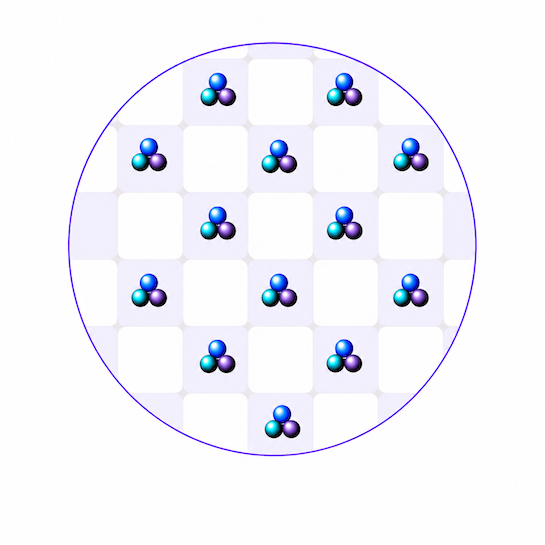
If you imagine a space full of equal amounts of red, blue and yellow balls, a trion would form when a red, blue and yellow ball all stuck to each other, Hazzard explained. Once all the balls, or particles, are bound together, he was curious about how these trions would arrange themselves in space. Would they reorganize as a result of being in this new formation? If they did, what would that look like and what would it reveal about how the trions interacted with each other?
“It turns out that at the right density of particles in the space, they will form trions that go into this checkerboard pattern,” said Jonathan Stepp, first author on this study and graduate student at Rice. “Each trion is next to an empty space rather than another trion. This indicates that the trions are interacting with each other to some extent — if they weren’t, they would just be right next to each other.”
Trions, the theory posits, would block each others’ motion if they were too close. The checkerboard pattern gives each trion space to move without interference from its neighbors.
Hazzard’s team was inspired by work done on atoms in ultracold systems. Physicists put molecules into a box whose temperature was just a nanokelvin — just a tiny bit above absolute zero. At this ultracold temperature, the molecules are still enough to be manipulated by light. Hazzard’s team predicted that under the right conditions, trions will form which experimentalists can then manipulate and observe.
“We were able to take the equations and understandings derived from results of experiments with ultracold molecules and use them to design simulations that would let us ask larger questions about how these trions would behave,” Stepp said. “We ran those simulations and then worked backwards to understand what simple, underlying principles would give rise to those results.”
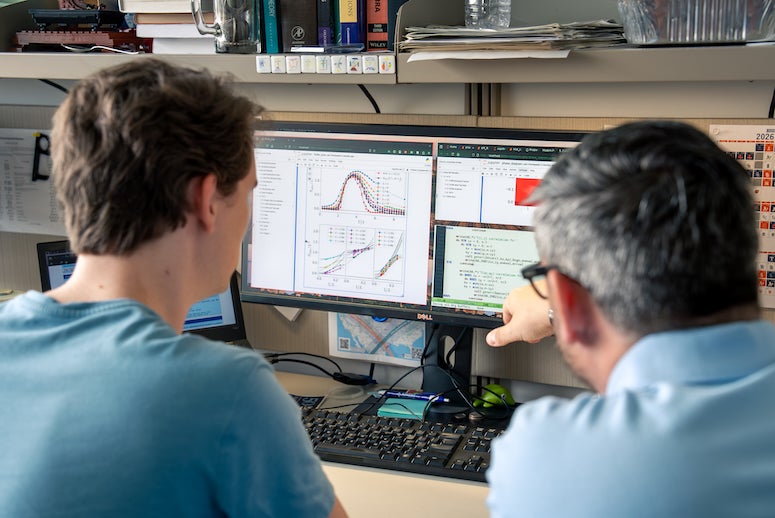
Stepp used a Monte Carlo program, a computational algorithm that runs millions of simulations to converge to the true result. He then took those results, mathematical descriptions of the final patterns, and discovered the laws governing their organization.
“You get this massive output from the simulations,” Stepp said. “Then you start looking at it critically. Would this result come from it behaving like an ideal gas or as a liquid? Would it come from three particles acting independently or from three particles bound in a trion? That’s the beauty of physics — it’s the same underlying equations describing how things behave in systems as cold as these nanokelvin systems to ones as hot as the sun, whether it’s one particle or billions.”
The simulations indicated that, like Goldilocks’ porridge in the classic fairy tale, the density needed to be just right for the trions to form the checkerboard pattern. If the density of the particles changed — too many or too few for the size of the space they are in — so, too, would their behavior, becoming more liquidlike in one direction and more gaseous in another.
This, and other findings of the theory, provides a path forward for experimentalists. They can run experiments testing the theory, deriving more information on how trions behave. In turn, theorists can use that information to glean more insights, setting the stage for more experiments. This collaborative approach is key to physics research, including this project, which was done in which was done in partnership with professors Richard Scalettar, at the University of California, Davis and Eduardo Ibarra-García-Padilla, at Harvey Mudd College.
“This work starts a conversation on trions that couldn’t have been had before,” Hazzard said. “It opens up the possibility of answering questions that we didn’t previously know to ask on these formations that are so common and so foundational in many branches of physics.”
This work was funded by the National Science Foundation (PHY-1848304), the W.M. Keck Foundation (grant No. 995764) and the Department of Energy (DOE DE SC0014671) with support from the NOTS cluster operated by Rice’s Center for Research Computing.