

Restarting a once annual tradition, the Rice Student Association along with Fondren Library sponsored three sessions of end-of-semester de-stressing with therapy dogs.
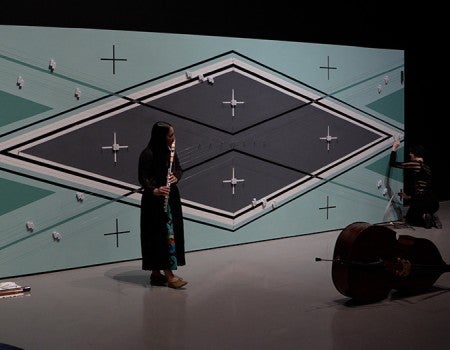
Nameless Sound musicians performed an original score on Nanibah Chacon’s interactive installation following Danza Azteca Macuilxochitl's activation of...
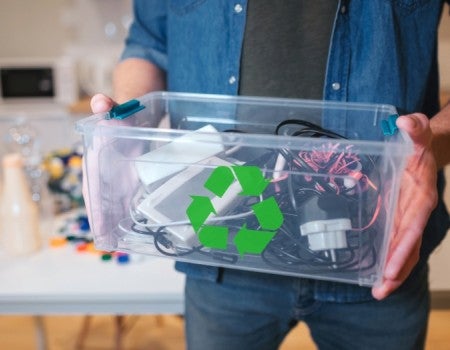
Rice’s James Tour recently published an improved method to recover antimony from this electronic waste stream. ...

Three Rice faculty members from the Department of Earth, Environmental and Planetary Sciences have recently been honored with career awards, showcasin...

The Adventurous Electric Guitar Festival gathered players, composers and scholars to test the instrument’s next act....
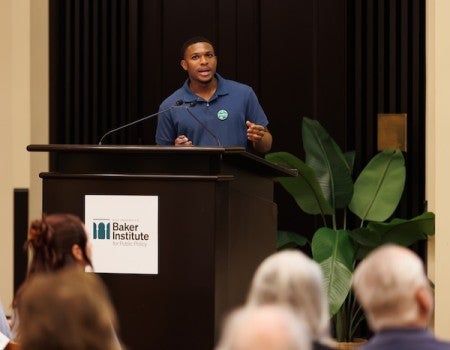
The Science and Technology Policy Program at Rice’s Baker Institute for Public Policy hosted a “science cafe” Oct. 13 to bring research to reality and...

The Doerr Institute for New Leaders at Rice has launched CoachRICE: Team Coaching, a new professional education program designed to help coaches, mana...
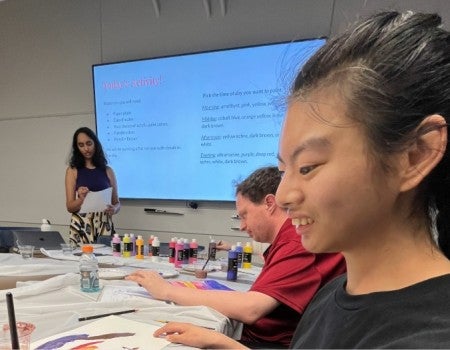
Graduate student Sayuri Jayawardena has started a Rice chapter of Lifelong Learning with Friends. ...
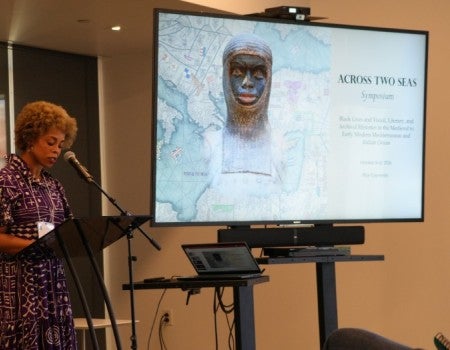
Scholars, curators and filmmaker Daphne Di Cinto gather at Rice to explore Black histories from Renaissance Italy to medieval Africa and Islamic world...

For the sixth fall in a row, Rice welcomed a new group of researchers to STaRT@Rice, giving emerging researchers both the skills and the support to gr...

Rice and the Houston Methodist Research Institute have signed a memorandum of understanding with LSE Health at the London School of Economics and Poli...

As the 2026-27 Aleko Endowed Artist, Julia Bullock curated an evening of song, chamber music and poetry celebrating the Harlem Renaissance....

Rice’s Yonglong Xie is one of 20 early-career scientists, mathematicians and engineers to receive a 2026 Packard Fellowship. ...
Restarting a once annual tradition, the Rice Student Association along with Fondren Library sponsored three sessions of end-of-semester de-stressing with therapy dogs.

Battle of the birds: LendingTree Bowl at a glance
The game marks the Rice football program’s first postseason action since 2014

Campus holistic garden plants roots in new location
The Betty and Jacob Friedman Holistic Garden has been replanted in a new location on the Rice University campus, just north of the Gibbs Recreation Center in between the basketball courts and O'Connor Field.

Rice’s Take Flight program helping community college STEM students soar
Rice University welcomed more than 80 students and 10 faculty members from Lone Star College and San Jacinto College in early December to learn more about its Take Flight STEM Pathway program.

Ramesh, vice president for research, inducted as National Academy of Inventors Fellow
Ramamoorthy Ramesh, vice president for research, has been elected as a National Academy of Inventors Fellow, the highest professional distinction awarded to academic inventors.
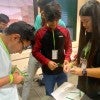
Students immersed in STEM at daylong workshop
Rice hosts elementary, middle and high school students at the Fresh Start Engineering Workshop.
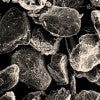
Rice flashes new life into lithium-ion anodes
Rice chemists use flash Joule heating to recover graphite anodes from spent lithium-ion batteries.

In appreciation of the Alexander family of Houston's longtime support of Jewish Studies in the School of Humanities and the Woodson Research Center in Fondren Library, Rice will name the Houston Jewish History Archive the Joan and Stanford Alexander South Texas Jewish Archives effective Jan. 1.

Texas power grid debate should focus on reliability and economics, says Baker Institute expert
Building new ties between the Texas electrical grid and the major grids in North America should be explored with strict regard to economics and reliability — leaving politics aside — according to a new report from Rice University’s Baker Institute for Public Policy.

Pathogenic sensor’s surprising capabilities revealed
Rice synthetic biologists have uncovered new capabilities of a genetically encoded sensor that allows salmonella, E. coli and other pathogens to sicken millions of people each year.