
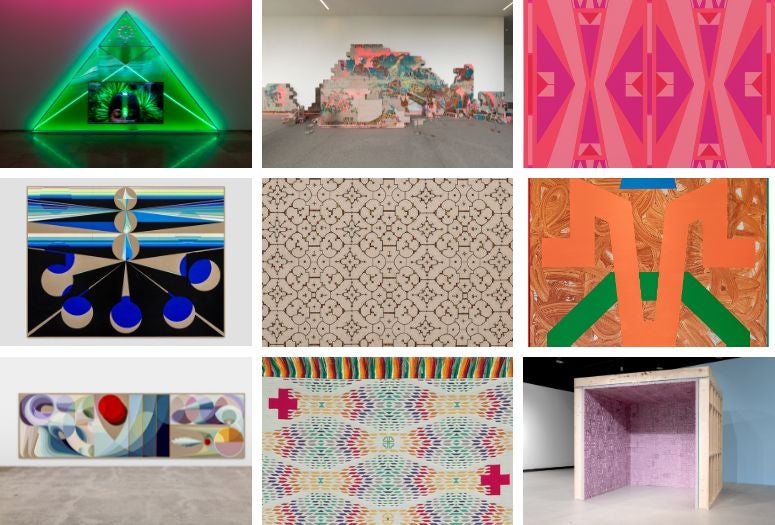
Through a framing of North, Central and South America as interconnected regions, “Radiant Geometries: Vectors of Knowledge from the Indigenous Americas” brings together contemporary Indigenous and Latin American artists whose practices illuminate knowledge as a living technology, through which the mathematical, metaphysical and artistic realms converge. At a moment when the social and environmental consequences of technological advancement are prompting global debate, this selection of works — among them paintings, sculptures, textiles, video works and site-specific commissions — convey relational, rather than extractive, approaches to science. Opening Sept. 4, the exhibition features national and international artists, including Nanibah Chacon, Melissa Cody, Jordan Ann Craig, Patricia Domínguez, Sara Flores, Natalia Montoya Lecaros, Patrick Martinez, Cisco Merel, Caroline Monnet and Eamon Ore-Giron, among others.
“At its core, ‘Radiant Geometries’ centers Indigenous ways of knowing that continue to shape relationships to territories, waterways and interspecies care,” said Noor Alé, Moody Center for the Arts associate curator. “By reconsidering the histories of mathematics, architecture and science through Indigenous perspectives, the exhibition invites viewers to consider the enduring connections between cosmology, technology and the living world.”
Set on the campus of a leading research university, the Moody’s presentation includes artists whose works evoke the symbiotic relationship between art, math, technology and science, often through the language of abstraction. Among them, Flores’ paintings foreground the interdependence of all life forms and call attention to interspecies care; Martinez’s painted sculpture, inspired by the pre-Columbian murals of Cacaxtla, positions Indigenous architecture as sites of material knowledge and urban intelligence; Montoya Lecaros’ totemic sculptures draw on an Aymara ceremonial dance that honors agricultural cycles; Monnet’s Styrofoam installation etched with Anishinaabe iconography, reconsiders colonial legacies in architecture; Domínguez’s videos explore astronomy and plant intelligence to bridge spiritual and scientific divides; Merel’s totemic work references protective sigils found in Guna textile traditions; and Cody’s jacquard tapestry fuses Navajo textile traditions with computational aesthetics.
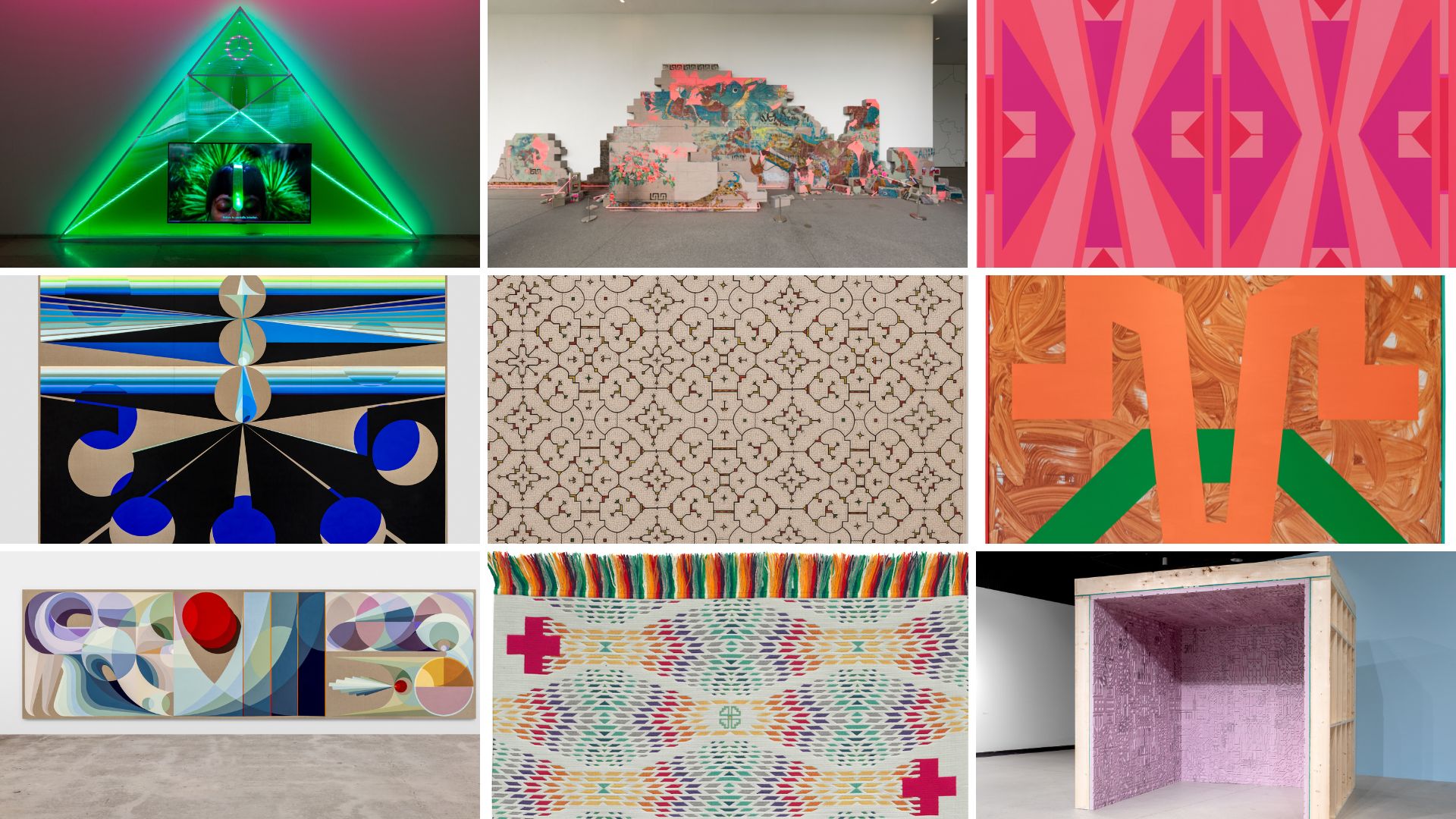
In addition, newly commissioned works extend the visibility of knowledge as an evolving technology, illuminating its transmission across generations while continuously responding to the future. These works include an interactive sound installation with Diné designs from Chacon; installation and paintings by Craig that explore Cheyenne beadwork and parfleche designs drawn from museum collections in Texas and Colorado; and new paintings from Ore-Giron inspired by Maya ceramics in Rice’s collection.
“Through this compelling selection of works and complementary programming, we’re able to achieve the Moody’s mission to synthesize Rice’s academic resources and artists’ creative insight into meaningful connections and critical dialogue,” said Joel Thompson, Moody Center for the Arts deputy director.
Featured artists include Chacon (Diné/Chicana) (b. 1980 in Gallup, New Mexico; lives in Albuquerque, New Mexico), Cody (Navajo/Diné) (b. 1983 in No Water Mesa, Arizona; lives in Long Beach, California), Craig (Northern Cheyenne) (b. 1992 in San Jose, California; lives in Santa Fe, New Mexico), Domínguez (b. 1984 in Santiago de Chile; lives in Puchuncaví, Chile), Flores (Shipibo-Konibo) (b. 1950 in Tambomayo, Peru; lives in Yarinacocha, Peru), Montoya Lecaros (Aymara) (b. 1994 in Iquique, Chile; lives in Santiago de Chile), Martinez (b. 1980 in Pasadena, California; lives in Los Angeles), Merel (b. 1981 in Panama City; lives in Panama City), Monnet (Anishinaabe/French) (b. 1985 in Ottawa, Canada; lives in Montreal), and Ore-Giron (b. 1973 in Tucson, Arizona; lives in Los Angeles), among others.
The exhibition is curated by Alé. Graphic design is by Sébastien Aubin.
“Radiant Geometries: Vectors of Knowledge from the Indigenous Americas” is made possible by the Libbie Rice Shearn Moody Fund for the Arts and the Thomas D. and Pamela Riley Smith Endowment for the Moody Center for the Arts. Major support is provided by the city of Houston through the Houston Arts Alliance, the Elizabeth Lee Moody Excellence Fund, the H. Russell Pitman Fund for the Moody Center for the Arts and the Moody Center for the Arts Founders Circle.
Special Events
Opening Reception for Radiant Geometries
Sept. 5, 6-8 p.m.
With artists Nanibah Chacon and Natalia Montoya Lecaros in attendance.
Dimensions Variable: Danza Azteca Macuilxochitl with Nameless Sound
Oct. 10, 3-5 p.m.
Performance by Danza Azteca Macuilxochitl with Nameless Sound, presenting musicians Laura Dykes and Aryn Ward, activating Nanibah Chacon’s site-specific mural.
Artists-in-Dialogue: Ore-Giron + Boornazian Diel
Nov. 12, 6-8 p.m.
Conversation with exhibiting artists Eamon Ore-Giron and Lori Boornazian Diel, the L. H. Favrot Professor of Humanities and professor of art history at Rice.
New Art/New Music: Radiant Geometries
Nov. 21, 3-5 p.m.
Original musical performances inspired by Radiant Geometries, composed and performed by Shepherd School of Music students.
Hours & Admission
Exhibition spaces are open to the public and free of charge Tuesday through Saturday from 10 a.m. to 5 p.m. and closed Sundays, Mondays and holidays.