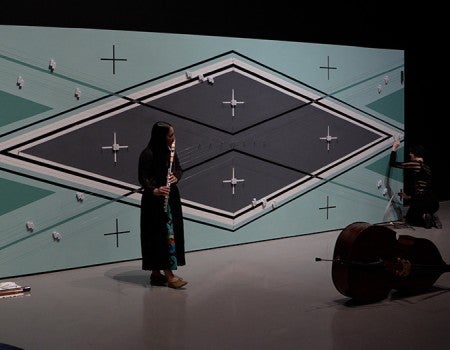
Nameless Sound musicians performed an original score on Nanibah Chacon’s interactive installation following Danza Azteca Macuilxochitl's activation of...
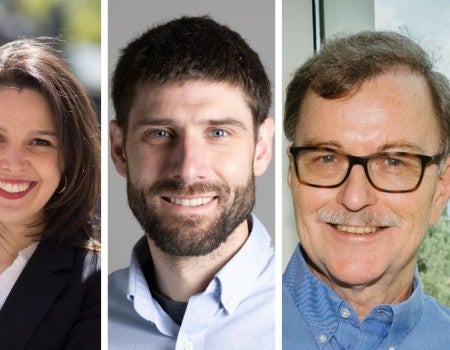
Three Rice faculty members from the Department of Earth, Environmental and Planetary Sciences have recently been honored with career awards, showcasin...
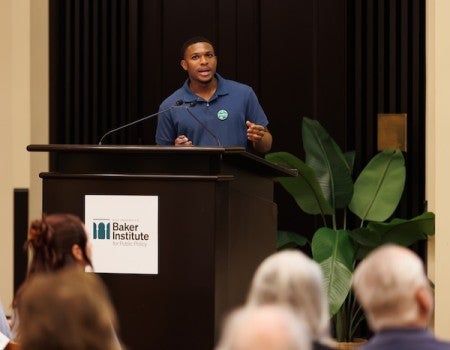
The Science and Technology Policy Program at Rice’s Baker Institute for Public Policy hosted a “science cafe” Oct. 13 to bring research to reality and...
The Doerr Institute for New Leaders at Rice has launched CoachRICE: Team Coaching, a new professional education program designed to help coaches, mana...
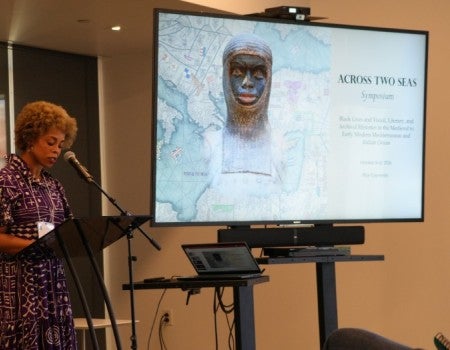
Scholars, curators and filmmaker Daphne Di Cinto gather at Rice to explore Black histories from Renaissance Italy to medieval Africa and Islamic world...
For the sixth fall in a row, Rice welcomed a new group of researchers to STaRT@Rice, giving emerging researchers both the skills and the support to gr...
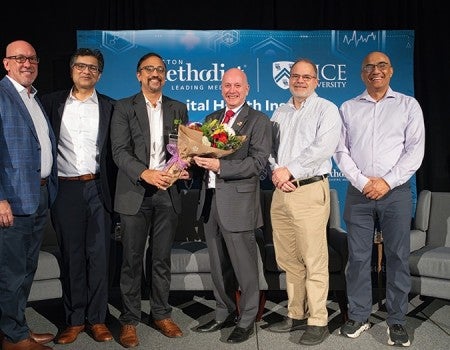
Rice and the Houston Methodist Research Institute have signed a memorandum of understanding with LSE Health at the London School of Economics and Poli...
Yonglong Xie, assistant professor of physics at Rice University, has been awarded a Faculty Early Career Development (CAREER) Award from the National Science Foundation (NSF). The $888,555 grant over five years will support Xie’s research into harnessing magnons, quantum mechanical wavelike objects in magnetic materials, to create synthetic matter and develop next-generation quantum devices and sensors.
Fresh off its first visit to Houston in Fall 2023, The Concert Truck will return to Houston for more shows with students from Rice University’s Shepherd School of Music March 5-7.
Super Tuesday is less than a week away — March 5 — and voters in one U.S. territory and 15 states, including Texas , will head to the polls. Rice University political scientist Mark Jones is available to discuss what to expect from election day in the Lone Star State.
Following the racial and gender reckonings intensified by the #BlackLivesMatter and #MeToo movements, diversity, equity and inclusion (DEI) has been the subject of significant public debate and widespread media attention. A new book from Rice University psychologists outlines the state-of-the-art science that makes the case for DEI.
Rice University hosted the groundbreaking ceremony for Susan and Fayez Sarofim Hall Feb. 29, marking a significant milestone in the university’s commitment to advancing its growing arts program.
Rice researchers have developed a new, energy-efficient upcycling method to transform glass fiber-reinforced plastic (GFRP) into silicon carbide, widely used in semiconductors, sandpaper and other products.
Alumna Peggy Whitson ’86, America’s most experienced astronaut, will deliver the address at Rice’s 111th commencement during the undergraduate ceremony May 4.
Rice University researchers have developed a rapid, accurate test for diagnosing malaria that is significantly faster and easier to use than traditional tests. The advancement has the potential to improve patient outcomes, especially in rural regions with limited health care resources.
Rice University welcomes members of the Owls community to visit the pathway between Entrance 1 and the Sallyport to enjoy the colorful flowers, community, a food truck and entertainment in celebration of the crown jewel of the university’s welcoming driveway from 12-1:30 p.m. March 1. As an added bonus, the first 100 people dressed in Rice blue will receive a free cupcake.