
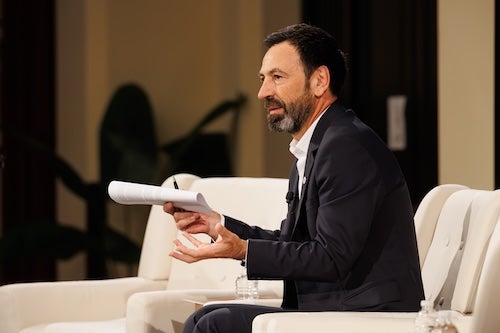
Attacks on health care in conflict zones are occurring at unprecedented levels, according to Safeguarding Health Care in Conflict Coalition and Médecins Sans Frontières (Doctors Without Borders). Rice University’s Baker Institute for Public Policy on April 21 hosted global leaders in the field and frontline medical professionals to discuss the erosion of protections for health care in conflict zones and explore solutions to ensure these critical rules are respected.
Fabrizzio Carboni, head of the regional delegation to the United States and Canada at the International Committee of the Red Cross, explained that worldwide armed conflicts have significantly increased over the last few decades. By the ICRC’s count, there are currently 130 conflicts.
“I’ve seen this as my own career in the Middle East has brought me in and through many conflicts,” said David Satterfield, former U.S. ambassador and director of the Baker Institute, in conversation with Carboni. “Conflicts where the harm to civilians and the unnecessary exposure of innocent civilians to risk has produced not only human tragedy and suffering, as we have seen profoundly in Gaza and are seen on a different scale in Lebanon today, but has also made resolution of those conflicts more difficult.”
Carboni and Satterfield mentioned that those who are most susceptible to harm and those being harmed were workers, not combatants — workers for the ICRC and United Nations entities who were trying to provide humanitarian assistance and medical care. Carboni’s career has been at the forefront of efforts to uphold human dignity in conflict zones as well as promoting the laws of armed conflict and humanitarian action. His work has included visiting places of detention to ensure humane treatment of detainees captured in conflict, advocating for the dignity and rights of displaced individuals, reuniting families separated by war and fostering critical dialog with both governmental and nongovernmental actors on the conduct of hostilities.

“There’s never been a more apt time for us to be having a discussion like this,” said panelist Tirana Hassan, CEO of Médecins Sans Frontières. Humanitarian organizations provide impartial medical care, driven by medical ethics, and do not provide care based on the patient’s uniform, she said. However, medical practitioners are increasingly becoming seen as “part of the fight” and have been made active targets by belligerent forces.
“We are seeing consistently in conflict these days that there are other dangers, and increasingly we are seeing medical workers being specifically targeted during times of armed conflict,” Hassan said. “It’s not that this is a new phenomenon, but we are increasingly seeing a justification of war and justification of tactics, including more brazen rationales for actually attacking specific, identified health care facilities, including MSF health care facilities — targeting the doctors, the nurses and the staff who work in those facilities.”
Hospitals and other health facilities perform lifesaving functions during armed conflict and are protected under international humanitarian law (IHL), also known as the laws of armed conflict or the rules of war. However, respect for the rules that protect health facilities and civilians in conflict zones is diminishing due to the eroding adherence to IHL by both state and nonstate actors. This growing challenge was highlighted in 2016 when the United Nations Security Council unanimously adopted resolution 2286, which urged all states to take measures to respect and protect health care during armed conflict.
“Attacks on health care can be part of a deliberate strategy, a scorched-earth campaign to target hospitals and health providers,” said Trevor Keck, head of policy for the U.S. delegation to the ICRC. “Absolutely that happens, and there’s many cases like that, but there is also the result of ignorance or negligence or operational failures — at least that was one of the major issues that led to the really unfortunate attack on the (MSF) Kunduz hospital over 10 years ago.”
Attacks on hospitals and infrastructure systems create cascading effects; sanitation, water, electricity and access to medications can be wiped out in an instant.
“We’ve seen in places like in Gaza or in Yemen or other places where you have these urban conflicts, that you’re just as likely to die from being wounded in a war-related injury as from cholera or an easily treatable disease that we can treat very well here in the United States or in functioning health systems,” Keck said. “But when you have sanitation, water, electricity and health care all breaking down at the same time, now you’ve just spiked the chances of people dying from those easily treatable diseases. So one of the things we try to do is also work to ensure protection of all those facilities.”
This event was co-sponsored by the ICRC and Baylor College of Medicine Center for Global Surgery. The ICRC has developed research and policy recommendations for militaries, health care practitioners and legislators to bolster protections for health care in conflict zones.