
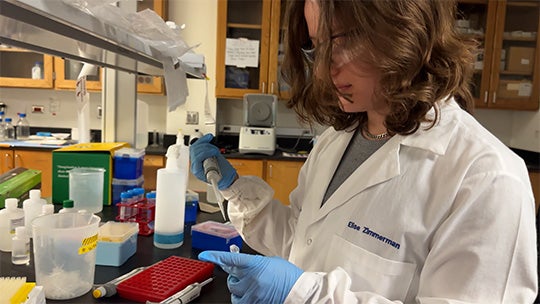
By the time Sofia Crespo reached the freezer, she had already lost track of how many machines she’d asked about. The Argentine artist, who is known internationally for work that uses microscopic imagery and artificial intelligence to explore the natural world, was standing inside Rice University’s Chappell Lab, being walked through a decade’s worth of genetically engineered bacteria stored at minus 80 degrees Celsius. The doctoral student giving the tour, Elise Zimmerman, also showed Crespo an incubator that gently rotates trays of bacteria engineered to glow fluorescent green.
“Everything that she was doing was fascinating to me,” Crespo said. “But to her, that was her everyday life. There are all these tools that were developed that, as an artist, we never learn about.”
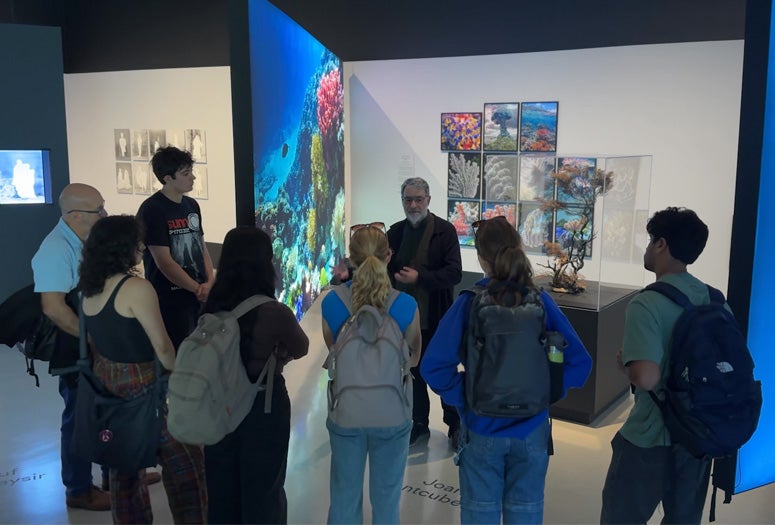
The lab visit was one of dozens of open-ended cross-disciplinary engagements sparked this spring by “Imaging after Photography,” the Moody Center for the Arts’ exhibition examining how artificial intelligence is reshaping the medium. Curated by Alison Weaver, the Suzanne Deal Booth Executive Director, and associate curator Noor Alé, the show brought together seven international artists — Crespo, Nouf Aljowaysir, Refik Anadol, Gregory Chatonsky, Joan Fontcuberta, Lisa Oppenheim and Trevor Paglen — to confront a moment when the line between a photograph and a fabrication has all but dissolved. But the exhibition itself was only the starting point.
“At the Moody, our mission is to foster interdisciplinary conversation through the arts,” Weaver said. “In this case, we’re most interested in how artists help us begin a conversation around the moment we’re in and the technologies we’re living with and what the future possibilities can be.”
Into the classrooms
Throughout the spring semester, faculty from across Rice walked their students into the exhibition and, in several cases, sat them down across from the artists themselves. Luis Duno-Gottberg, the Lee Hage Jamail Professor of Latin American Studies, was preparing to teach a course called Latin American Photography: Image and Thought when he learned Fontcuberta, a Catalan photographer central to the field’s theoretical canon, would be visiting Rice.
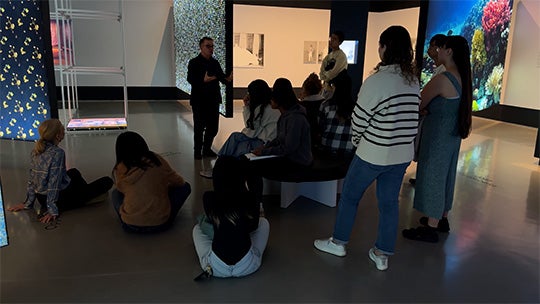
“I was delighted when (the Moody) reached out,” Duno-Gottberg said. “Syllabi are living documents, and adapting mine to meet this opportunity was a genuine pleasure.”
The payoff was a class period spent in the gallery with the artist whose work his students had only encountered in books and slide projections.
“Having the person himself presenting the work, it’s a wonderful opportunity,” Duno-Gottberg said. “It makes it a lived experience.”
A similar scene unfolded in French. Julie Fette, associate professor of French studies, brought her Contemporary French Society class to meet Chatonsky, a Paris-based artist whose installation “Completion 1.0” uses ImageNet, a 14-million-image dataset, and AI-generated voiceover to interrogate how machines describe the world. The session was conducted entirely in French.
“Hearing from an artist in French, talking about how AI affects his work and affects all of us, was absolutely amazing for the students,” Fette said. “I think students may remember this forever.”
For Chatonsky, who has taught at universities himself, the exchange ran in both directions. He said he has come to see classroom conversations about AI as the only honest way forward.
“As a teacher, we need to listen to the students to know how we can manage this revolution together — teacher and student together — and not to keep the authority of teacher against students’ use of AI,” Chatonsky said.
A third class, an AI ethics course co-taught by Rodrigo Ferreira, associate dean for technology and responsibility in engineering and computing and assistant teaching professor of computer science, and Robert Howell, the Yasser El-Sayed Professor of Philosophy, met with Aljowaysir, whose installation “Salaf (Ancestors)” uses generative AI to surface what colonial archives left out of the historical record.
“The story around AI is so often focused on what AI can generate. It was great for the students to hear Aljowaysir speak about how the story about AI is also about erasure — about how it can also lead us to forget,” Ferreira said.
Into the labs
While the classrooms came to the Moody, the artists also went the other direction. Crespo’s tour of Zimmerman’s lab was part of her residency through the Leslie and Brad Bucher Artist-in-Residence Program, which connected her with more than 15 Rice faculty and graduate students this semester. She also delivered a lecture in the history of science class taught by Luis Campos, the Baker College Associate Professor for History of Science, Technology and Innovation.
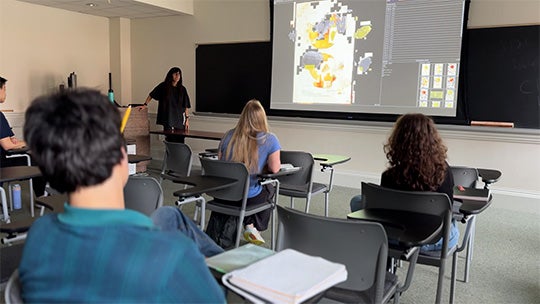
The premise of Crespo’s work — that the technologies we use to observe the natural world fundamentally shape what we see in it — is precisely the territory a synthetic biology lab occupies every day. For Zimmerman, watching an artist marvel at her workflow reframed how she understood her own field.
“I think we can take these things for granted, and they become pretty mundane to us because we’re using them every day,” Zimmerman said. “It’s a good reminder of how cool this stuff is and gets us to see the bigger picture beyond the specific data that we’re working with.”
The exchange flipped a familiar dynamic. Visiting artists typically arrive on campus to teach; here, the student-scientist did much of the teaching.
“Science is very creative, and it has a lot of overlap with art,” Zimmerman said. “Art is a way that science becomes accessible to people.”
Beyond the gallery walls
The exhibition’s reach extended past Rice’s hedges through a slate of public programming designed to pull the conversation outward. In March, the Moody convened a half-day symposium that brought Aljowaysir and Crespo together with technologists, writers and scholars including Ferreira, who served as a moderator, to examine the creative and ethical questions AI is forcing into the open.
Aljowaysir, whose practice focuses on what AI fails to see, said the Moody’s installation choices amplified that argument. The training datasets she fed her models hung on the gallery walls; the generative images they produced were blown up to scale.
“AI makes mistakes,” Aljowaysir said. “It’s not this hyperrealistic tool that can generate all beautiful imagery. It can also replicate images that are problematic, such as those rooted in colonial or orientalist traditions.”
Two additional programs activated the exhibition through performance. “Dimensions Variable: Open Machine,” an AI-integrated choreographed dance, brought the show’s themes into the body. “New Art / New Music,” a recurring series at the Moody, invited composition students from the Shepherd School of Music to compose original scores in response to works in the galleries.
What art is for
The faculty and students who passed through “Imaging after Photography” this spring will leave with different things: a clearer view of how a Catalan photographer thinks about fiction; a French conversation about machine vision; a sharper sense of what generative models can and cannot do. What ties those takeaways together is the conviction that art belongs in the same room as the questions a research university is trying to answer.
“Art deals with imagination, with creativity,” Fontcuberta said. “But it also fosters critical thinking. And I think these are the main tools for students right now.”
The exhibition is on view through May 9. Learn more about it on the Moody’s website.