
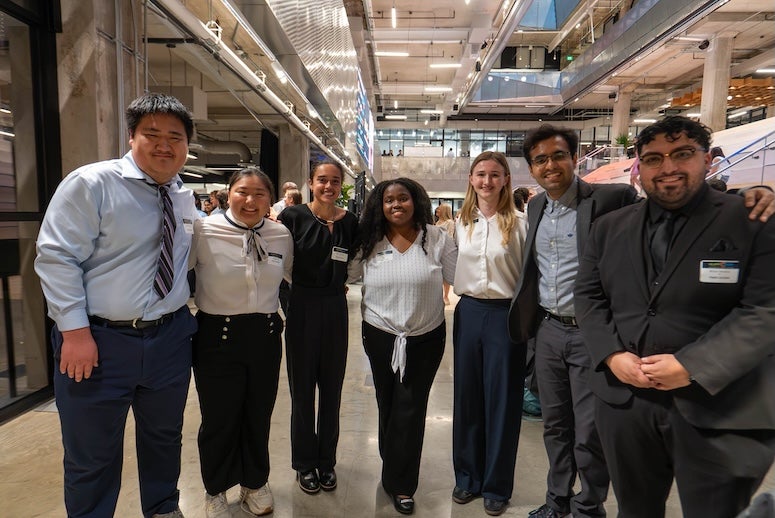
From lifesaving medical devices to sustainable energy systems and robotics, Rice University students packed the Ion with ingenuity April 16 for the Huff OEDK Engineering Design Showcase, an annual event highlighting the creativity and technical skill of undergraduate and graduate engineers.
The event brought together nearly 400 students across 75 competing teams, supported by 95 judges and a wide network of faculty, alumni and industry partners. Over the past year alone, the Oshman Engineering Design Kitchen (OEDK) has supported more than 1,200 students across at least 27 courses in all departments at the George R. Brown School of Engineering and Computing, as well as more than 150 design teams and clubs, underscoring its central role in hands-on engineering education at Rice.
“This does not happen on its own,” said Maria Oden, faculty director of the OEDK, as she opened the awards ceremony. “To our judges, sponsors, donors and partners — your support is what makes all of this possible. The tools, the materials, the space, the opportunities — they exist because of your generosity.”
Top prize goes to UroVac
The night’s top honor, the $5,000 Woods Leazar Innovation Award for Excellence in Engineering, went to UroVac for a complete bladder tumor resection and intravesical closure device.
The team, which includes Rice students Sanjay Soni, Catherine Stidham, Diane Moturi, Bryan Medina, Mira Srinivasa, Samuel Zhang and Angela Cai, developed a minimally invasive device designed to improve outcomes for bladder cancer patients.
Bladder cancer affects roughly 80,000 people annually in the U.S., and the current standard treatment can lead to recurrence rates as high as 70% within five years. UroVac aims to address those limitations by enabling complete tumor removal while also repairing the bladder wall, potentially reducing complications and repeat procedures.
“We knew the work we had done was super important and valuable,” Moturi said. “Seeing it being acknowledged means a lot as a team, and we’re all just really happy.”
Innovation across disciplines
Other top winners reflected the breadth of engineering challenges tackled by Rice students with projects spanning health care, energy, robotics, sustainability and advanced computing.
In competition for the Willy Revolution Award for Outstanding Innovation, TacTile earned first place ($3,500) for its at-home rehabilitation system for stroke patients, followed by Empower ($1,500) for its powered upper-extremity exoskeleton and Haast Autonomous ($1,000) for its drone technology.
In the Excellence in Capstone Engineering category, Trach Trainer took first place ($2,000) for its pediatric tracheostomy training device, while soft robot Swampster ($1,500) and pediatric oral imaging tool LOOK ($1,000) placed second and third, respectively.
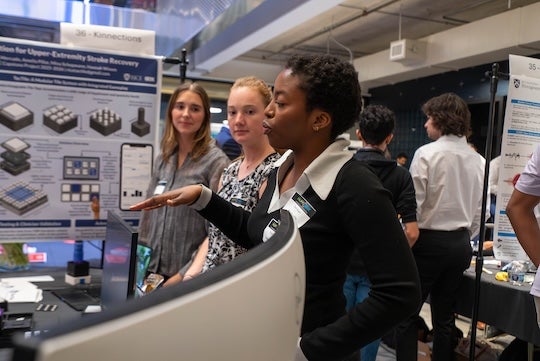
Additional category winners highlighted the showcase’s interdisciplinary reach. SoleSearch won the Excellence in Graduate Engineering Award for its device aimed at reducing diabetic ulcer-related amputations in underserved communities, while Kinnections earned recognition in the independent and multiyear category for its vibrotactile glove for Parkinson’s Disease treatment. Tennis training model SwingPal took top honors among freshman teams, and SimplySpiral’s method for quantifying pediatric tremor severity was recognized as the top student organization or club.
Several teams were honored for specialized innovation areas. AGILE received the Best Interdisciplinary Engineering Design Award for its low-cost endometrial biopsy training model, and ultrasound prostate biopsy model TRUSt was recognized for Best Technology for Low-Resource Settings. In medical technology, both FES System and Relievio were honored, while illoominati earned recognition for gaming and creative technology for its lab-scale yarn spinning and twisting or braiding machine.
Sustainability and energy solutions were also strongly represented, with ERROR 404 winning for environmental and sustainability design for its sustainable green ammonia plant and Optimus Blade earning the energy-related engineering design award for its small-scale carbon composite wind turbine blade. Team fMRI was recognized for conceptual and computational engineering design for creating a deep learning framework for optimizing rodent functional MRI for research, and Haast Autonomous earned additional honors in aerospace and transportation technology.
Judges and staff also highlighted standout projects across the showcase, awarding the OEDK Staff Favorite Award to Optimus Blade and the Staff Favorite Video Award to Lemons for its race car project.
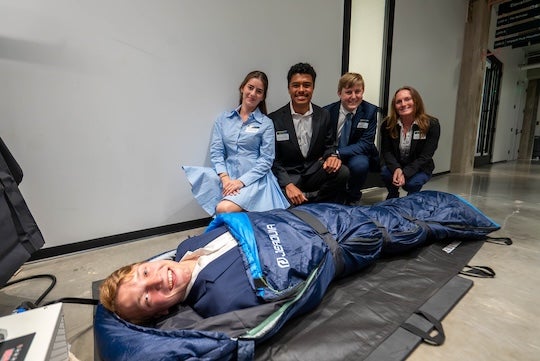
A launchpad for real-world impact
Beyond competition, the showcase serves as a proving ground for ideas with real-world potential, from health care innovations to climate and energy solutions. The diversity of projects also reflects the interdisciplinary nature of modern engineering, something students said was central to their experience.
“Working on this project really showed me how computer science, electrical engineering and mechanical engineering come together to make such an interdisciplinary product,” said senior Diya Gupta of Rescue Rangers. “There’s so much I couldn’t have done on my own — it all came together because of the team.”
The OEDK’s collaborative environment, students said, is key to turning ideas into reality.
“The OEDK has supported this in just mind-blowing ways,” said senior Henry Prendergast of the race car created by his team, Lemons. “We have this amazing space where we’re able to take an idea and bring it to fruition. Anything that we need to 3D print or machine or fabricate, it’s all right there in front of us … and we’re able to rely on the OEDK staff who are so friendly or other undergraduates who are working there and can offer their knowledge or experience. They have just provided a ton of resources, and I think it would have been almost impossible to do this anywhere else.”
As the event concluded, the room reflected not just a celebration of finished projects but a glimpse of future technologies shaped by Rice engineers — solutions designed with creativity, collaboration and impact.