
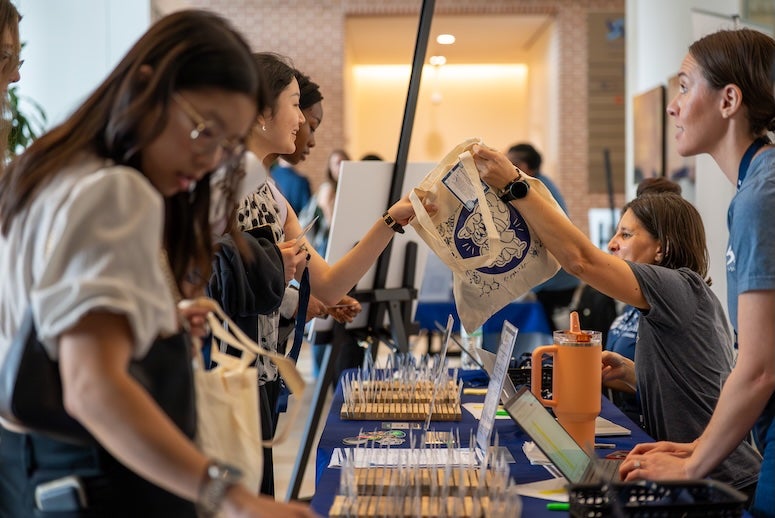
At Rice University’s Natural Sciences Undergraduate Research Symposium (NSURS), hundreds of posters lined the room with ambitious questions and early answers.
Could damaged heart tissue one day be coaxed to heal after a heart attack? How do conservation decisions shape bat habitat in Tanzania? Might a new approach help disrupt HIV replication without harming healthy cells? What can math reveal about fertility outcomes after cancer treatment?
For the undergraduate researchers presenting, those questions were not abstract. They were the focus of months, and in some cases years, of work in labs, in the field and behind computer models.
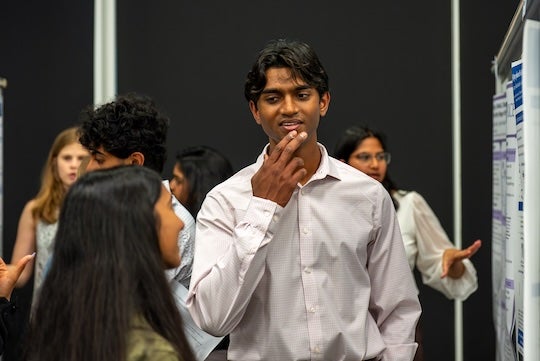
Held at the BioScience Research Collaborative, the third annual event brought together more than 300 students, filling the space with a steady buzz of conversation as presenters shared their work with judges, alumni, faculty, friends and peers.
What made the moment stand out was not just the volume of voices but the weight of the discussions. Much of the research is still in its early stages. Some of it may take years to fully develop. But across the room, there was a shared sense that the ideas on display could one day reach far beyond campus.
The symposium capped a weekend of programming that brought students together with faculty and alumni through presentations, panels and advisory board discussions, all designed to connect research with real-world application.
“This is the culmination of the research experiences for the year for many of our students,” said Thomas Killian, dean of the Wiess School of Natural Sciences. “It’s a really wonderful time where the students get to bring together all that they’ve learned and share it with the community.”
Research at the event is organized into five key areas reflecting the school’s priorities and some of the most pressing questions in science today: cancer research; human health and development; materials; Earth and the environment; and patterns and origins in nature.
“These are areas where we see the biggest opportunities to have an impact,” Killian said.
From lab to real life
That sense of possibility carried across the room, from global fieldwork to research that could reshape how doctors treat disease.
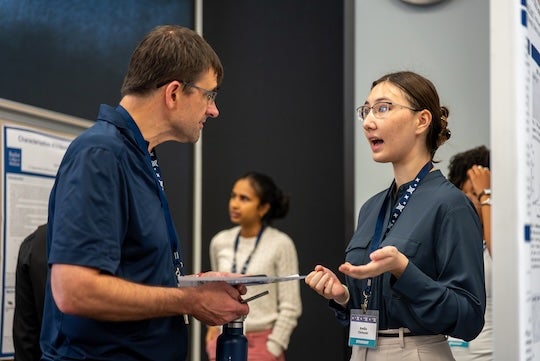
For Morgan Toran, a senior majoring in biosciences and Spanish, the focus is the heart.
She is part of a research team studying a preclinical therapy designed to help regenerate damaged heart tissue after a heart attack, something the human body is largely unable to do on its own.
“The heart only regenerates very early on in human development,” Toran said. “After a certain point, once those cells are damaged, they can’t regenerate.”
The therapy is delivered through a catheter-based approach, offering a less invasive alternative to open-heart surgery. The work is currently in the preclinical stage, where researchers are determining optimal dosage levels and timing required for eventual FDA review and human trials.
Toran’s research examines how low, medium and high doses impact recovery, including improvements in heart function and reductions in scar tissue.
“When the heart fails, it affects every other system in the body,” she said. “Being able to restore that function could improve lifespan and quality of life.”
Research without borders
For Caroline Pollan, a junior double-majoring in ecology and evolutionary biology and visual art, her research took her far beyond Houston.
Her project examined how different conservation strategies affect echolocating bats in Tanzania, using acoustic-based monitoring to understand how these animals respond to different levels of conservation management.
“Bats are often overlooked, but they play a critical role in ecosystems as pollinators, seed dispersers and insectivores,” Pollan said.
Her preliminary findings suggest that some bat groups rely more heavily on strictly conserved environments, while others may be able to adapt to change, offering insight into how conservation decisions shape biodiversity in an understudied region.
Tackling global health challenges
Other students are focused on diseases that continue to affect millions worldwide.
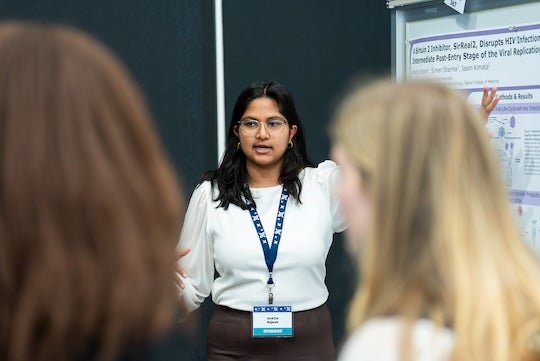
Ankita Rajesh, a sophomore studying biosciences, is researching how a host-directed inhibitor may disrupt HIV replication. Her work focuses on identifying where in the virus’s life cycle the intervention occurs and ensuring it does not harm healthy immune cells.
“There are treatments that manage HIV,” Rajesh said. “But there’s still no cure.”
Her research is still in its early stages, but it could help inform future therapies, particularly in regions where access to consistent treatment remains limited.
In another project, Sophia Lyu, a senior in chemistry, is studying fertility preservation for women undergoing cancer treatment through ovarian tissue cryopreservation and transplantation.
Her work models how the timing of tissue removal and return may affect menopause and long-term fertility outcomes.
“There may be an optimal time window to return the tissue to achieve the best outcome,” Lyu said.
Her findings suggest the process does not guarantee a delay in menopause, challenging assumptions and offering guidance for patients navigating complex medical decisions.
A framework for discovery
Behind the crowded room and fast-paced presentations is a broader structure designed to guide students from curiosity to discovery.
The symposium represents a year’s worth of work with projects emerging from coursework, independent research and internships with Rice faculty and collaborators, including those at the Texas Medical Center.
Those projects are organized into five core research areas, each reflecting a different way science connects to the world.
In human health, students are tackling questions around disease, development and new therapies. In materials, a longstanding strength at Rice, research spans chemistry, physics and engineering, including innovations in biomaterials, energy efficiency and next-generation technologies.
Earth and environmental research focuses on challenges ranging from climate change to energy transition and biodiversity, while patterns and origins in nature explore fundamental questions about the universe, from the formation of planets to the forces that shaped the earliest moments after the big bang.
Together, the categories reflect both immediate challenges and long-term scientific inquiry, preparing students for a wide range of paths after graduation.
The symposium is also designed to connect students with alumni, many of whom return to campus as mentors, panelists and judges.
Throughout the weekend, advisory board meetings, student presentations and program events create opportunities for those connections to happen in real time.
“It helps everybody,” Killian said. “Our alumni have tremendous experience and insight they can share with students.”
Failure, growth and what comes next
For alumni returning to campus, that growth is part of what makes the event so meaningful.
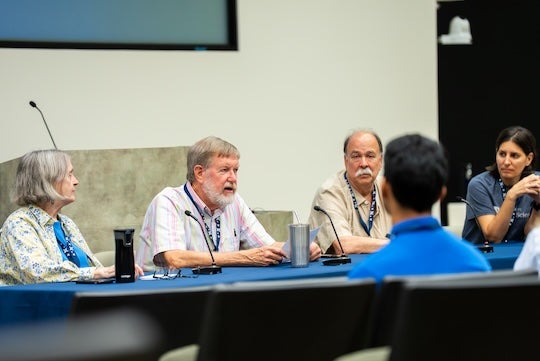
John Spurlino ’88, who built a career in structural biology and pharmaceutical research, said he was impressed by the quality of the work and the questions students are asking.
But he also emphasized something many students are still learning: Progress in science rarely happens without failure.
“Mistakes are your friends,” he said. “If you’re not making mistakes, you’re not trying hard enough.”
That mindset echoed across the symposium, where many students described research as a process of trial, error and persistence.
A community that comes full circle
For alumni like Ed Biegert ’74 ’76 ’77, who earned all three of his degrees from Rice, the symposium represents more than a showcase of research. It is a reflection of a community he has remained deeply connected to for decades.
His wife, Kathleen Trechter ’77, shares that connection, and both of their sons followed a similar path, graduating from Rice in 2011 and 2017.
“I’m just blown away by what they’re doing,” Biegert said. “Some of this work, if it continues, could really change the world.”