


As space agencies and private companies look toward sustained human presence on the moon, a fundamental challenge centers on how to build strong, durable infrastructure without hauling every material from Earth. New research from Rice University points to an unexpected solution — transforming one of the moon’s most stubborn obstacles, its abrasive dust, into a valuable building resource.
Led by Denizhan Yavas, assistant teaching professor of mechanical engineering at Rice, in collaboration with Ashraf Bastawros of Iowa State University, the study demonstrates that lunar regolith simulant, a terrestrial stand-in for the moon’s fine, abrasive dust, can be used to strengthen advanced composite materials. The work, published in Advanced Engineering Materials, was also selected for the cover of the journal’s latest issue.
“This work started with a simple but powerful question,” Yavas said. “Lunar dust is typically viewed as a major obstacle for exploration because of how abrasive and pervasive it is. We asked whether that same material could instead be used as a resource — something that could actually improve the performance of structural materials.”
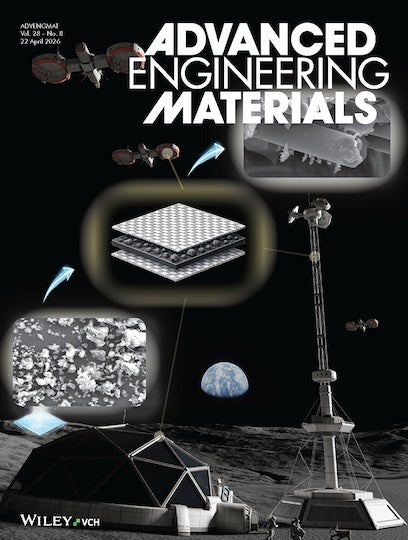
The researchers explored how lunar regolith simulant could be incorporated into fiber-reinforced polymer composites, a class of lightweight materials already widely used in aerospace and high-performance engineering applications. By integrating the simulant as a reinforcing phase, they found measurable improvements in strength, toughness and resistance to damage with performance increases of up to 30-40%.
“Our results show that you can take a material that is inherently challenging and convert it into something structurally beneficial,” Yavas said. “That shift in perspective is critical for building sustainably beyond Earth and enabling long-term exploration.”
The idea emerged from earlier work focused on developing nanoscale polymer surfaces designed to repel lunar dust. As the team worked to mitigate the hazards posed by the material, a broader opportunity came into focus.
“Instead of only trying to keep lunar dust away, we began to think about how to use it,” Yavas said. “That led us to this concept of embedding it directly into composite systems as reinforcement.”
The implications extend beyond laboratory testing. Lightweight, high-performance composites reinforced with lunar material could play a key role in constructing habitats, protective barriers and other infrastructure needed for sustained human presence on the moon.

The researchers emphasized the importance of reducing dependence on Earth-supplied materials, noting that one of the biggest constraints in space exploration is the cost and logistics of transporting them. If engineers could utilize what is already available on the lunar surface, it greatly increases the feasibility of longer missions and infrastructure development.
“Our long-term vision is to design materials that are not only high performing but also deeply integrated with the environment in which they are built,” Yavas said. “For the moon, that means leveraging lunar regolith as much as possible to create resilient, scalable infrastructure.”