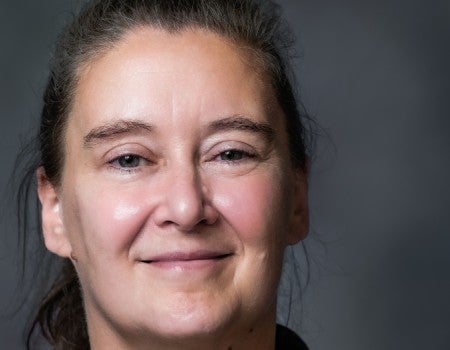

Lisa Basgall, Rice's Emergency Medical Services director, has earned the Chief EMS Officer designation, a professional credential held by fewer than 3...

When geopolitical conflicts disrupt fuel shipments, electricity demand outpaces infrastructure development or critical mineral shortages threaten indu...

The Global Consortium of Entrepreneurship Centers (GCEC), headquartered at the Rice Alliance for Technology and Entrepreneurship, brought leading univ...

Adeline Thompson spent six weeks with her host family in Toulouse through Rice in France and came home seeing herself differently....

As early voting begins, new Rice research sheds light on why some members of one of Houston’s fastest-growing populations say they remain underreprese...

Nameless Sound musicians performed an original score on Nanibah Chacon’s interactive installation following Danza Azteca Macuilxochitl's activation of...
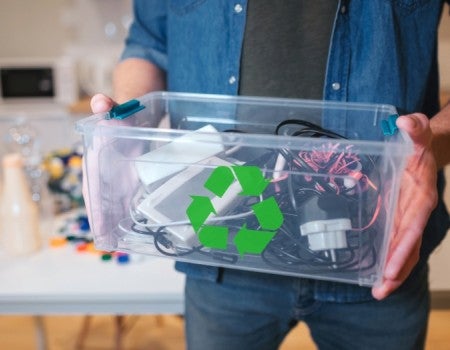
Rice’s James Tour recently published an improved method to recover antimony from this electronic waste stream. ...

Three Rice faculty members from the Department of Earth, Environmental and Planetary Sciences have recently been honored with career awards, showcasin...

The Adventurous Electric Guitar Festival gathered players, composers and scholars to test the instrument’s next act....
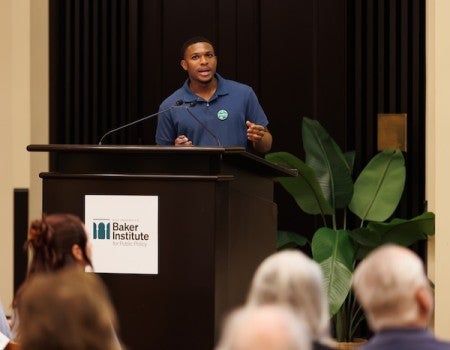
The Science and Technology Policy Program at Rice’s Baker Institute for Public Policy hosted a “science cafe” Oct. 13 to bring research to reality and...

The Doerr Institute for New Leaders at Rice has launched CoachRICE: Team Coaching, a new professional education program designed to help coaches, mana...
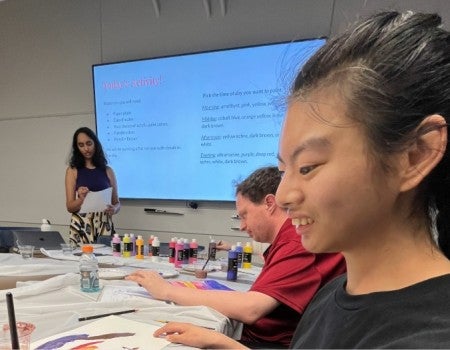
Graduate student Sayuri Jayawardena has started a Rice chapter of Lifelong Learning with Friends. ...
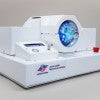
FDA OKs manufacturer’s version of Rice ventilator
An enhanced version of the ApolloBVM designed by Rice University engineers has received Emergency Use Authorization (EUA) by the U.S. Food and Drug Administration as an emergency resuscitator for use during the COVID-19 pandemic.


Galveston Bay Park is a 'vision' of Houston's future
An ambitious plan to shield Houston from a devastating hurricane by creating Galveston Bay Park, a 10,000-acre public park on a chain of man-made islands, earned top honors in the international design competition Houston 2020 Visions.

People, papers and presentations Aug 3, 2020
The Rice University School Mathematics Project (RUSMP), led by Adem Ekmekci, director of research and evaluation, has received a $300,000 grant.