
Each month during a woman’s menstrual cycle, an ovary prepares 10-20 antral follicles, fluid filled sacs that hold immature eggs, for maturation. In most cycles, only one follicle is selected to undergo maturation, eventually releasing an egg ready for fertilization. In fact, only 2-3% of natural pregnancies result in fraternal twins, or two eggs being released and fertilized. For natural pregnancies, it is most common for only one egg to be released and fertilized.
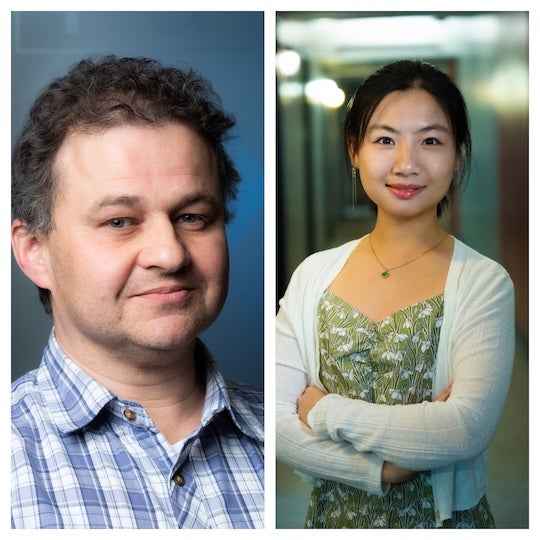
“We were interested in understanding how and why a single follicle is selected to mature,” said Anatoly Kolomeisky, a professor of chemistry at Rice University. “We knew that at least two hormones are involved, follicle stimulating hormone (FSH) and estradiol, but there is not a lot of information on how exactly the selection process works.”
When Kolomeisky looked at the available data, though, he realized it reminded him of chemistry processes, something he knew a lot about when teaching physical chemistry classes. By applying his knowledge to the data, he was able to develop a model, published in the Journal of Royal Society Interface, predicting how follicle selection was controlled. Contrary to prior belief, the model suggests that the process is entirely random.
“Previous theories stated that follicle selection depends on size or their sensitivity to hormones,” said senior Zhuoyan Lyu, first author of the paper, who will start her graduate studies at the Massachusetts Institute of Technology this fall. “Our model, which correlates well with real-world data, suggests that selection is completely random and still very precise.”
During the menstrual cycle’s follicular phase, Lyu explained, FSH levels start rising. According to the model, once FSH levels hit a certain threshold, one of the 10-20 prepared follicles is randomly selected to fully develop into a follicle with a matured egg. As soon as one follicle is selected, estradiol levels start rising, which causes the FSH levels to fall back below the threshold. Once FSH levels are below the threshold, no more follicles can be selected. Unselected follicles then die off, leaving only the selected follicle to mature and, eventually, release the matured egg into the fallopian tube.
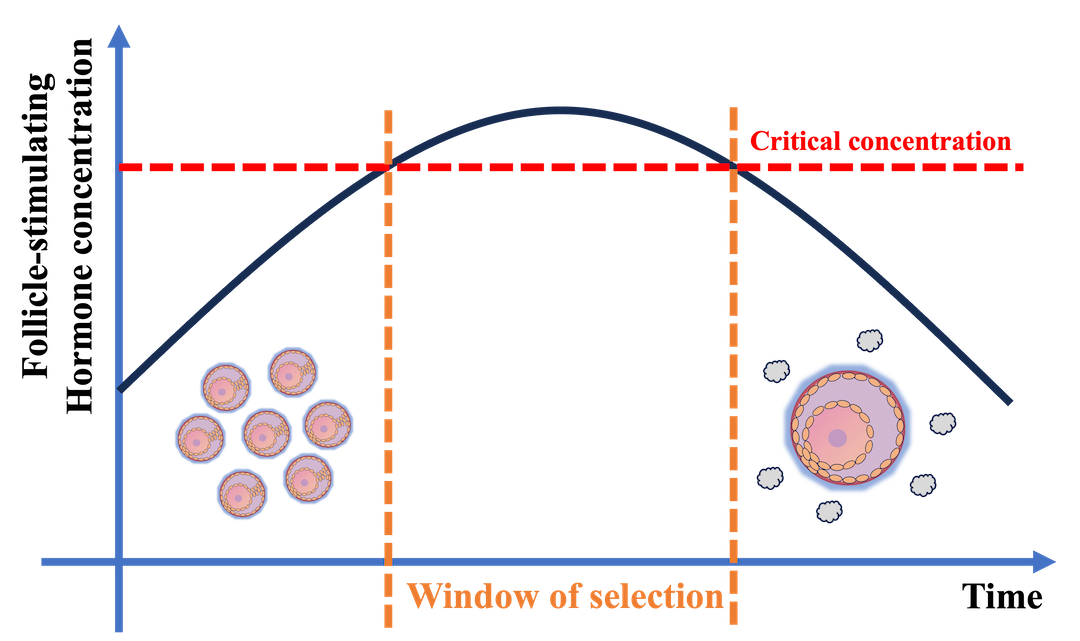
“The model shows the first follicle selection event is most likely to happen when FSH rises only slightly above the threshold. FSH then drops quickly once a follicle is selected and estradiol is produced,” Lyu said. “In most cases, this short time interval limits the number of selected follicles to just one.”
Because this is a random process, the model predicted that on rare occasions a second follicle could be selected before the FSH dropped below the threshold. Since even a small change in timing could also result in a second follicle being selected, this model also suggests new theories to explain some observed fertility phenomenon.
“We can use this model to start interrogating fertility questions that affect women across the world,” Kolomeisky said. “For example, it could be that control of this FSH-estradiol cycle loosens slightly as women age, leading to increased probability of fraternal twins for women over 35. Women with polycystic ovarian syndrome, who often have low FSH levels, may struggle with infertility because the FSH levels never reach the threshold to select a follicle for development. These are possibilities opened by the model’s predictions.”
The work was supported by the Welch Foundation (C-1559), the NIH (R01GM148537) and the Center for Theoretical Biological Physics sponsored by the NSF (PHY-2019745).