


Celebrations at home will sweeten America’s pandemic Valentine’s Day
Valentine’s Day consumer spending will look different this year, according to an expert from Rice’s Jones Graduate School of Business.
Nameless Sound musicians performed an original score on Nanibah Chacon’s interactive installation following Danza Azteca Macuilxochitl's activation of...
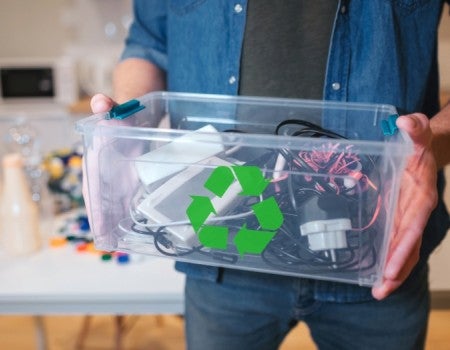
Rice’s James Tour recently published an improved method to recover antimony from this electronic waste stream. ...

Three Rice faculty members from the Department of Earth, Environmental and Planetary Sciences have recently been honored with career awards, showcasin...

The Adventurous Electric Guitar Festival gathered players, composers and scholars to test the instrument’s next act....
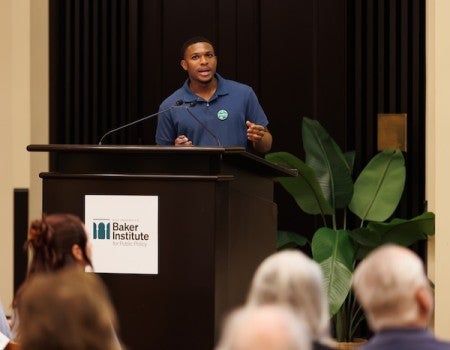
The Science and Technology Policy Program at Rice’s Baker Institute for Public Policy hosted a “science cafe” Oct. 13 to bring research to reality and...

The Doerr Institute for New Leaders at Rice has launched CoachRICE: Team Coaching, a new professional education program designed to help coaches, mana...
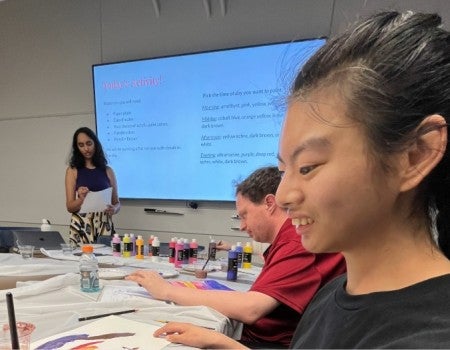
Graduate student Sayuri Jayawardena has started a Rice chapter of Lifelong Learning with Friends. ...

Scholars, curators and filmmaker Daphne Di Cinto gather at Rice to explore Black histories from Renaissance Italy to medieval Africa and Islamic world...
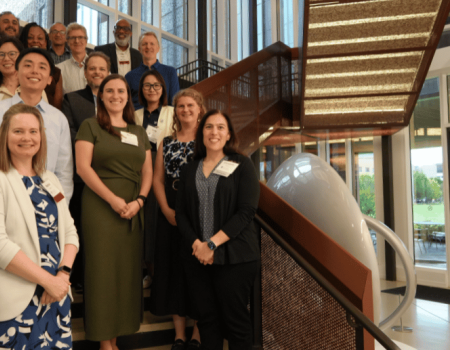
For the sixth fall in a row, Rice welcomed a new group of researchers to STaRT@Rice, giving emerging researchers both the skills and the support to gr...

Rice and the Houston Methodist Research Institute have signed a memorandum of understanding with LSE Health at the London School of Economics and Poli...

As the 2026-27 Aleko Endowed Artist, Julia Bullock curated an evening of song, chamber music and poetry celebrating the Harlem Renaissance....

Rice’s Yonglong Xie is one of 20 early-career scientists, mathematicians and engineers to receive a 2026 Packard Fellowship. ...
Celebrations at home will sweeten America’s pandemic Valentine’s Day
Valentine’s Day consumer spending will look different this year, according to an expert from Rice’s Jones Graduate School of Business.

Restaurant recommendation system wins Rice Datathon
A restaurant recommendation system to support small Houston businesses during the pandemic wins this year’s Rice Datathon.

OpenStax releases new features, titles in courseware
OpenStax, Rice’s educational technology initiative, has added more of its textbooks and new features for instructors to OpenStax Tutor, an online reading and homework platform designed to engage all students.

Better transit, emergency response, broadband access top post-pandemic priorities
The United States must focus on improving infrastructure as it recovers from the COVID-19 pandemic, and the top priorities include increasing broadband access, expanding public transportation, and improving emergency response and health care facilities, according to a new survey and report from Rice's Kinder Institute for Urban Research.
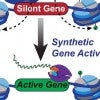
New CRISPR tech targets human genome’s complex code
Rice bioengineers harness the CRISPR/Cas9 system to program histones, the support proteins that wrap up and control human DNA, to manipulate gene activation and phosphorylation. The new technology enables innovative ways to find and manipulate genes and pathways responsible for diseases.

‘Defective’ carbon simplifies hydrogen peroxide production
Rice scientists introduce a new catalyst to reduce oxygen to widely used hydrogen peroxide.

The 84-year-old textile artist Sheila Hicks has shown her rainbow-hued “Questioning Column” everywhere from the 20th Biennale of Sydney, where it cascaded down one of the stately Ionic pillars of the Art Gallery of New South Wales, to the 2017 Venice Biennale.

New humanities podcast explores personal connections between life and scholarship
"Connections" was conceived as a way to explore a topic that’s long been fundamental to humanistic fields of study.

Nanotechnology is crucial to US energy independence, says Baker Institute expert
Nanotechnology can deliver solutions to U.S. economic, energy and geopolitical challenges while also helping the world meet climate targets and sustainability goals, according to a new report from Rice University's Baker Institute for Public Policy.
US must do its fair share for refugees, says Baker Institute expert
Increasing the number of refugees resettled to the U.S. is critical for the well-being of refugees across the globe, according to an expert from Rice’s Baker Institute for Public Policy.