
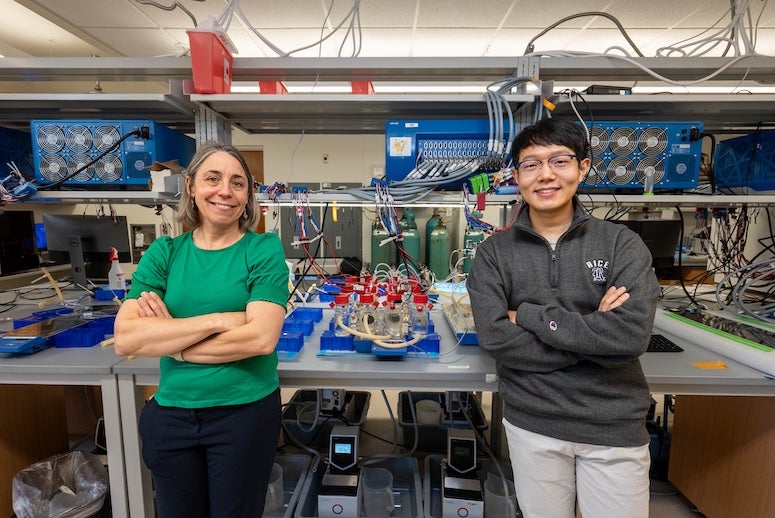
Bacterial sensors usually rely on emitting light to transfer information about what they’re sensing, but that method isn’t practical in many settings. That’s why most information transmission is done via electricity. And while electricity-emitting bacteria exist, manipulating them into useful sensors has been quite challenging. Rice University professor Caroline Ajo-Franklin’s group, working in collaboration with researchers from Tufts University and Baylor College of Medicine, recently developed a flexible bioelectrical sensor system called electroactive co-culture sensing system (e-COSENS). The study was published in Nature Biotechnology.
“Bioelectrical sensing is by no means a new concept,” said Ajo-Franklin, the Ralph and Dorothy Looney Professor of Biosciences and corresponding author on this paper. “But e-COSENS is the first system that allows us to easily engineer bioelectronic sensors in a modular manner, like assembling Legos, allowing us to potentially use them to monitor everything from human health to environmental contaminates.”
Bioelectrical sensing requires bacteria that produce electricity and are easy for researchers to manipulate to respond to different substances. Ideally, the bacteria would be able to live in a variety of different places so that the system could be used in environments ranging from rivers to milk.
The challenge was finding bacteria that met all three conditions. E. coli, for example, is simple to engineer but doesn’t produce electricity. L. plantarum, a common food bacterium, produces electricity using a molecule called quinone but is incredibly difficult to engineer.
“Instead of forcing a single bacterium to do everything, we split the job between two bacteria,” said Siliang Li, the first author on this study and postdoctoral fellow. “That division of labor is what makes e-COSENS so flexible and powerful.”
The key to e-COSENS is quinone, the molecule L. plantarum uses to create electricity. L. plantarum cannot create its own quinone; it has to be provided by the environment. This means the quinone can be used as a signal, or trigger, to turn electricity on or off.
The researchers revealed that they could easily manipulate bacteria like E. coli, a bioengineering workhorse, to make quinone only in the presence of a specific substance called an analyte. Once E. coli released the quinone in the environment, L. plantarum would use it to send an electrical signal, which could be read by an electrode — in this case, a current meter.
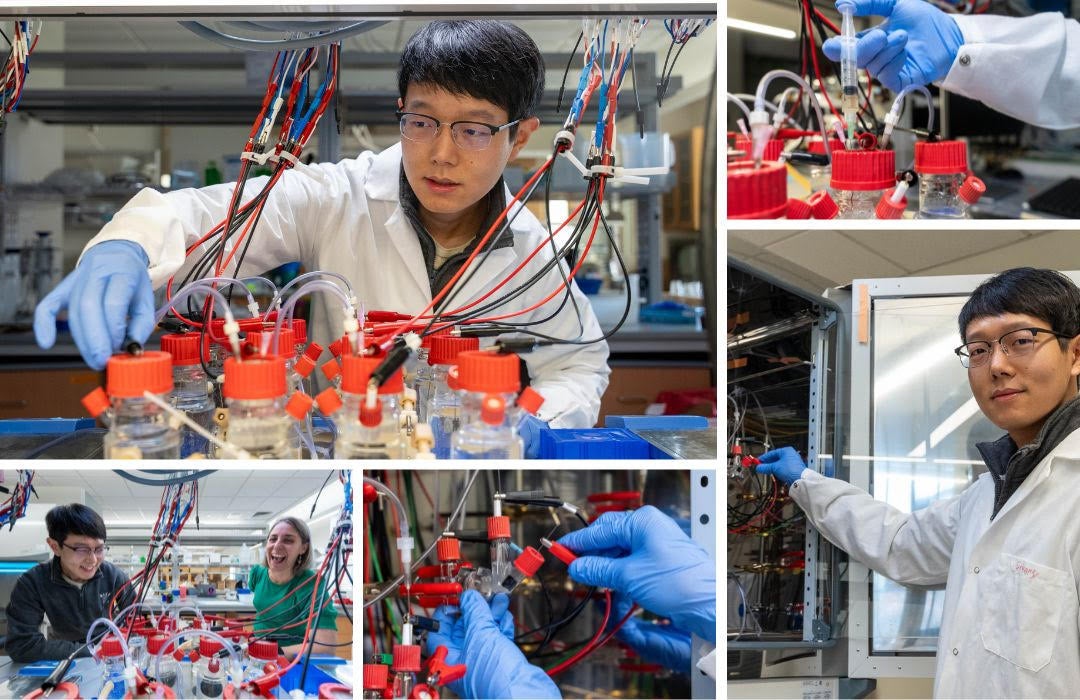
To test this system, the researchers designed systems to look for four different analytes in four different environments. They used E. coli to sense heavy metal ions in bayou water and inflammation markers in artificial saliva, and L. lactis, another quinone-producing bacterium, to sense antimicrobial peptides in human fecal-derived samples provided by Baylor and an antibiotic in milk from the grocery store. They placed each sample and bacterial systems into individual reactors connected to current meters. Within a few hours, all four current meters showed an electrical charge, revealing the bacteria were responding to the analytes — some in as few as 20 minutes.
All four versions of the system were successful, but the large reactors they used wouldn’t easily translate from the lab to the outdoors. Luckily, their collaborators at Tufts had a solution: a compact electronic disk roughly the size of a quarter which can be paired with commercially available digital multimeters.
“This simplified hardware dramatically lowers the barrier to using bioelectronic sensors outside the lab and opens possibilities for low-cost, field-ready diagnostics,” Li said. The researchers had also identified multiple other bacteria that could either send or receive a quinone signal, increasing the number of possible environments e-COSENS could be used in.
“The strength of e-COSENS is the flexibility derived from sharing the work across multiple cells,” said Ajo-Franklin, director of the Rice Synthetic Biology Institute, which focuses on supporting interdisciplinary research. “In the same manner, the success of this research hinged on sharing expertise and work among my research group and our partners, Duolong Zhu and Robert Britton at Baylor and Kundan Saha and Sameer Sonkusale at Tufts.”
This work was supported by the Cancer Prevention and Research Institute of Texas (RR190063) and the Army Research Office (W911NF-22-1-0239). Two of the authors filed a provisional patent entitled “Compositions and Methods of Bioelectronic Sensing” on Aug. 12, 2024 (No. 63/682,083), covering the design criteria of e-COSENS. A subsequent appendance was filed on June 23, 2025 (No. 63/828,835), covering the use of the MFC device with a multimeter for electrical signal detection, as well as a provisional patent entitled “Nanosheet Clay Cation Exchange Membrane for Microbial Fuel Cell” on March 4, 2025 (No. 63/766,456), covering the fabrication and application of the clay membrane.