Nameless Sound musicians performed an original score on Nanibah Chacon’s interactive installation following Danza Azteca Macuilxochitl's activation of...
Three Rice faculty members from the Department of Earth, Environmental and Planetary Sciences have recently been honored with career awards, showcasin...
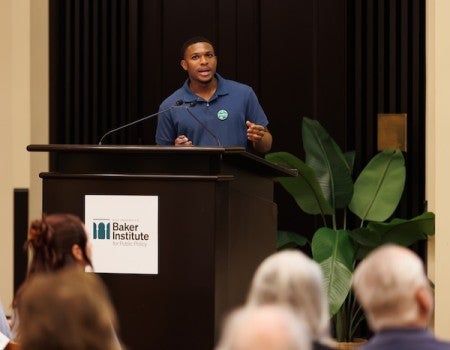
The Science and Technology Policy Program at Rice’s Baker Institute for Public Policy hosted a “science cafe” Oct. 13 to bring research to reality and...
The Doerr Institute for New Leaders at Rice has launched CoachRICE: Team Coaching, a new professional education program designed to help coaches, mana...
Scholars, curators and filmmaker Daphne Di Cinto gather at Rice to explore Black histories from Renaissance Italy to medieval Africa and Islamic world...
For the sixth fall in a row, Rice welcomed a new group of researchers to STaRT@Rice, giving emerging researchers both the skills and the support to gr...
Rice and the Houston Methodist Research Institute have signed a memorandum of understanding with LSE Health at the London School of Economics and Poli...
Competition with China is the United States' "existential challenge now and for the next three or four decades" and must be addressed by the White House immediately, according to a new report from Rice University's Baker Institute for Public Policy.
An algorithm by Rice University scientists predicts the structures and melting temperatures of collagen, the triple helix that accounts for about a third of the body’s proteins and forms the fibrous glue in skin, bones, muscles, tendons and ligaments.
An essay written by Hanszen College junior Mason Reece, the official Election Judge for Rice’s precinct, was selected as a winning entry in the American Political Science Association’s new magazine.
Chloe Oani ’21 moved all around the world as a child because of her dad’s job, so when it came time to make her own decision about where to attend college, she took it very seriously.
Inequities in marijuana policy persist because of a failure to center reform around racial justice, according to a new report by experts at Rice's Baker Institute for Public Policy in the American Bar Association publication The Judges’ Journal.
A limited number of fans will be admitted to Rice baseball and soccer games this season after the university's Crisis Management Team approved a set of protocols for outdoor venues, the athletics department announced this week.
Members of Rice's Department of Chemistry put forth a video “choose-your-own-adventure” strategy to help undergraduate students conduct virtual experiments.