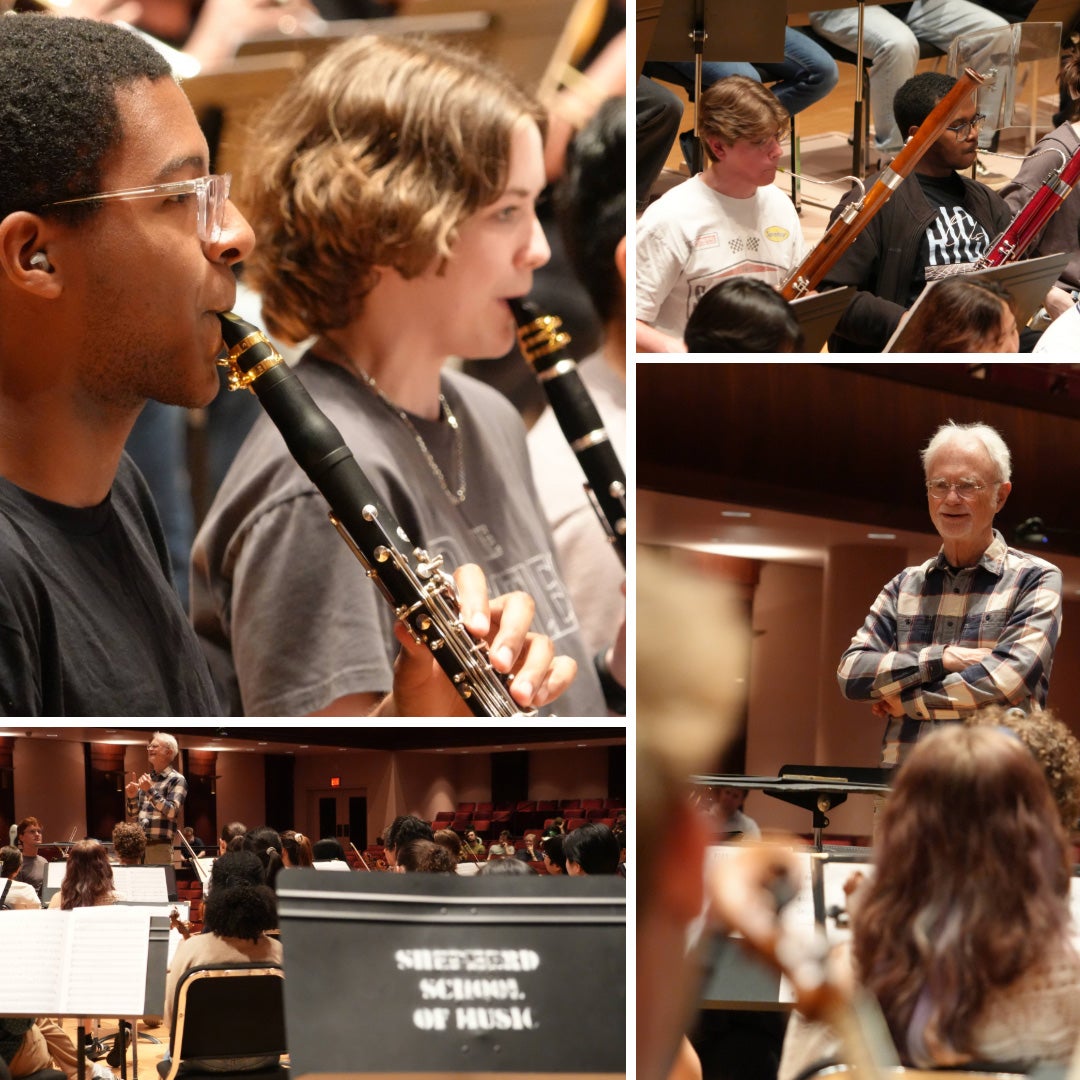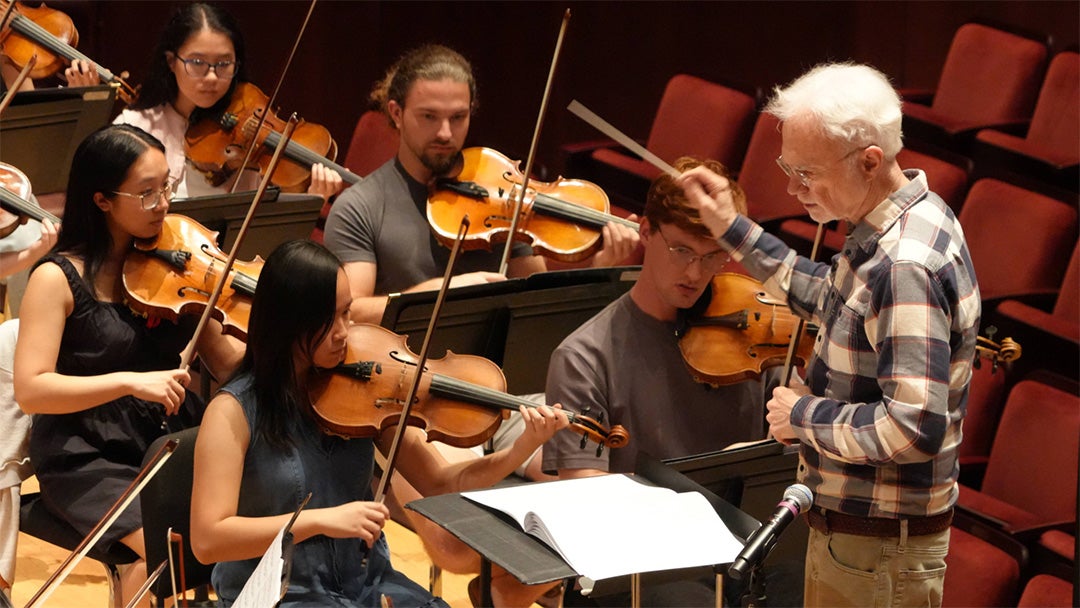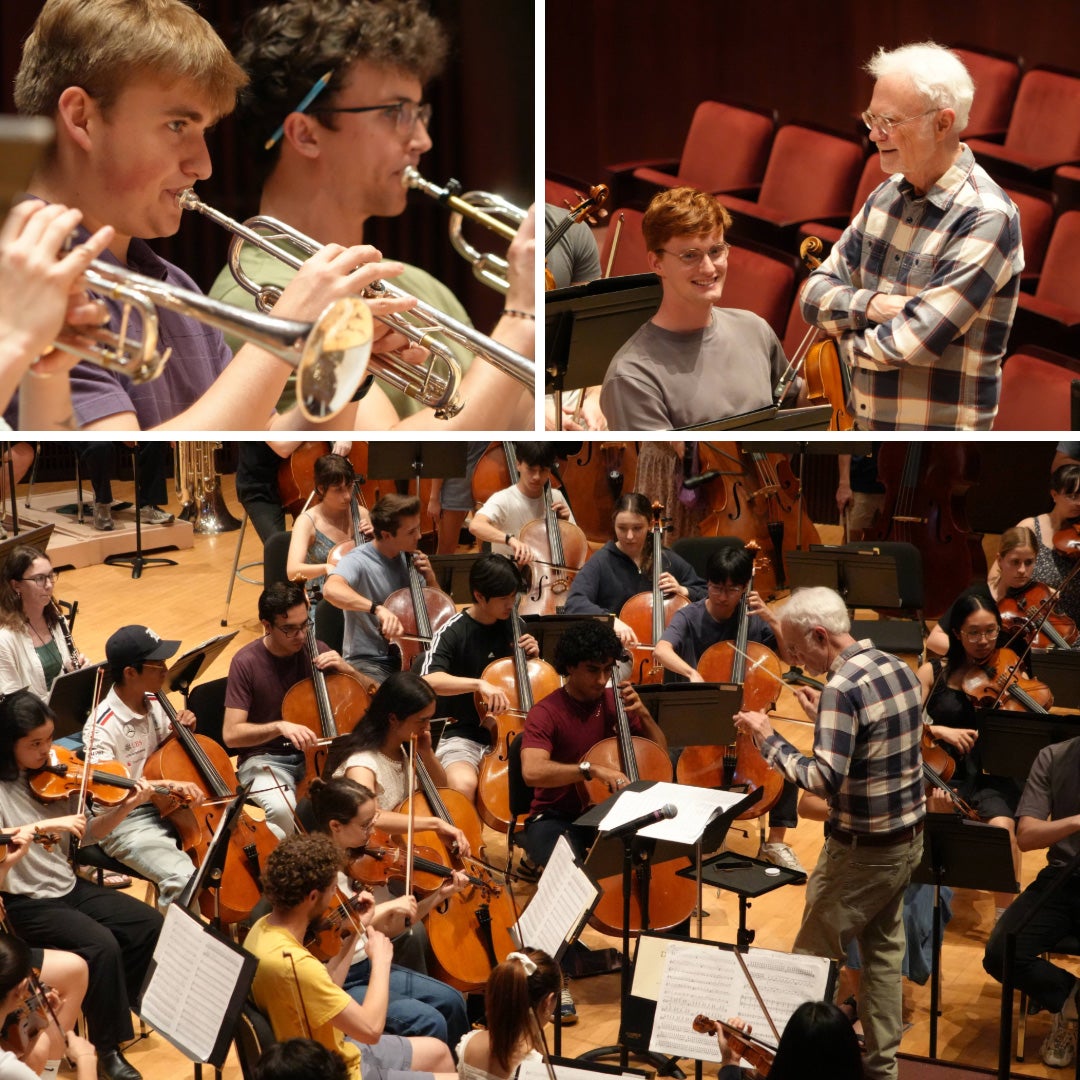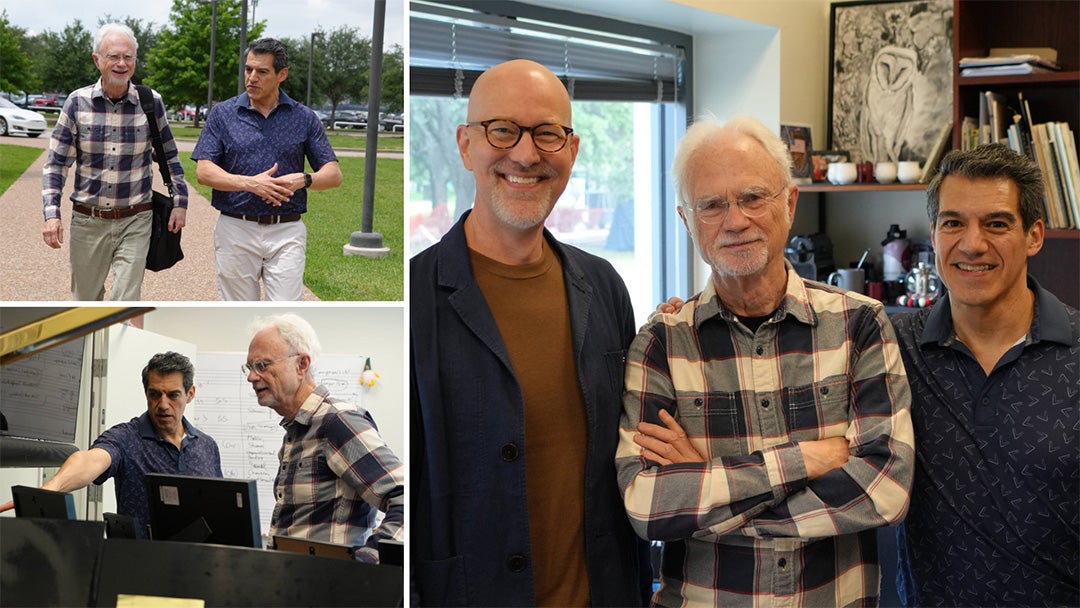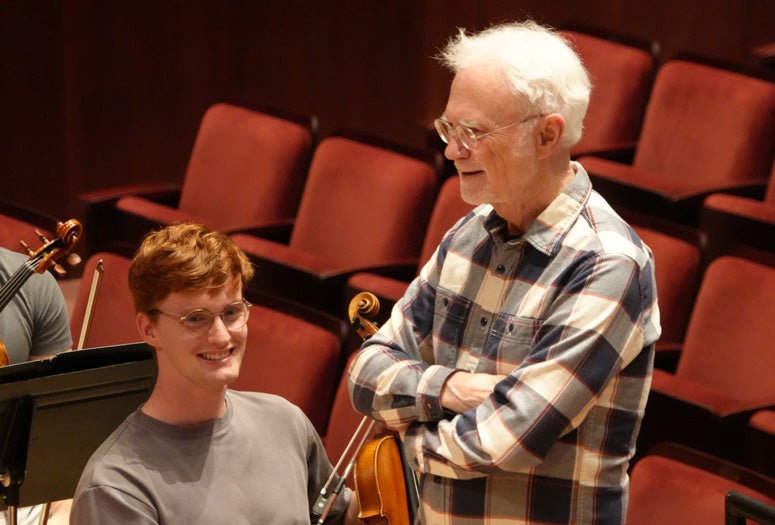
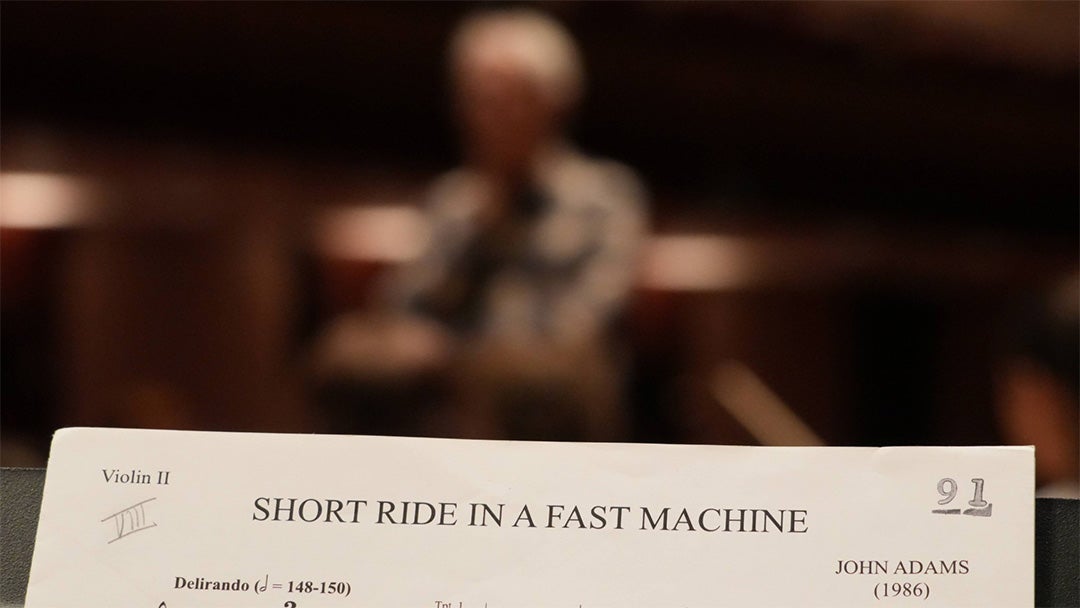
Composer and conductor John Adams visited Rice University’s Shepherd School of Music April 15 to rehearse his iconic “Short Ride in a Fast Machine” with the school’s symphony orchestra in Stude Concert Hall. His visit stems from the Shepherd School’s partnership with the Houston Symphony, which includes opportunities for guest conductors to work directly with student musicians.
Few guests carry the credentials Adams does. A five-time Grammy winner and creative chair of the Los Angeles Philharmonic since 2009, he has composed landmark works including “Nixon in China,” “Doctor Atomic,” “Harmonielehre” and “The Dharma at Big Sur.” He holds honorary doctorates from Yale University, Harvard University, University of Cambridge and the Juilliard School, and his 2025-26 conducting schedule includes return engagements with the Houston Symphony and appearances with orchestras in Tokyo, Rome and Gothenburg, Sweden.
The students came prepared. Miguel Harth-Bedoya, the distinguished resident director of orchestras, had previously worked with the orchestra on “Short Ride” for its October concert, giving them a strong foundation before Adams took the podium.
After the first run-through, Adams praised the orchestra as “very tight, very controlled,” then got to work coaching the orchestra to unlock what he described as “more power” in certain passages and sharing his own interpretation of the score.
“Twenty years ago, a conservatory orchestra couldn’t have performed this piece,” Adams told them.
The piece itself was born from a phone call. Longtime collaborator and conductor Michael Tilson Thomas told Adams he needed a fanfare.
“You don’t say ‘no’ to MTT,” Adams said. “I grumbled. Wrote it. And I’m glad I did.”
Between rehearsal passages, Adams opened up about his path to the podium. He grew up in small-town New Hampshire, where his parents gave him two LPs: Tchaikovsky’s “1812 Overture” and a novelty record featuring Bozo the Clown conducting circus marches. His first impression of a conductor, Adams told students with a laugh, was a clown. But even then, he responded to music physically, conducting along with records in his living room.
His first orchestral experience came in junior high, playing in an amateur ensemble sponsored by a state mental institution. Rehearsals and performances took place on the facility’s basketball court before an audience of its patients.
“They were so profoundly moved by amateurs sawing away,” Adams recalled. “I would look out and see tears. That made me realize that what we’re doing as musicians is communicating emotion. It’s all about communicating emotion.”
He eventually led that orchestra, then continued conducting through college and beyond.
“I’m very spoiled,” Adams said. “Now I get to conduct the best orchestras in the world.”
Adams also fielded questions from students about their craft. A composition student’s question about the creative process drew one of the afternoon’s most vivid answers. Adams likened composing to gardening.
“Once you have an idea, you water it, fertilize it, clip it,” Adams said. “When I see a piece that doesn’t work, I notice the gardener didn’t do a good job.”
He stressed the technical foundation underlying that intuition, particularly harmony.
“You really have to know harmony,” Adams said. “You cannot be a good living composer if you can’t do harmony. Most of the magical moments in music happen because of a change in harmony.”
Adams noted that he embraces the pop, rock and jazz that surround modern listeners, choosing to welcome those influences into his classical works. His piano concerto “Must the Devil Have All the Good Tunes?” — which the Houston Symphony performs this weekend — features bass guitar and what he called a “honky-tonk” piano.
Asked how young musicians can find freedom within the discipline of orchestral playing, Adams acknowledged that ensemble performance demands a suppression of individual ego in service of collective sound. But the reward, he said, is worth it: At its best, the orchestra provides what he called a “fabulous communal sense of joy.”