
A few years after graduation, once their experience has had a chance to decant, Rice University alumni are asked to reflect on their learning journey and commend former instructors for their excellence in teaching. The process determines the recipient of the George R. Brown Excellence in Teaching Award.
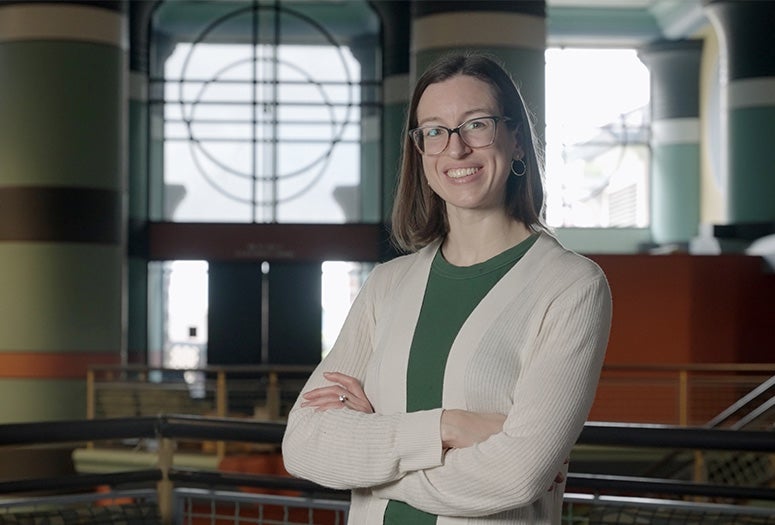
This year, the recognition goes to Rebecca Schreib, associate teaching professor and director of undergraduate studies in the Department of Computer Science.

“I was really surprised and grateful,” Schreib said. “I know there are a lot of excellent teachers here at Rice, and so it was really a huge honor that I was selected by the alumni for this award. It is so fulfilling to hear that students, years out from graduation, still feel like my teaching had a meaningful impact on them.”
Schreib has spent much of her academic life at Rice. She arrived as an undergraduate in 2010, stayed for graduate school and joined the faculty in 2020. As a student, she chose Rice for “the opportunities for building personal connections with faculty.” As someone now in charge of the classroom, she continues to value building relationships and creating a space where everyone feels known and supported.
“One of the most important things is really just trying to build personal connections with the students and making sure that they feel like they are valued members of the classroom community,” Schreib said.
For Schreib, community is part of how learning takes hold: Students ask more questions, stay engaged longer and are more willing to work through uncertainty.
“The more questions I get in a given day of class, the more I consider it to be a success, because that means that the students are engaging with the material, working to process it and feel comfortable voicing questions,” she said.
Schreib has taught several different classes over the years, including introductory courses on computational thinking, program design and programming languages as well as a graduate-level course on pedagogy. She has also built several computer science educational tools.
As someone who thrives on structure, Schreib takes a deliberate approach to course design. The Center for Teaching Excellence’s certificate program, which Schreib completed when she was a graduate student, introduced her to evidence-based pedagogy and backwards design — a teaching framework where learning outcomes dictate how teaching activities are structured. Since then, she has built her courses around clearly defined learning objectives and aligned her teaching choices with those goals.
“Being intentional about teaching is something that I try really hard to do,” she said.
Each semester is an opportunity to exercise that commitment: She gathers feedback, reflects on what worked and makes adjustments — sometimes small, sometimes more structural. Something Schreib said she has gotten better at along the way is allowing for more flexibility in the classroom.
“We are dealing with humans and inherently that means that there are a lot of variables; each new class brings a fresh group of students with different questions and perspectives,” she said. “I have learned to be a lot more adaptable.”
For Schreib, success in the classroom is tied in part to whether students meet the learning objectives she outlines at the outset, but also to whether they come away recognizing that learning continues beyond the classroom.
“It is an ongoing process,” Schreib said. “I think a lot of what I hope to instill in my students is not just skills but also attitudes, like curiosity and excitement.”