
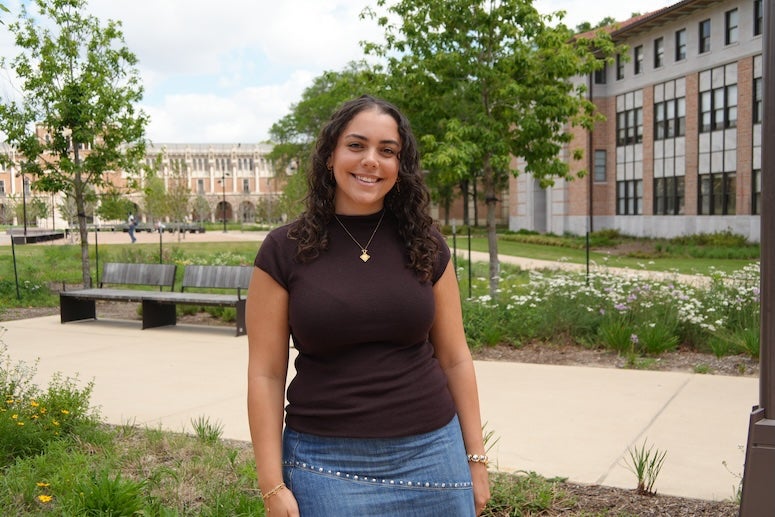
For Karma Elbadawy, the idea of home is not defined by borders or paperwork.
It is something people build. Carry. Practice.
Elbadawy, a graduating senior at Rice University, has been named a 2026 Thomas J. Watson Fellow, one of 40 students selected nationwide. The fellowship provides $40,000 for a year of independent travel and research outside the United States, allowing fellows to pursue a self-designed project shaped by curiosity and lived experience.
Elbadawy’s project centers on refugees and stateless individuals and how they preserve a sense of home without formal legal recognition.While much of the global conversation around displacement focuses on policy, borders and legal status, she is intentionally looking beyond those systems to what happens in everyday life.
“I’ve had a lot of experience focused on the policy side of it,” Elbadawy said. “But now it’s my chance to focus on the lived experience portion.”
Over the course of the year, she will travel to six countries — Turkey, Jordan, Malaysia, South Africa, Colombia and the Dominican Republic — each offering a different perspective on displacement and statelessness.
“I’m really interested in how people create these everyday rituals of belonging through food, language and community,” she said.
Rather than conducting traditional research, Elbadawy plans to immerse herself in daily life, spending time in community spaces such as kitchens, youth programs and cultural centers while working alongside local organizations.
“Karma distinguishes herself through both intellectual curiosity and emotional depth,” said Michi Heckler, assistant director of Rice’s Center for Civic Leadership. “Her project reflects the fellowship’s emphasis on independent exploration, humility and a willingness to be changed by the world.”
Heckler noted that the fellowship’s selection process spans months and includes multiple rounds of review and interviews, with institutions nominating a limited number of candidates each year.
“Karma’s thoughtful, human-centered approach to global issues really stood out,” she said. “Her selection reflects the strength of Rice students pursuing nuanced, globally minded work.”
Elbadawy’s interest in the topic grew at Rice, where she studied migration and refugee policy and worked with the Baker Institute for Public Policy.
“Karma is one of the best students I have had the opportunity to work with,” said Ana Martín Gil, research manager at the institute’s Edward P. Djerejian Center for the Middle East. “She has contributed to a wide variety of projects and consistently demonstrated strong research skills, independence and a willingness to learn.”
That experience helped shape both her academic focus and the direction of her project.
Throughout her work at the Baker Institute, Elbadawy contributed to research on refugee resettlement, migration enforcement and media representations of refugees, building a strong foundation in the policy landscape she now hopes to explore more deeply through lived experience.
“Karma’s intellectual curiosity, independence and deep commitment to understanding refugee issues make her especially well suited for a global, self-directed experience like the Watson Fellowship,” said Kelsey P. Norman, director of the Women’s Rights, Human Rights and Refugees Program at the Baker Institute.
But the project is also deeply personal.
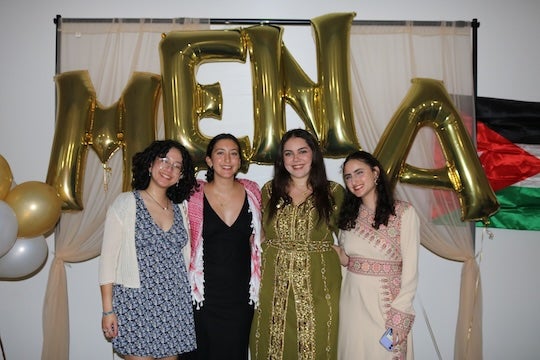
“I’ve grown up with this pan-Arab identity,” Elbadawy said. “The struggles of the people in my region is something that I feel myself.”
The Watson Fellowship, now in its 58th year, is designed to give students the freedom to explore without a fixed outcome. Fellows are encouraged to follow their ideas, adapt along the way and grow through the experience.
“The end goal is not to come up with any one answer,” Elbadawy said. “It’s really about the growth and transformation along the way.”
That perspective shapes how she approaches the year ahead. Her focus is not on advocacy or policy change during the fellowship but on listening and learning directly from the people she meets. That includes individuals living without legal citizenship, a condition that affects millions worldwide and fundamentally shapes access to everyday life.
“You don’t have a birth certificate. Your life isn’t registered with any government,” she said. “You can’t go to school, you can’t have a job, you can’t open a bank account. And yet people still build lives in those conditions.”
Through observing and researching these experiences, Elbadawy said she hopes to develop a deeper understanding of belonging that extends beyond formal systems.
“I believe that you can create and carry belonging, but you can’t necessarily be given it,” she said.
That understanding is something she plans to carry forward. After completing the fellowship, she hopes to pursue a career in immigration law, focusing on asylum cases.
“I hope to become a better, more emotional advocate for people,” she said.
As she prepares to begin her journey, Elbadawy is not focused on finding answers. She is focused on understanding people and in the process redefining what it means to belong.