
The question of how artificial intelligence will transform research is top of mind for researchers in all areas of academic inquiry.
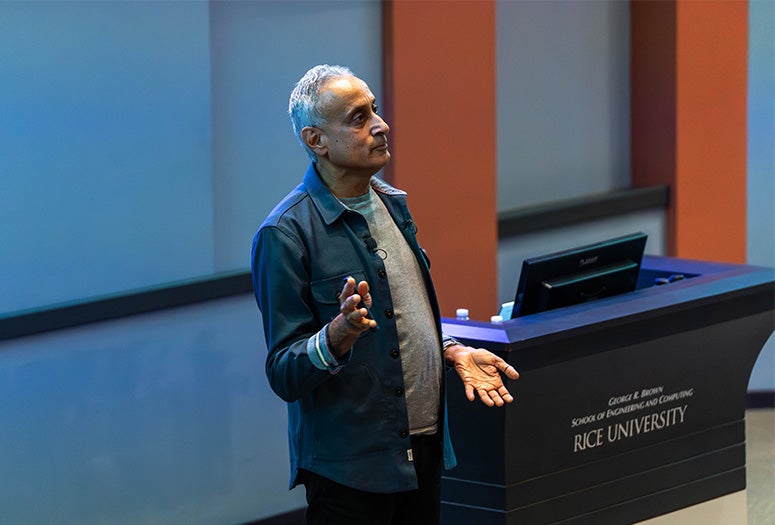
Prabhakar Raghavan, chief technologist at Google, shared insights on how this question plays out specifically in the realm of mathematics and computer science during a recent talk delivered at Rice University as part of the Ken Kennedy Institute Distinguished Lecture Series.
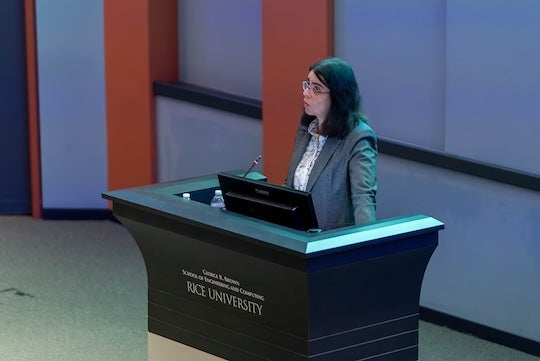
Lydia Kavraki, University Professor at Rice and director of the Ken Kennedy Institute, introduced Raghavan by highlighting his extensive work in algorithms, web search and databases and noting his pivotal contributions to search infrastructure and user experience for global products like Google Search and Gmail.
In opening his talk, Raghavan took a moment to recall an earlier visit to Rice in which he encountered the late professor Ken Kennedy, a pioneer in high-performance computing whose legacy continues to drive research collaboration and foster community through the work of the eponymous institute.
“Ken Kennedy dedicated his career to bridging the gap between human abstraction and machine execution,” Raghavan said. “In today’s world of AI, he would likely have viewed LLMs as the ultimate compiler: removing the architecture that stands between human curiosity and its realization.”
Raghavan’s lecture explored this concept by unpacking a range of results in mathematics and computer science research and posing a critical question: When and how can large language models (LLMs) assist in ways that exceed human capability?
He structured the lecture in three parts with an initial warmup example, followed by a set of research cases and concluding with a series of reflections.
The opening example focused on balanced allocations, a concept from probability and computer science that deals with distributing tasks efficiently — for instance, routing large volumes of requests across servers without overloading any one system. Drawing on examples from Google, Raghavan pointed to complications that arise in real-world systems such as sudden spikes in traffic, competing priorities and incomplete information.
“You don’t want requests to have to wait too long; to which server do you dispatch an incoming request?” Raghavan said.
From there, he turned to ongoing research, describing how AI systems can be used to generate programs that explore many possible solutions to difficult problems. In some cases, these systems can arrive at results that would be difficult for a human to produce directly, even if they remain, in principle, within reach. At the same time, Raghavan noted that long-standing problems in the field pose a compelling challenge to AI systems.
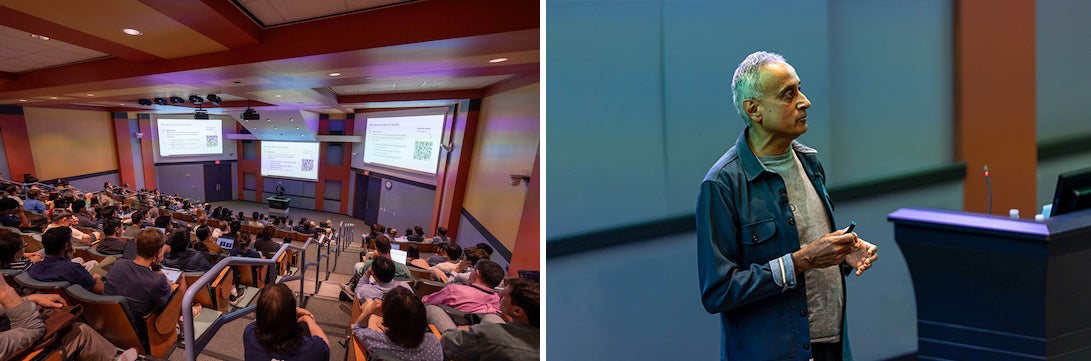
“Our goal isn’t to ask if AI can help with math research ⎯ it already does,” Raghavan said. “Our goal is to ask whether problems that have stood the test of time can see progress from AI, yielding results that stand the test of time.”
Raghavan did not shy away from acknowledging the limits of current approaches, for instance the fact that AI-generated results still require careful verification, which can be a time- and effort-intensive process.
“Verifying the correctness of a proof generated by AI remains a critical bottleneck,” Raghavan said. He noted that while human verification is essential, AI can also be used to accelerate the discovery process.
His talk raised broader questions about the nature of mathematical work and scientific research, suggesting that LLMs function more as an enabling ally in building understanding rather than a competing machine focused primarily on model progression.
“Is mathematics about hill climbing on benchmarks, akin to a video game leaderboard? Or is it a fundamentally different human enterprise?” Raghavan said.
It can be argued that a core component of building human understanding is recognizing fault. Raghavan noted that current AI systems are trained largely on successful results rather than the failures that are often intrinsic to human insight and learning.
At the same time, Raghavan made clear that AI is already embedded in scientific work and can accelerate research. Advances such as AlphaFold, which contributed to a Nobel Prize-winning breakthrough in protein structure prediction, illustrate how integral these tools have become.
“Banning LLMs from science is like banning microscopes from biology or telescopes from astronomy,” he said.
Exploring questions about the impact of modern technology in science, mathematics and engineering is imperative in today’s age of rapid AI growth and implementation. For Richard Wong, an assistant teaching professor of mathematics, the talk was notable for the balance it kept between showcasing AI capabilities while also broaching areas where the technology falls short.
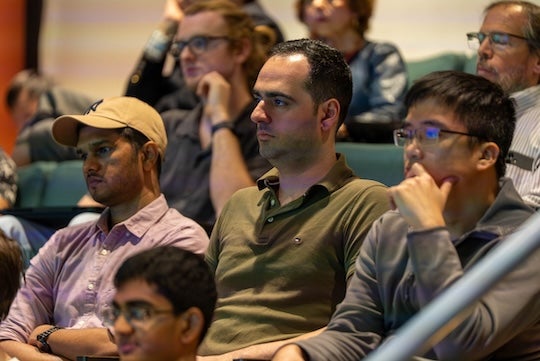
“It was really insightful to hear from someone at Google who knows the state of the art … but I also appreciated that he talked about the limitations,” Wong said. “It’s a topic that I think a lot of people are interested in, and having someone speak about their experiences in a way that’s digestible is really important.”
Nada Ali, a graduate student in Rice’s Department of Mathematics, echoed Wong’s sentiment, adding that she found the lecture “informative.”
“It was interesting to actually hear all of this from someone who is directly engaged in making all of these AI engines,” Ali said.
The event was part of the Ken Kennedy Institute’s broader programming, which includes lectures, workshops and collaborative research initiatives aimed at advancing AI and computing across disciplines. Through efforts like the Distinguished Lecture Series, the institute brings together researchers, students and practitioners to engage with questions that cut across fields — a focus that aligns with Rice’s wider emphasis on AI as a universitywide priority.
Related events include:
- Previous Distinguished Lecture in January by Rice’s Luay Nakhleh on “Reconstructing Evolution Across Scales: Phylogenomics from Species to Cells” — view the recording here.
- Upcoming Distinguished Lecture April 20 by California Institute of Technology’s Pietro Perona on “Visipedia — Empowering Communities of Experts by Sharing Data, Algorithms and Expertise” — register to attend.
A recording of the lecture is now available on the Ken Kennedy Institute YouTube page:
- Access associated media files:
-
https://rice.photoshelter.com/galleries/C0000ozmLFGQBqew/G00008q_2tSYSJTA/I0000tfeWVL4zLcI/260324-Google-CT-Photos-109998-jpg
Credit: Photos by Jared Jones/Rice University