


Rice lab details conditions to decontaminate disposable masks
Researchers at Rice University and the University of Texas Medical Branch, Galveston, establish a framework for properly decontaminating disposable facemasks.
Nameless Sound musicians performed an original score on Nanibah Chacon’s interactive installation following Danza Azteca Macuilxochitl's activation of...
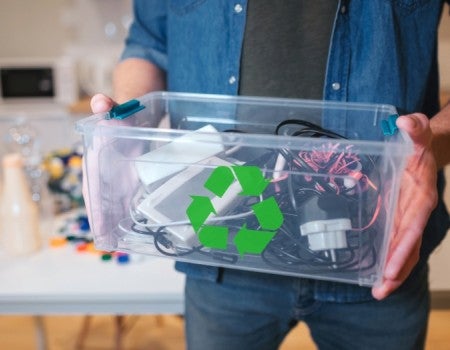
Rice’s James Tour recently published an improved method to recover antimony from this electronic waste stream. ...

Three Rice faculty members from the Department of Earth, Environmental and Planetary Sciences have recently been honored with career awards, showcasin...

The Adventurous Electric Guitar Festival gathered players, composers and scholars to test the instrument’s next act....
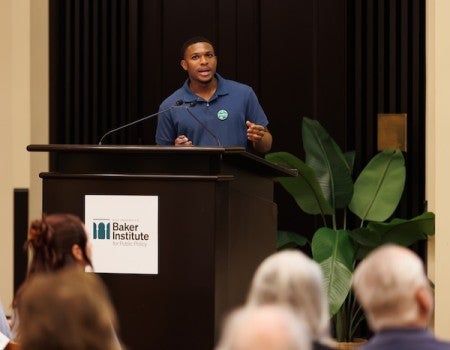
The Science and Technology Policy Program at Rice’s Baker Institute for Public Policy hosted a “science cafe” Oct. 13 to bring research to reality and...

The Doerr Institute for New Leaders at Rice has launched CoachRICE: Team Coaching, a new professional education program designed to help coaches, mana...
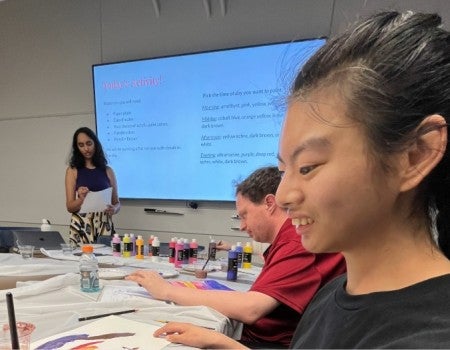
Graduate student Sayuri Jayawardena has started a Rice chapter of Lifelong Learning with Friends. ...

Scholars, curators and filmmaker Daphne Di Cinto gather at Rice to explore Black histories from Renaissance Italy to medieval Africa and Islamic world...
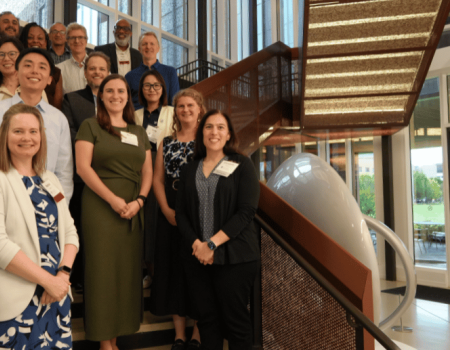
For the sixth fall in a row, Rice welcomed a new group of researchers to STaRT@Rice, giving emerging researchers both the skills and the support to gr...

Rice and the Houston Methodist Research Institute have signed a memorandum of understanding with LSE Health at the London School of Economics and Poli...

As the 2026-27 Aleko Endowed Artist, Julia Bullock curated an evening of song, chamber music and poetry celebrating the Harlem Renaissance....

Rice’s Yonglong Xie is one of 20 early-career scientists, mathematicians and engineers to receive a 2026 Packard Fellowship. ...
Rice lab details conditions to decontaminate disposable masks
Researchers at Rice University and the University of Texas Medical Branch, Galveston, establish a framework for properly decontaminating disposable facemasks.

Robotics expert Marcia O’Malley, associate dean for research and innovation in Rice’s Brown School of Engineering, co-authored a retrospective in this week’s Science Robotics about the past decade's advances in medical robotics.

Rice names Reginald DesRoches as next president
Reginald DesRoches, who is now serving as the university’s provost, has been named as the next president of Rice University.

Rice strategy refines genetic base editors
A new strategy by Rice University scientists seeks to avoid gene-editing errors by fine-tuning specific CRISPR-base editing parameters in advance.

Conservative customers are more satisfied than liberal ones, according to new study
Across industries, conservatives are more satisfied than liberals with the products and services they consume, according to a study of more than 326,000 U.S. consumers by an international research team from Rice University, the Catholic University of Portugal, Boston College, the University of Texas at San Antonio and Korea University.

Rice tapped to develop 3D-printed ‘smart helmets’ for the military
Rice University researchers have embarked upon a project to build the first printable “smart helmet” with funding from the Department of Defense.

High schoolers who change schools during academic year 40% more likely to drop out
One in 10 Houston-area high schoolers who change schools during the academic year end up dropping out, a rate 40% higher than peers who do not change schools, according to a new study released today by the Houston Education Research Consortium (HERC).

The Rice University Police Department (RUPD) shared doughnuts and safety tips with members of the Rice community during a pop-up event near Fondren Library Nov. 5.

The funding model for Texas K-12 education relies in part on the state’s energy sector – specifically its fossil fuel industry – raising questions about the impact on the state budget from the shift toward low-carbon and renewable energy. New research from Rice University’s Baker Institute for Public Policy forecasts the size of the projected funding shortfall through 2050 and proposes a series of policy solutions to address what the authors describe as a “manageable deficit.”
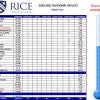
Rice United Way Campaign nears 60% of $250,000 goal
The Rice United Way Campaign is 59% of the way to its $250,000 goal, having raised $146,632 in the fundraising effort’s first three weeks.