
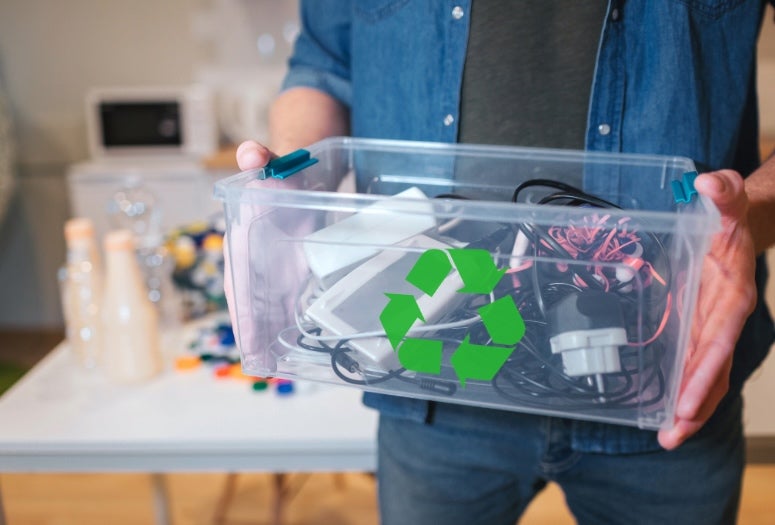
Many electronic devices use flame-retardant plastic as casing in order to reduce the risk of electrical fires. This plastic is formulated using a metal called antimony along with organic bromide compounds. In fact, 39% of the world’s antimony is used to create flame-retardant plastics, most of which will eventually end up as part of the tens of millions of tons of electronic waste generated each year. Rice University’s James Tour recently published a study in Nature Chemical Engineering detailing an improved method to recover antimony from this electronic waste stream.

“Antimony is a critical metal with a constrained supply,” said Tour, the T.T. and W.F. Chao Professor of Chemistry and corresponding author on the study. “My research team has adapted our flash Joule heating technique to quickly and effectively recover antimony from this plastic waste stream.”
To recapture antimony from the plastic, it first has to be released from the plastic. This is, chemically, a challenging step. As the antimony is released, other toxic compounds, organic bromides, can form that are difficult to capture.
“Conventionally heating the plastic releases the antimony in a volatile and difficult to collect form as well as creating and releasing hazardous organic bromide compounds,” said Leo Haoxin Ye, the first author of this paper and a graduate student at Rice. “Other options are risky or more impractical, such as using strong acids, organic solvents or multistep treatment options.”
The issue, the team thought, could be with the slowness of conventional heating, which allowed the elements to change forms or create new compounds. If they could adapt Tour’s flash Joule heating, which heats materials up to hundreds of degrees Celsius in a manner of milliseconds, they might be able to avoid some of the pitfalls of conventional heating while still releasing the antimony from the plastic.

“We found flame-retardant plastic waste generated by our own laboratory, ground it up and then placed it between two sheets of electrically heated carbon paper. We used ultrafast heating to pulse-heat it several times,” Ye said. “Then we held the plastic briefly at a high temperature, which allowed the antimony to evaporate and condense in a collection area.”
The method, called isothermal-clamped flash Joule heating, was tested on three different types of flame-retardant plastic: a power-supply housing, a printed circuit board and an electrical connector. From these, the team was able to recover approximately 90% of the antimony, while converting 83% of the bromide into hydrogen bromide, an inorganic compound that, while hazardous, a valuable industrial chemical that can be captured with sodium hydroxide to form a stable salt And the number of organic bromide compounds produced dramatically reduced, a result of the flash Joule heating’s speed. The plastic spent only 9.4 milliseconds in between 200-500 degrees Celsius, the temperature range in which organic bromide compounds form.
“Isothermal-clamped flash Joule heating could improve the speed, safety and practicality of antimony recovery from discarded flame-retardant plastics,” Tour said. “Given that the world is on track to produce 82 million metric tons of flame-retardant plastic waste by 2030, this represents an important step forward to conserving and reusing our critical antimony supply while also regenerating bromide salts for reuse.”
This research was funded by the Air Force Office of Scientific Research (FA9550-22-1-0526) and the US Army Corps of Engineers, ERDC (W912HZ-24-2-0027).