

Parking fees reduced for 2020-21; new options available
With Rice's on-campus population expected to be half its usual size this academic year, the university is reducing parking fees and offering new options.
Lisa Basgall, Rice's Emergency Medical Services director, has earned the Chief EMS Officer designation, a professional credential held by fewer than 3...

When geopolitical conflicts disrupt fuel shipments, electricity demand outpaces infrastructure development or critical mineral shortages threaten indu...

The Global Consortium of Entrepreneurship Centers (GCEC), headquartered at the Rice Alliance for Technology and Entrepreneurship, brought leading univ...

Adeline Thompson spent six weeks with her host family in Toulouse through Rice in France and came home seeing herself differently....
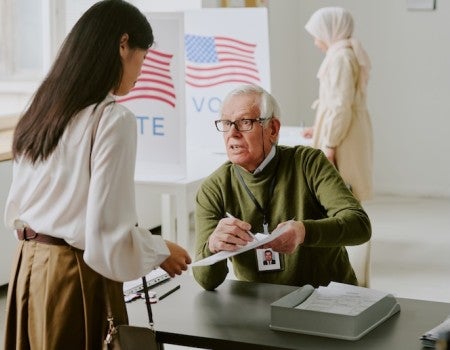
As early voting begins, new Rice research sheds light on why some members of one of Houston’s fastest-growing populations say they remain underreprese...

Nameless Sound musicians performed an original score on Nanibah Chacon’s interactive installation following Danza Azteca Macuilxochitl's activation of...

Rice’s James Tour recently published an improved method to recover antimony from this electronic waste stream. ...

Three Rice faculty members from the Department of Earth, Environmental and Planetary Sciences have recently been honored with career awards, showcasin...

The Adventurous Electric Guitar Festival gathered players, composers and scholars to test the instrument’s next act....
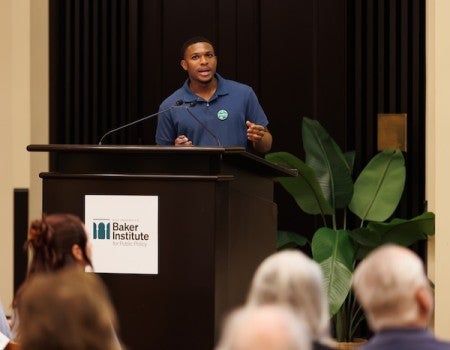
The Science and Technology Policy Program at Rice’s Baker Institute for Public Policy hosted a “science cafe” Oct. 13 to bring research to reality and...
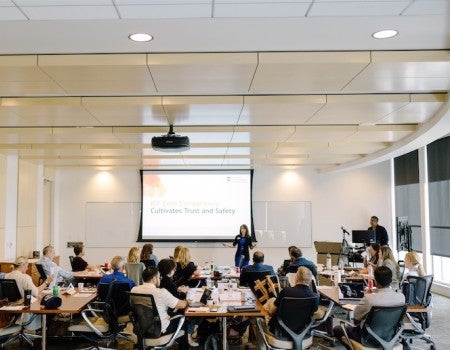
The Doerr Institute for New Leaders at Rice has launched CoachRICE: Team Coaching, a new professional education program designed to help coaches, mana...
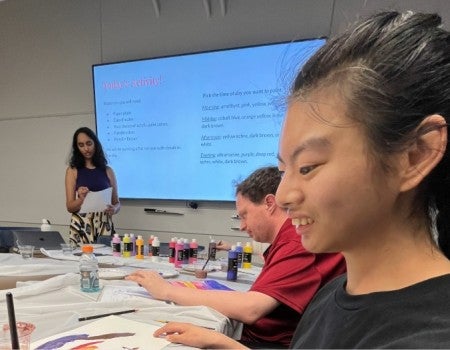
Graduate student Sayuri Jayawardena has started a Rice chapter of Lifelong Learning with Friends. ...
Parking fees reduced for 2020-21; new options available
With Rice's on-campus population expected to be half its usual size this academic year, the university is reducing parking fees and offering new options.

‘This time is different’: Experts reimagine the police force
Sending law enforcement officers into situations beyond their expertise – and asking them to do jobs more appropriate to other professions – contributes significantly to overpolicing in America, according to experts in a panel discussion hosted by Rice’s Baker Institute for Public Policy.
'States of Mind' fall exhibition at Moody Center scrutinizes American democracy through art
Events will include socially distanced opening receptions, outdoor film screenings and virtual conversations with artists.

President, provost set faculty and staff town hall for Aug. 3
President David Leebron and Provost Reginald DesRoches will host a virtual town hall for Rice faculty and staff regarding the university's plans for the fall semester at 4 p.m. Aug. 3.

Rice football game against national champ Louisiana State canceled
Rice's Sept. 19 football game against defending national champion Louisiana State University at Houston's NRG Stadium has been canceled following the Southeastern Conference's decision to play only conference games this season amid the COVID-19 pandemic.

Acclaimed author Bryan Washington appointed Scholar-in-Residence for Racial Justice at Rice
Washington will be the first to occupy an 'important and necessary' position at the university.

7 selected for Rice alumni board; president and president-elect announced
Seven alumni have been selected to serve on the Association of Rice Alumni (ARA) Board of Directors: Estevan Delgado ’13; Carol Der Garry ’83, ’85; Sten Gustafson ’89; Milinda McNeely ’79; Priya Prasad ’08; Shawn E. Simmons '99; and Mike Yuen ’89. They began their three-year terms July 1, when Bryan Guido Hassin ’01, ’02 became president of the ARA and Monique Shankle '86 became president-elect.

To help hard-hit nonprofits, first fix existing relief programs, Rice expert says
HOUSTON – (July 29, 2020) – Nonprofits are struggling to survive during the pandemic’s economic downturn.

It pays to major in fields with close ties to jobs, study shows
HOUSTON – (July 29, 2020) – College graduates make more money if they major in fields with close ties to jobs, according to a new study from the Houston Education Research Consortium (HERC), part of Rice University's Kinder Institute for Urban Research and School of Social Sciences.

Rice researchers helping to ready vote-by-mail system for November
Rice University researchers have won a federal grant to validate and improve VotingWorks' open-source vote-by-mail technology in time for November's election.