
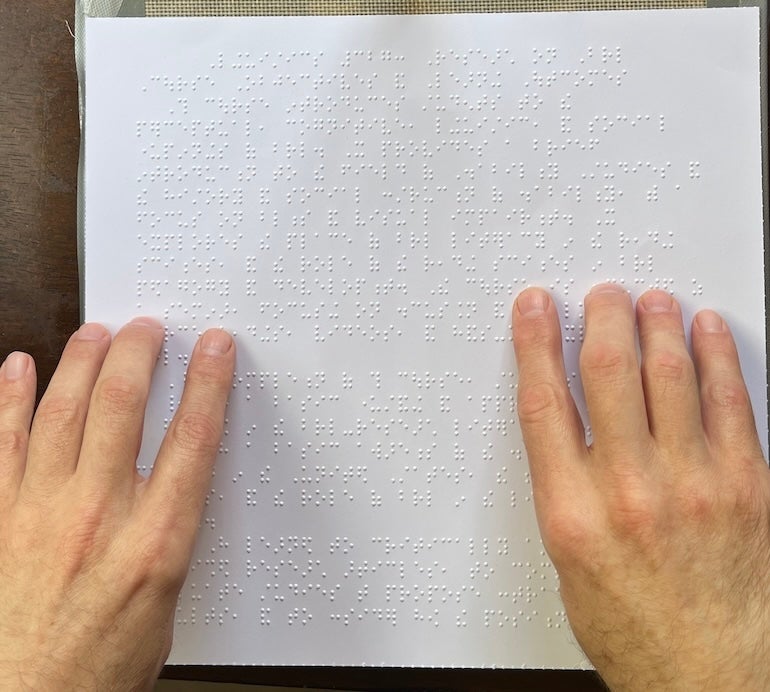
For many people, braille is something they encounter only on elevator buttons or public signs. Others assume advances in audiobooks and screen readers have largely replaced the need for braille.
Rice University researchers Simon Fischer-Baum and Robert Englebretson say those assumptions miss a fundamental truth.
Braille is literacy.
As schools across the country increasingly embrace evidence-based approaches to reading instruction through the science of reading, the two researchers are leading an effort to ensure students who learn through braille are not left out of the research shaping literacy education.
Englebretson, associate professor of linguistics, a researcher and braille reader, believes that message is long overdue.
“Braille is literacy,” he said. “For many of us who are blind and visually impaired, braille is literacy.”
To help close that gap Englebretson, Fischer-Baum, associate professor of psychological sciences, director of Rice’s T.L.L. Temple Foundation Neuroplasticity Lab and co-director of the Brain and Society Initiative in the Rice Brain Institute, and longtime collaborator Cay Holbrook, professor emerita of special education at the University of British Columbia, are working to build a stronger scientific foundation for braille literacy instruction and ensuring future reading policies reflect the needs of all students who access literacy through braille.
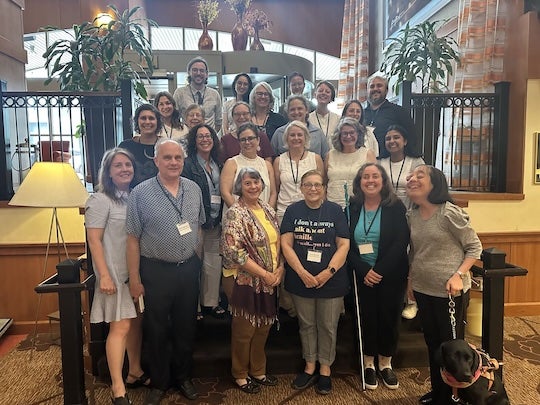
That effort recently culminated in a workshop held near the University of Pittsburgh, where several collaborators are based. Organized as part of the team’s Institute of Education Sciences grant, Exploring the Knowledge, Skills, and Strategies Teachers of Students with Visual Impairments Need to Effectively Teach braille Reading and Writing (R324A190093), the workshop brought together 23 researchers, educators and accessibility leaders from across the United States, Canada and Australia.
Supported by the Institute of Education Sciences with additional support from Rice’s School of Social Sciences and the Center for the Neural Basis of Cognition at the University of Pittsburgh, the meeting united neuroscientists, cognitive scientists, linguists, teacher educators, classroom teachers of students with visual impairments, curriculum developers and leaders from organizations serving blind and visually impaired communities, including the American Printing House for the Blind and state schools for the blind in California and Texas.
Rather than presenting research within individual disciplines, the workshop was designed to break down long-standing silos.
“This is not a conference from the perspective of neuroscience or cognitive science or linguistics or education,” Englebretson said. “This is a conference that brings together all of these people from different backgrounds.”

For both Englebretson and Fischer-Baum, bringing those perspectives together fundamentally changed how their research approaches braille.
For years, much of the field viewed braille primarily through the lens of print. The workshop challenged that assumption.
“We changed our questions,” he said. “Instead of studying braille in comparison to print, we began studying braille for itself.”
That shift represents more than a change in research methods. It changes how scientists think about literacy.
For decades, braille has often been treated simply as a code for printed text. Englebretson, Holbrook and Fischer-Baum argue it should instead be understood as its own writing system, one that deserves to be studied on its own terms.
That perspective also reflects braille’s remarkable complexity. Rather than a single universal code, braille encompasses writing systems for more than 140 languages, along with specialized systems for mathematics, science, music, chess, knitting, origami and other forms of communication. Like print, braille represents spoken language, adapting to the structure of each language it serves.
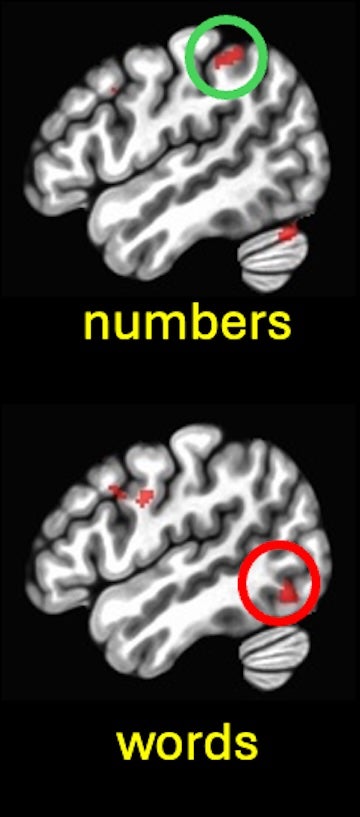
Viewing braille as a writing system rather than a code for print opens entirely new questions about how people learn to read through touch, how the brain adapts to different writing systems and how literacy instruction should be designed for students who are blind or visually impaired.
Those questions have become increasingly urgent as states adopt legislation based on the science of reading, an approach grounded in decades of research on how children learn to read. While the movement emphasizes evidence-based instruction, much of the research informing those policies focused on sighted children, leaving teachers of students with visual impairments with little guidance about how those practices apply to braille readers.
The research also challenges another common misconception: that advances in assistive technology have made braille less important. While screen readers and text-to-speech tools provide important access to information, researchers say they do not replace literacy any more than audiobooks replace learning to read for sighted children.
“There has been a real interest in having policy supported by research about how kids learn to read,” Fischer-Baum said. "One thing that’s clear is that the body of knowledge that’s supposed to make up the science of reading includes essentially nothing about how blind kids read.”
The consequences extend beyond research.
Without evidence designed specifically for braille learners, students can be misunderstood in the classroom. Some are identified as needing remedial instruction not because they are struggling with literacy, but because the assessments and benchmarks used to evaluate them were never developed with braille readers in mind.
The workshop was designed to help change that.
By the end of the meeting, participants had moved beyond identifying gaps in the research and begun building a roadmap for the future. Together, they established a shared set of braille-centered research priorities and began collaborating on a paper that will provide evidence-based recommendations for teachers navigating today’s literacy policies.
The paper will help educators understand where strong evidence already exists, where important questions remain and what new research is needed to better support braille learners. At the same time, participants laid the groundwork for a broader collaborative research agenda they hope will shape the future of braille literacy.
The discussions also highlighted questions extending well beyond childhood education.
Researchers emphasized the need to better understand how people who lose their vision later in life learn braille, an area that has received relatively little scientific attention. Studying literacy across the lifespan offers new opportunities to better understand neuroplasticity, the brain’s remarkable ability to reorganize and adapt, while improving educational practices for children and adults alike.
For Fischer-Baum, that’s where the collaboration is at its best.
“We care about science because it’s helpful for the world,” he said. “But we also care about science because we’re deeply interested in understanding the world.”
The workshop marked the beginning of a new collaborative effort to answer fundamental questions about how people learn through braille and how that knowledge can improve literacy instruction for future generations.
For Englebretson, the workshop’s most important takeaway extends beyond neuroscience, education policy or linguistics.
It’s about literacy.
“Braille is alive and well,” he said. “It is central to the literacy of those of us who use it and will continue to be for blind and visually impaired children and many people as they lose their vision throughout their lifespan.”