

Over 70 million people in the U.S. are impacted by hearing loss and age-related hearing loss is the second most common health problem in older adults, according to the Advanced Research Projects Agency for Health. However, scientists still do not fully understand how the cochlea ⎯ a delicate, spiral-shaped cavity in the inner ear lined with thousands of specialized sensory cells ⎯ performs the signal processing needed to separate meaningful sounds from background noise.

Filling that knowledge gap could shed light on what happens as hearing deteriorates with age and make possible better assistive technologies for people with hearing loss. A study published in Proceedings of the National Academy of Sciences Nexus by Rice University researchers presents a step in the right direction ⎯ a new way to model how the cochlea processes incoming sound using graph signal processing.
Traditionally, in order to study how the cochlea works, researchers have used classical signal processing, which involves mapping the overall cochlear response onto a uniform grid of points, where each point isolates and tracks the distinct responses of individual sensory cells. In contrast, Rice researchers’ GSP-based method replaces this uniform grid with a graph structured around the cochlea’s natural spiral layout.
“Classical signal processing is typically built for regular domains like lines and grids,” said Santiago Segarra, W. M. Rice Trustee Associate Professor of Electrical and Computer Engineering at Rice and a study co-author. “Graph signal processing lets us move beyond that assumption and study data supported on irregular networks, which is often a better match for biological systems.”
The idea for the research emerged as Segarra explained GSP theory to Rice bioengineer Robert Raphael during a brainstorming session.
“My intuition was practically screaming at me, ‘this is the way the cochlea works,’” said Raphael, an associate professor in Rice’s Department of Bioengineering and a study co-author.
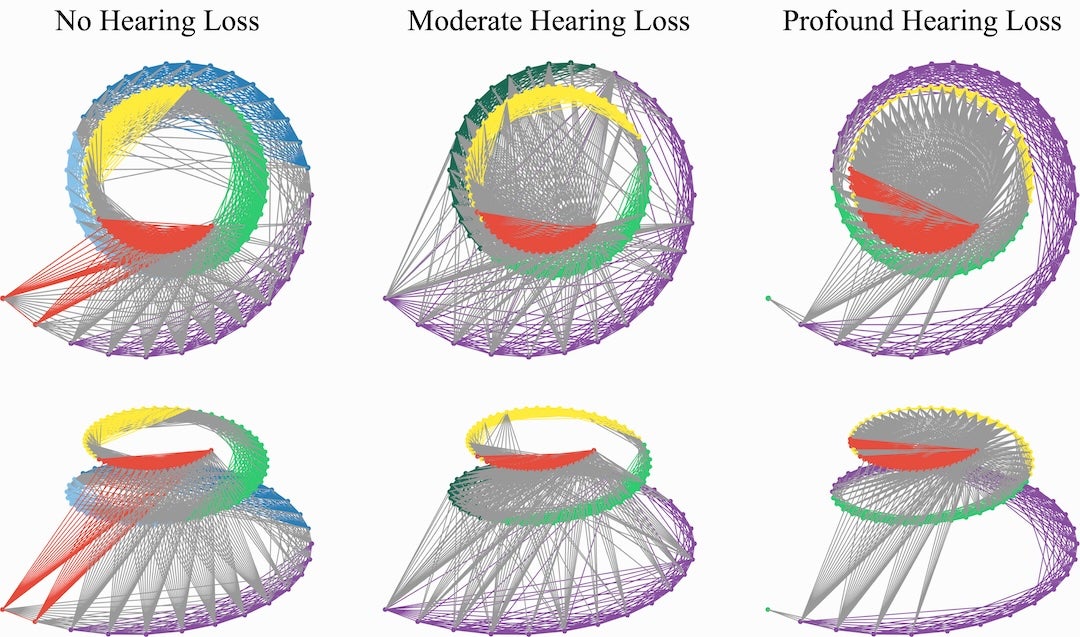
A graph, in the mathematical sense, is a collection of nodes connected by links. Graph-based methods have become increasingly influential in neuroscience, since the brain can be described as a network whose function depends not only on individual neurons (nodes), but also on patterns of connectivity (links).
Similarly, a graph-based modeling framework treats the cochlea as a network. To make the idea a reality, Melia Bonomo, then a postdoc in the Raphael laboratory, simulated the response of thousands of cochlear hair cells mapped onto a three-dimensional reconstruction of the human cochlea.
“Our framework provides a tool to study the overarching functional relationships between sensory cells, which is not possible using classical signal processing,” said Bonomo, who is now a lecturer in the Department of Physics and Astronomy at Rice.

Using advanced math and machine learning, the team was able to identify broader functional relationships connecting nodes across the spiral structure into modules. Together, the different modules form a mesh-like network. Testing revealed the mesh network model of the cochlea, called GSP Cochlea, performed better across different measures of information processing ⎯ such as detecting signals in noise ⎯ than other models.
“One of the extraordinary things the cochlea needs to do is separate signals from noise,” Raphael said. “When the model showed GSP is a superior method of signal detection, that led me to believe that GSP is more than a powerful tool: It could very well be that this is what the cochlea evolved to do.”
In other words, the research suggests that the cochlea plays a role in structuring sound information in a network-like fashion before it reaches the brain.
GSP Cochlea makes it easier to study human sound perception holistically by distilling responses to multiple auditory stimuli into a single visualization.
It also opens up a new way to think about hearing loss: The team generated cochlear graphs using hearing-loss data from more than 200 patients and found that worsening hearing loss was associated with a breakdown in network organization rather than just reduced sensitivity to particular sound frequencies.
“Hearing aids are tuned based on a patients’ audiogram, the standard clinical measure for hearing loss,” Raphael said. “Currently, what a hearing aid does is it amplifies the frequencies that the audiogram flags as deficient. However, that does not take into account that the modularity of the system has changed.”

This suggests GSP Cochlea can be applied to develop personalized device settings for hearing aids and cochlear implants.
Raphael is eager to apply the approach to higher levels in the auditory pathway, especially the auditory cortex.
“This work marks a paradigm shift in how we think about auditory processing,” Raphael said. “It opens up new avenues for research on the neural underpinnings of perception and it could eventually impact how we build auditory brain-computer interfaces.”
The research was supported by the U.S. National Library of Medicine (T15LM007093) and Rice University.
- Peer-reviewed paper:
-
GSP Cochlea: A graph signal processing approach for studying sound encoding | Proceedings of the National Academy of Sciences Nexus | DOI: 10.1093/pnasnexus/pgag134
Authors: Melia Bonomo, Santiago Segarra and Robert Raphael
https://doi.org/10.1093/pnasnexus/pgag134