


Rice University’s Susanne M. Glasscock School of Continuing Studies has announced Kristen Schlatre as its new assistant dean for professional and corporate programs.
Nameless Sound musicians performed an original score on Nanibah Chacon’s interactive installation following Danza Azteca Macuilxochitl's activation of...
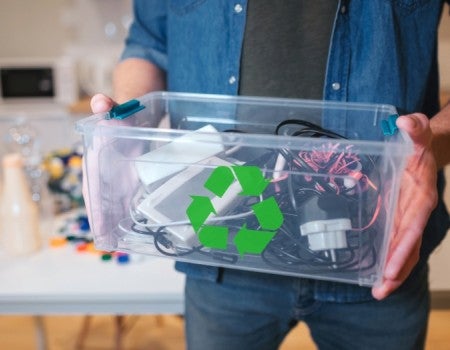
Rice’s James Tour recently published an improved method to recover antimony from this electronic waste stream. ...

Three Rice faculty members from the Department of Earth, Environmental and Planetary Sciences have recently been honored with career awards, showcasin...

The Adventurous Electric Guitar Festival gathered players, composers and scholars to test the instrument’s next act....
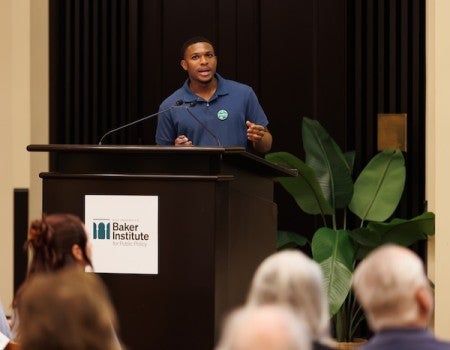
The Science and Technology Policy Program at Rice’s Baker Institute for Public Policy hosted a “science cafe” Oct. 13 to bring research to reality and...

The Doerr Institute for New Leaders at Rice has launched CoachRICE: Team Coaching, a new professional education program designed to help coaches, mana...
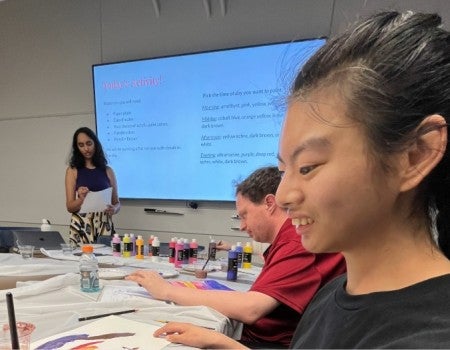
Graduate student Sayuri Jayawardena has started a Rice chapter of Lifelong Learning with Friends. ...
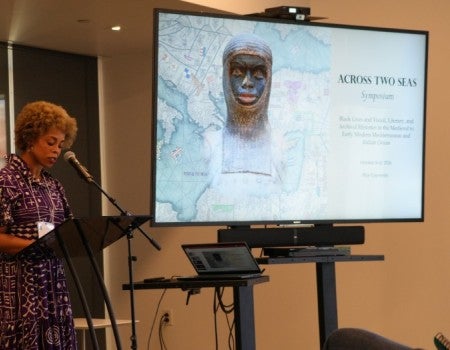
Scholars, curators and filmmaker Daphne Di Cinto gather at Rice to explore Black histories from Renaissance Italy to medieval Africa and Islamic world...
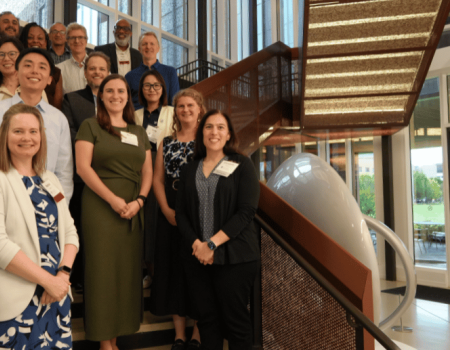
For the sixth fall in a row, Rice welcomed a new group of researchers to STaRT@Rice, giving emerging researchers both the skills and the support to gr...

Rice and the Houston Methodist Research Institute have signed a memorandum of understanding with LSE Health at the London School of Economics and Poli...

As the 2026-27 Aleko Endowed Artist, Julia Bullock curated an evening of song, chamber music and poetry celebrating the Harlem Renaissance....

Rice’s Yonglong Xie is one of 20 early-career scientists, mathematicians and engineers to receive a 2026 Packard Fellowship. ...
Rice University’s Susanne M. Glasscock School of Continuing Studies has announced Kristen Schlatre as its new assistant dean for professional and corporate programs.

NeuWS camera answers ‘holy grail problem’ in optical imaging
Engineers from Rice and the University of Maryland have created technology that could allow cameras to "see" through fog, smoke, driving rain, murky water, skin, muscle and other light-scattering obstructions.
Electrochemical device captures carbon dioxide at the flick of a switch
New carbon capture technology developed by Rice University engineers can generate a continuous, high-purity carbon dioxide stream from diluted, or low-concentration, gas streams using only electricity and a water-and-oxygen-based reaction.

New enzyme could aid anticancer drug development
Retracing nature’s steps, Rice University engineer Xue Gao and her team mapped out the full series of enzyme-powered reactions a marine fungus uses to produce a complex molecule with anticancer properties. In the process, the Gao lab uncovered the first fungal enzyme of its kind known to break an amide bond.

People, papers and presentations for June 26, 2023
Fred Oswald, the Herbert S. Autrey Professor of Psychology in Rice University’s School of Social Sciences, is a member of The National Artificial Intelligence Advisory Committee.

Rice caps off monthlong festivities at annual Pride parade
Dozens of members of the Rice community hit the streets of downtown Houston June 24 to walk in the city’s 45th annual LGBTQ+ Pride parade.

Juneteenth events examine Black leadership and ideas central to the holiday
Rice honored Juneteenth with a discussion series on June 15 to discuss issues of race, racism and injustice. Author Annette Gordon-Reed joined audiences June 20 to discuss her book “On Juneteenth,” which recounts the holiday’s origins and the complex history of Black Texans before, during and after the rise of chattel slavery in the state.

Houston high-schoolers get environmental boot camp
Rice University’s Center for Environmental Studies, in partnership with the Houston Climate Justice Museum, hosted students from the Houston Independent School District the week of June 12 as part of a summer program focused on Houston environmental justice.

The Russian invasion of Ukraine has brought renewed focus on the use of energy resources as geopolitical “weapons.” But the respective experiences for oil and natural gas in the past year — Russia’s two main energy exports and the leading energy sources for Europe and the U.S. — provide strategic lessons for policymakers, according to a new report from Rice University’s Baker Institute for Public Policy.

Study finds human impact on wildlife even in protected areas
The largest long-term standardized camera-trap survey to date finds that human activity impacts tropical mammals living in protected areas and sheds light on how different species are affected based on their habitat needs and anthropogenic stressors.