
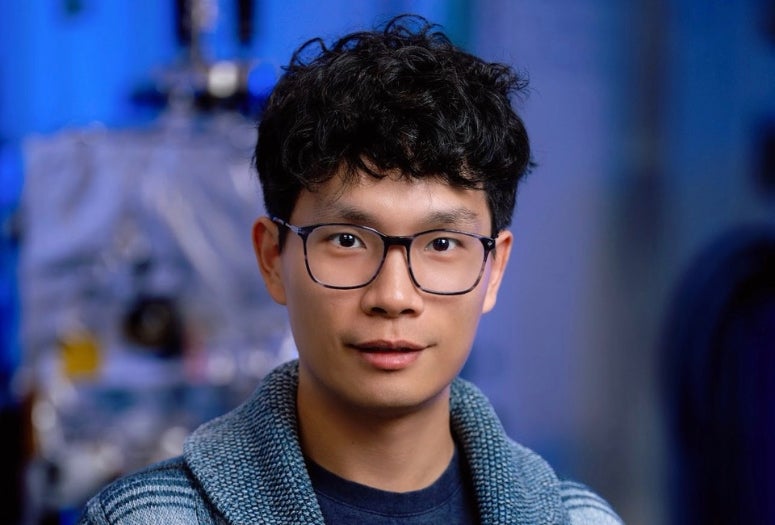
Rice University’s Yonglong Xie, an assistant professor in physics and astronomy, is one of 20 early-career scientists, mathematicians and engineers to receive a 2026 Packard Fellowship. Xie will use this award to develop new microscopy tools to reveal how matter is transformed by the quantum vacuum.
Xie’s lab studies the electronic properties of materials that are only an atom or a few atoms thick. The team uses Scotch tape to prepare these atomically thin materials, then measures their electronic properties using custom-built scanning probe microscopes that read signals with a tiny needle carrying a sensor at its apex.
“The Packard Fellowship is an investment in people, which is part of why it felt so unbelievable to hear I had received it,” Xie said. “I have spent years developing and applying microscopy techniques to uncover new phenomena in stacks of atomically thin materials. Combining these techniques with cavity is a new direction for my lab. Can we use it to create new quantum properties? That’s the really exciting but risky question this funding will enable.”
The Packard award of $985,834, distributed over five years, will be used to expand his work in a new direction. His team will place these two-dimensional materials in a cavity — a tiny structure that confines and concentrates the vacuum’s electromagnetic fluctuations. They will then seek to understand if tailored fluctuations can create quantum phenomena that do not otherwise exist.
“I’m thrilled to see Yonglong recognized for his incredible work, and I look forward to seeing what he will accomplish with the support of the Packard Fellowship,” said Amy Ditmar, the Howard R. Hughes Provost and executive vice president for academic affairs. “The Packard Fellowship can be transformative for early-career faculty, allowing them to take risks and push the boundaries of our understanding.”
“I am delighted that Yonglong’s work has been recognized with this distinguished award. His pioneering research has already revealed how materials can be designed and manipulated to give rise to surprising and useful properties,” said Thomas Killian, dean of the Wiess School of Natural Sciences. “The resources from Packard will allow him to pursue new directions that hold promise for exciting applications related to computing and environmental sensing.”\
Xie has previously received a National Science Foundation CAREER Award, an ORAU Ralph E. Powe Junior Faculty Enhancement Award and the 2D Materials Young Scientist Award from IOP Publishing. He was also named to MIT Technology Review’s Innovators Under 35 list and a Scialog Fellow for Quantum Matter and Information from RCSA.
“Yonglong’s proposed research on cavity-coupled two-dimensional materials offers an exciting path to understanding and controlling quantum matter through light-matter interactions,” said Junichiro Kono, the director of Rice’s Smalley-Curl Institute. “He combines scientific creativity, technical ingenuity, careful judgment and persistence — all the qualities that outstanding experimentalists need. He is a rising star in quantum materials research, earning growing recognition and respect from the scientific community. I am proud to have him as a colleague, and Rice is fortunate to have such an exceptional talent.”
Xie credits conversations with colleagues in the Department of Physics and Astronomy and at the Smalley-Curl Institute, in particular with Kono, with both the inspiration for this new direction and the encouragement to pursue it.
Since 1988, the Packard Fellowships for Science and Engineering have supported transformative work by providing unrestricted funds, giving fellows the freedom to follow the science wherever it leads. Each year, the foundation invites 50 universities to nominate two faculty members for consideration. The Packard Fellowships Advisory Panel, a group of 12 internationally recognized scientists and engineers, evaluates the nominations and recommends fellows for approval by the Packard Foundation Board of Trustees.
Previous Rice Packward Fellows include Thomas C. Killian, physics, 2002; Douglas Natelson, physics, 2003; Cin-Ty Lee, geosciences, 2005; Rajdeep Dasgupta, geosciences, 2010; Matthew Robert Jones, chemistry, 2018; Haotian Wang, chemistry, 2020; Jerzy Szablowski, engineering-chemical or biological, 2021.