
Rice University and the Houston Methodist Research Institute have signed a memorandum of understanding with LSE Health at the London School of Economics and Political Science (LSE) to explore collaboration on an interdisciplinary training program for future global health care leaders.
The proposed Global Digital Health Scholars Program would be led by the Digital Health Institute, a joint initiative of Houston Methodist and Rice University launched in 2024. Scholars would receive joint mentorship from DHI and LSE Health faculty while working to develop digital health solutions that make care more affordable and accessible, particularly in underserved communities.
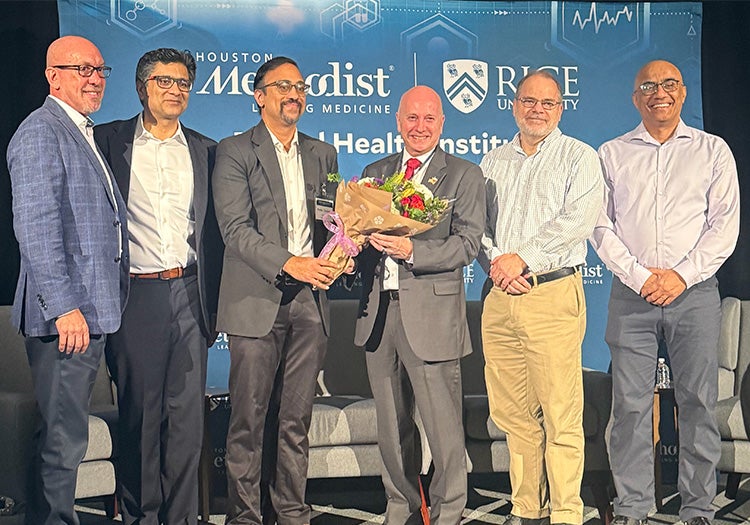
Richard Shackleton, MBE, the British Consul General in Houston, announced the planned collaboration during the Digital Health Institute symposium before a diverse audience of researchers, clinicians, academics and industry representatives.
The core goals of the Global Digital Health Scholars Program are to
- Build a talent pipeline to recruit and support exceptional postdoctoral and early-career scholars pursuing clinical and/or engineering-track degrees with a health policy component
- Advance technological innovation for cost-efficient care
- Focus on underserved populations
- Ensure global relevance and scalability
The collaboration plan envisions supporting one or two scholars annually to serve multiyear appointments embedded in, or leading, high-impact digital health projects focused on translation and innovation informed by real-world evidence platforms and potential for scalable impact.
“We have no shortage of brilliant engineers, and no shortage of brilliant physicians,” said Khurram Nasir, the William A. Zoghbi Centennial Chair in Cardiovascular Health, chief of cardiovascular disease prevention at Houston Methodist DeBakey Heart & Vascular Center and DHI co-director. “We have very few people who can sit with a physician, an engineer and a health economist and be genuinely fluent in all three rooms. What will make the difference are people who can work across those disciplines. In digital health, the greatest breakthroughs happen when different perspectives come together. This program will train people to bridge those worlds and bring ideas into practice.”
Areas of technical focus include artificial intelligence, digital diagnostics, remote care, wearables and predictive analytics. Projects would be selected based on their ability to reduce healthcare costs, eliminate inefficiencies, promote early disease detection and optimize care delivery, with a particular focus on under-resourced environments and historically underserved populations.
“Who benefits from advances in medical technology depends on how health systems put those innovations into practice,” said Elias Mossialos, the Cheng Yu Tung Chair in Global Health and director of LSE Health. “Our vision is to help scholars connect the development of digital tools with the policy expertise needed to guide their use.”
Scholars would cultivate expertise at the intersection of data science, clinical care and innovation, in collaboration with Rice, LSE and Houston Methodist faculty and practitioners, as well as industry, government and community stakeholders.
“Having a global impact is part of Rice’s strategic plan, and global impact means we need global partners,” said Ashutosh Sabharwal, Rice’s Ernest D. Butcher Professor of Engineering, a professor of electrical and computer engineering and computer science, and DHI co-director. “Over the past five years, our global footprint has grown significantly. This new partnership with LSE aligns perfectly with that momentum, and all three institutions bring together complementary strengths that will enable the DHI to carry out its mission to its fullest potential.”