


Owls shine at Tom Tellez Invitational
The Rice women’s track and field team took home multiple event titles and top finishes at the Tom Tellez Invitational at the University of Houston this past weekend.
Nameless Sound musicians performed an original score on Nanibah Chacon’s interactive installation following Danza Azteca Macuilxochitl's activation of...

Rice’s James Tour recently published an improved method to recover antimony from this electronic waste stream. ...

Three Rice faculty members from the Department of Earth, Environmental and Planetary Sciences have recently been honored with career awards, showcasin...

The Adventurous Electric Guitar Festival gathered players, composers and scholars to test the instrument’s next act....
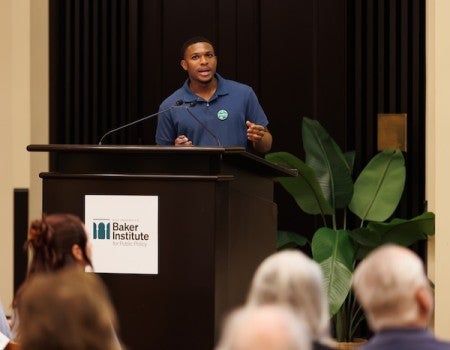
The Science and Technology Policy Program at Rice’s Baker Institute for Public Policy hosted a “science cafe” Oct. 13 to bring research to reality and...

The Doerr Institute for New Leaders at Rice has launched CoachRICE: Team Coaching, a new professional education program designed to help coaches, mana...
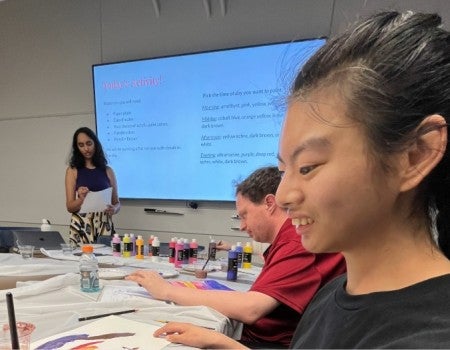
Graduate student Sayuri Jayawardena has started a Rice chapter of Lifelong Learning with Friends. ...
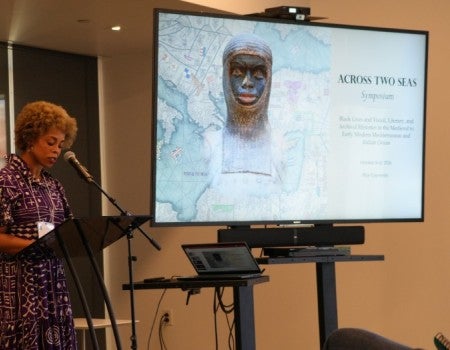
Scholars, curators and filmmaker Daphne Di Cinto gather at Rice to explore Black histories from Renaissance Italy to medieval Africa and Islamic world...
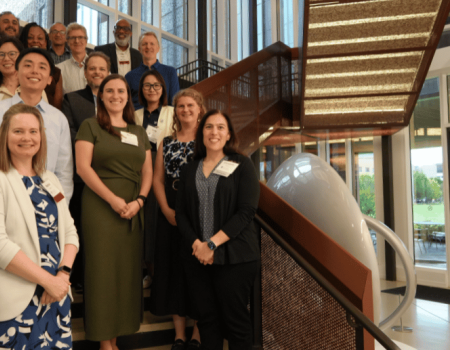
For the sixth fall in a row, Rice welcomed a new group of researchers to STaRT@Rice, giving emerging researchers both the skills and the support to gr...
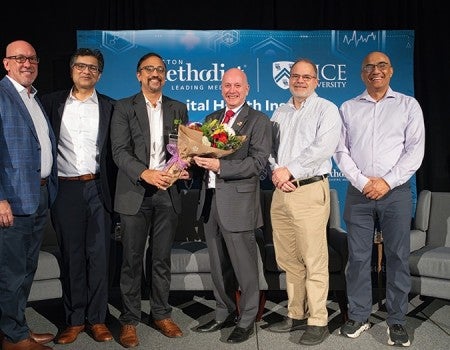
Rice and the Houston Methodist Research Institute have signed a memorandum of understanding with LSE Health at the London School of Economics and Poli...

As the 2026-27 Aleko Endowed Artist, Julia Bullock curated an evening of song, chamber music and poetry celebrating the Harlem Renaissance....

Rice’s Yonglong Xie is one of 20 early-career scientists, mathematicians and engineers to receive a 2026 Packard Fellowship. ...
Owls shine at Tom Tellez Invitational
The Rice women’s track and field team took home multiple event titles and top finishes at the Tom Tellez Invitational at the University of Houston this past weekend.
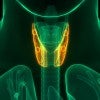
Rice U. students design congenital hypothyroidism test for newborns
A team of Rice University students developed a low-cost, point-of-care screening tool that can diagnose congenital hypothyroidism in low-resource areas.
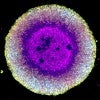
Experimental model gets cells to behave as they would in utero
Rice U.’s Aryeh Warmflash wins $1.9 million NIH grant to develop experimental cell models that can shed light on critical embryonic developmental processes.
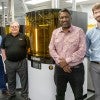
Rice’s Office of Innovation partners with Carbon and TyRex Group
Rice’s Office of Innovation is partnering with two companies to make additive manufacturing equipment and expertise an integral part of its initiative to provide campuswide access to prototyping and design facilities.
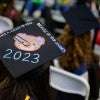
Rice’s Class of 2023 heralded as ‘empathetic team players with superpowers to change the world’
Across two days of joyful tears, stirring speeches, embraces and exultation, Rice University’s 2023 graduates celebrated the end of one chapter in their lives inside the hedges and the thrilling possibilities that lay before them in the chapters beyond.

Rice Business graduates another class of MBAs
The Jones Graduate School of Business held its commencement ceremony for Master of Business Administration (MBA) degree recipients May 5 at Rice Stadium.
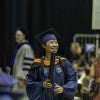
More than 800 Rice students graduate with advanced degrees
Hats off to another outstanding group of Rice University graduates!

Rice honors late Kamryn Sanamo with posthumous degree
Amid the celebration at Rice University’s 110th commencement ceremony on May 6, there was one unforgettable moment that stood out to everyone in attendance: when President Reginald DesRoches asked for a moment of silence before offering Rice’s first-ever posthumous degree to the family of Kamryn Sanamo.

Rice U. confers doctoral degrees to more than 250 students
More than 250 Rice University students were recognized during a doctoral commencement ceremony at Tudor Fieldhouse the morning of May 6. They join the more than 7,600 alumni who have earned a doctoral degree at Rice.

Duncan, Spiegel honored at Rice360 awards breakfast
The Rice360 Institute for Global Health Technologies presented its 2023 Global Champion Award to philanthropist Jan Duncan and its 2023 Alumni Leadership Award to physician Elizabeth Spiegel ’11 at its graduate recognition and awards breakfast May 5.