Rice has released two new editions of its flagship publications — Rice Magazine and R3: Rice Research Review — offering readers a look at the university’s rapidly growing global presence and research efforts aligned with major societal challenges and opportunities.
Rice and Lehigh University have announced the launch of the Consortium for Enhancing Resilience and Catastrophe Modeling, a research initiative designed to advance catastrophe risk modeling and resilience assessment.
“Impluvium Redux,” an innovative architectural structure designed by Juan José Castellón of Rice’s School of Architecture, has been short-listed for the 2025 European Cultural Centre (ECC) Awards in the University Project category.
Rice sociologist investigating how features of the built environment — like dead-end streets, highways, fences and railroad tracks — shape patterns of neighborhood separation and access to opportunity across U.S. cities.
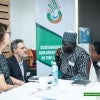
Rice is fostering sustainable water and energy solutions by convening leaders across industry, policy and research to confront one of the most pressing challenges of our time: water scarcity and resilience.
For decades, researchers believed that Homo habilis — the earliest known species in our genus — marked the moment humans rose from prey to predators, but new findings from a team led by a Rice anthropologist challenge that view.
Researchers led by Rice’s Yong Lin Kong have developed a soft but strong metamaterial that can be controlled remotely to rapidly transform its size and shape.
Rice's César A. Uribe is developing computational tools to help scientists better understand ecosystems with recent studies using AI to glean new insights from different kinds of ecological data — from African mammal food webs to tropical forest soundscapes.
New research using NASA’s Perseverance rover has uncovered strong evidence that Mars’ Jezero Crater experienced multiple episodes of fluid activity — each with conditions that could have supported life.
With the 2025–26 academic year underway, Rice is taking bold steps to harness the transformative potential of artificial intelligence in teaching, research and operations. Guided by Momentous, the university’s 10-year strategic plan, Rice is positioning itself as a global leader in the responsible development and application of AI, computing and other disruptive technologies.
Rice Real Estate Co., in partnership with Lincoln Property Co., has unveiled plans to develop a landmark research, laboratory and office building designed to catalyze world-class innovation and enterprise in Houston.
The Ken Kennedy Institute at Rice will host the fourth annual AI in Health Conference this month, aiming to forge interdisciplinary, cross-institutional collaborations and showcase innovative AI advancements for health research, medicine and data-driven technology.