
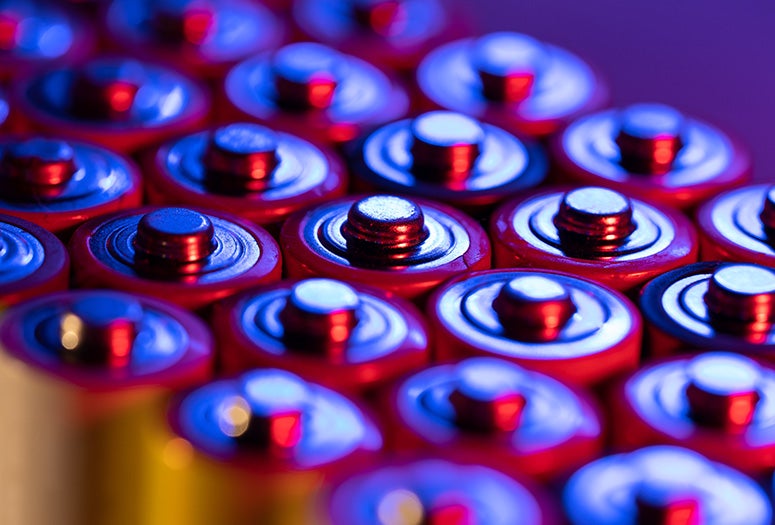
Critical minerals such as those used in lithium-ion batteries come in limited supply and are concentrated in specific regions around the world. Securing a reliable supply of these materials is a priority for governments worldwide, yet most spent batteries end up in landfills, leeching toxic chemicals into the environment.
“Recycling waste batteries is the most practical solution for tackling this strained supply chain, but studies show that that happens with less than 10% of battery waste,” said Gautam Chandrasekhar, a doctoral student in the materials science and nanoengineering department at Rice University who is a first author on a study pioneering a new battery recycling method.
The researchers used a brief microwave-induced plasma treatment to recover nearly all of the valuable metals in battery waste using room-temperature, comparatively mild solvents, including citric acid. The process also regenerated graphite — the main material in a battery’s anode.
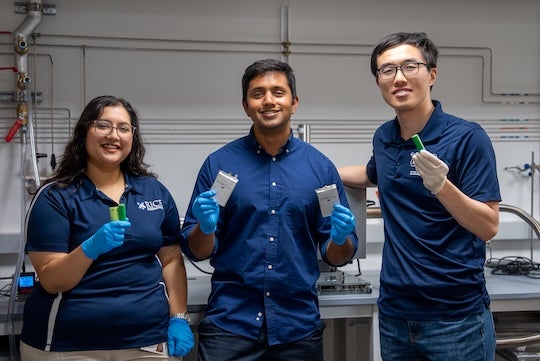
“With plasma pretreatment, almost 95% of metals, including lithium, can be recovered from battery black mass using nothing harsher than the acid found in a lemon,” said Chandrasekhar, who is part of Pulickel Ajayan’s research group at Rice.
Current recycling protocols involve shredding battery waste down to a substance known as black mass, which contains minerals such as lithium, cobalt, nickel, graphite, manganese, aluminum and more. Processing black mass for mineral extraction typically requires energy-intensive industrial processes involving high temperatures and strong acids, and recovery rates are uneven.
“Industrial battery recycling processes in use today have very low metal extraction efficiency and focus mostly on the cathode,” said Xiang Zhang, assistant research professor at Rice and a co-first author on the study.
Lithium can be particularly difficult to capture efficiently, and graphite — which makes up roughly 22% of the battery’s weight — is rarely returned to batteries because it gets damaged during conventional recycling processes.
“This is one of the most important things to note regarding battery recycling: As the single most voluminous component in lithium-ion batteries, graphite remains almost irreplaceable as anode in widespread commercial battery applications,” said Sohini Bhattacharyya, a research scientist in the Ajayan group who is a corresponding author on the study.
Bhattacharyya said the goal of the research was to develop a one-step pretreatment process for battery recycling that could be added onto existing industrial processes to improve efficiency and reduce environmental impacts while recovering “all critical materials, including graphite.”
“We hypothesized that using microwave-induced plasma to break down the metal oxide particles as a pretreatment step would make their hydrometallurgical recovery in weaker acids easier,” Bhattacharyya said.
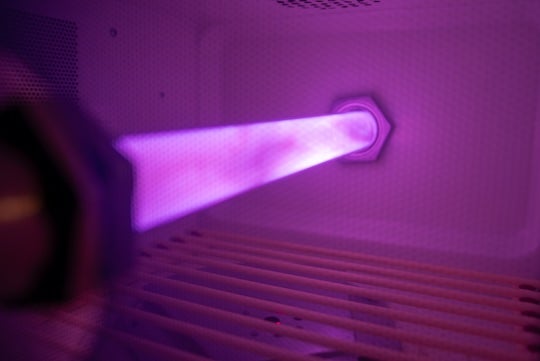
To test their hypothesis, the team used a custom microwave plasma reactor built by Zhang. After exposing black mass to microwave-induced plasma — an energized gas of charged particles — for 15 minutes, more than 90% of all metals were recovered in a citric acid bath at room temperature, while lithium was selectively recovered in water. Moreover, the treatment was found to remove residues and structural defects that accumulate on graphite during battery use.
“The recovered graphite shows excellent performance as an anode when reintroduced in a battery,” Chandrasekhar said.
The technology has been patented, and the team is moving toward commercialization. Early technoeconomic analysis suggests the process could outperform current industrial methods, particularly by recovering graphite in a form suitable for reuse in batteries.
“This is a breakthrough methodology for recovering all critical minerals from battery black mass with minimal chemical and energy usage,” said Ajayan, Rice’s Benjamin M. and Mary Greenwood Anderson Professor of Engineering and professor of materials science and nanoengineering.
- Peer-reviewed paper:
-
Plasma-Assisted Sustainable Recovery of Critical Minerals from Li-ion Battery Waste | Advanced Materials | DOI: 10.1002/adma.202515201
Authors: Gautam Chandrasekhar, Sohini Bhattacharyya, Xiang Zhang, Atin Pramanik, Maryam Amiri, Tanguy Terlier, Simon M. King, Aadit Vinoda and Pulickel M. Ajayan
https://doi.org/10.1002/adma.202515201 - Access associated media files:
-
Photos:
https://photos.app.goo.gl/e5Vtf1Cp3rZryMJC7
Credit: Photos by Jorge Vidal/Rice UniversityVideo:
https://www.youtube.com/watch?v=4j9kpYxtTXg
Video by Jorge Vidal/Rice University