
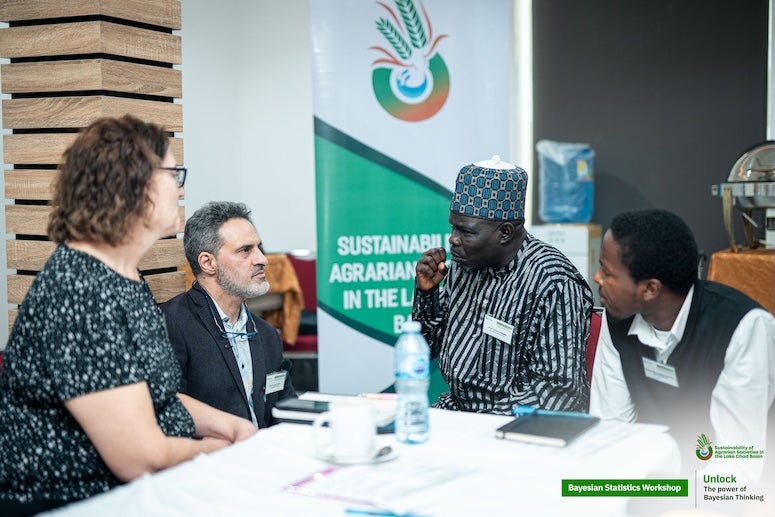
For more than a decade, Rice University’s Frederi Viens has been studying a body of water that much of the world believes is disappearing.
The work centers on Lake Chad, a vast freshwater lake in west-central Africa that borders Nigeria, Niger, Chad and Cameroon. Long portrayed as a symbol of climate collapse, Lake Chad is frequently described as having shrunk to a fraction of its former size, a claim that has shaped policy discussions, humanitarian rhetoric and media coverage for years.
But Viens’ research tells a more complicated story.
“Lake Chad did experience a dramatic contraction decades ago,” said Viens, a professor of statistics whose work combines statistical modeling, climate analysis and extensive field data collection. “What often gets lost is that the lake partially recovered and has remained relatively stable at a lower level for a sustained period. The idea that it is continuously vanishing is not supported by the data.”
Lake Chad is an endorheic lake, meaning it has no natural outlet to the sea, and it serves as a critical resource for millions of people. Its wetlands support fishing, farming and herding economies across the region, while its waters sustain one of Africa’s most productive inland fisheries. Fresh fish from Nigeria’s side of Lake Chad is often found in abundance in markets across the nation of 240 million people. Fertile plains along the lakeshore underpin agricultural livelihoods, making the lake central not only to ecosystems but to food security and economic survival. Crop farmers, sedentary livestock farmers and nomadic herders use the fertile lake bed’s millions of acres for months after each monsoon season, when the lake invariably recedes before rising again during the next monsoon.
Mischaracterizing the lake’s dynamics, Viens argues, has consequences.
“When a simplified narrative takes hold, it can distort how people understand conflict, migration and environmental risk,” he said. “If we start with the notion that the lake is simply ‘disappearing,’ we may overlook other drivers that are equally or more important than an occasional strong downturn in the lake’s extent.”
Viens’ research, nearly 15 years in the making, examines how environmental variability, resource access and social pressures intersect in northeastern Nigeria, which is heavily dependent on the Lake Chad Basin. The research focuses on the livelihoods of crop farmers, pastoralist herders and fishing communities — populations whose economic stability is deeply tied to water availability and climate patterns.
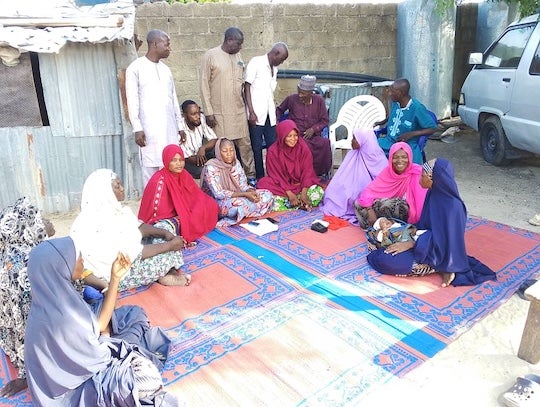
His project relies heavily on original agricultural field data, whose targeted collection and curation is otherwise missing from the region. Viens’ team, which includes Rice doctoral student Quadri Popoola, employs full-time research assistants and academic partners based in Nigeria who conduct surveys, coordinate interviews and gather local observations that are rarely captured in any datasets.
“This is an unusually data-intensive effort for a statistics-driven project,” Viens said. “We are not just analyzing existing numbers. We are building the datasets ourselves, from curating public remote-sensed observations and from gathering our own data, literally on the ground, thanks to our carefully cultivated relationships with our rural partners.”
Fieldwork in the region presents challenges that extend far beyond ordinary logistics. Parts of northeastern Nigeria remain affected by instability linked to the militant group Boko Haram, making some areas difficult or unsafe to access. In an early survey round, an entire village was inaccessible due to security concerns. As the team’s Nigerian logistics leader shared with Viens on a Zoom call in a hushed tone in May 2024: “We could not get to the village … because last week, it was overtaken by the Boko Boys,” a term locals use to describe the insurgents.
Despite these constraints, while assessing risks objectively as part of the operation’s logistics work, the team has completed multiple survey campaigns designed to capture both quantitative responses and narrative accounts. The goal is not only to measure economic conditions but to understand how rural communities perceive risk, climate variability, conflict over land resources and challenges due to water scarcity.
“We’re interested in the human dimension of environmental change,” Viens said. “Statistics allows us to identify patterns, but the lived experiences of farmers and herders provide essential context.”
One recurring theme in the data involves rainfall variability. Farmers frequently cite increasingly erratic rainy seasons, including prolonged dry spells during periods when crops traditionally depend on consistent moisture.
“In rain-fed agricultural systems, timing is everything,” Viens explained. “A six-week interruption during the growing season can be devastating for some crops.”
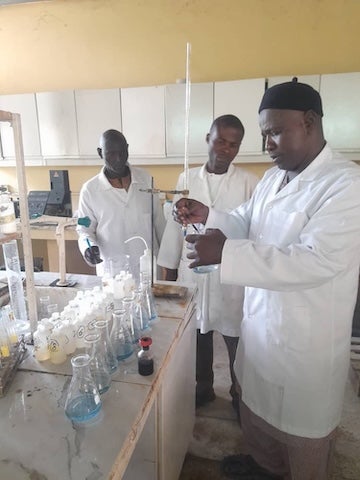
To address such concerns, the project has expanded beyond surveys to include soil sampling and environmental measurements. By analyzing soil characteristics alongside climate patterns, the team aims to generate practical insights that could help local communities adapt cropping strategies to local conditions.
“This is where statistical science becomes directly actionable,” Viens said. “We can begin translating environmental data into guidance that is meaningful on the ground.”
The research also challenges assumptions about local knowledge. Viens notes that farmers in the region often possess highly refined observational understanding of seasonal shifts developed through generations of experience in variable climates.
“People sometimes underestimate the sophistication of indigenous knowledge systems,” he said. “These communities are extraordinarily attuned to environmental signals because their survival depends on it.”
Funding for the long-running project has come from multiple sources, including the British Academy. Sustaining such work requires significant investment, particularly for field coordination and long-term data collection. Still, Viens views the effort as essential.
“The Lake Chad region is one of the most discussed and most deeply misunderstood environmental systems in the world,” he said. “Careful statistical analysis grounded in real data can help replace broad narratives with a more accurate picture of both environmental change and human resilience.”