
Amino acids are like Lego blocks — they can be linked together to form complex structures called proteins. Unlike Legos, however, there are only 20 different types of amino acids available to build a protein. Proteins depend on posttranslational modifications, or chemical changes to an amino acid that happen after the protein is built, to achieve many of their forms and functions by expanding how an amino acid can behave. Rice University chemistry professor Zachary Ball recently published a paper describing a new way to target a common but understudied posttranslational modification called pyroglutamate.
Pyroglutamate occurs when a chemical reaction makes a ring at an amino acid called glutamate, expelling a molecule of water in the process. This alteration is difficult to study because it doesn’t leave a big change in the protein, explaining why so little is known about this ubiquitous modification.
“We don’t know a lot about pyroglutamate beyond that we see it frequently,” said Ball, the corresponding author on this paper. “With this new technique, we can now start to ask questions about its distribution patterns and the roles it may play in protein folding, form and function.”
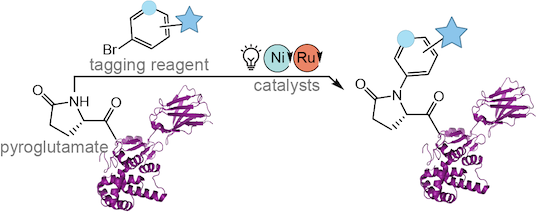
This new method, like the modification, is operationally simple. The team shines a blueish light on a mixture containing a protein, a tagging reagent and two different chemical catalysts, which work together in tandem. Under the light, one catalyst containing nickel binds to the pyroglutamate region on the protein.
“We had been experimenting with photochemistry, which is using light to initiate new reactions,” Ball said. “Light can excite molecules enough to allow them to form new bonds. In this case, shining a light with a wavelength of either 350 or 400 nanometers allows us to initiate remarkable chemistry that is otherwise impossible.”
Once the nickel compound is bound to pyroglutamate, it catalyzes attachment of a tagging reagent to the pyroglutamate. Why? Researchers don’t know quite yet, but with a little bit of blueish light, Ball and other biochemists can start to find out the answers.
This work was supported by grants from the National Science Foundation (CHE-2203948) and the Robert A. Welch Foundation (C-1680).