
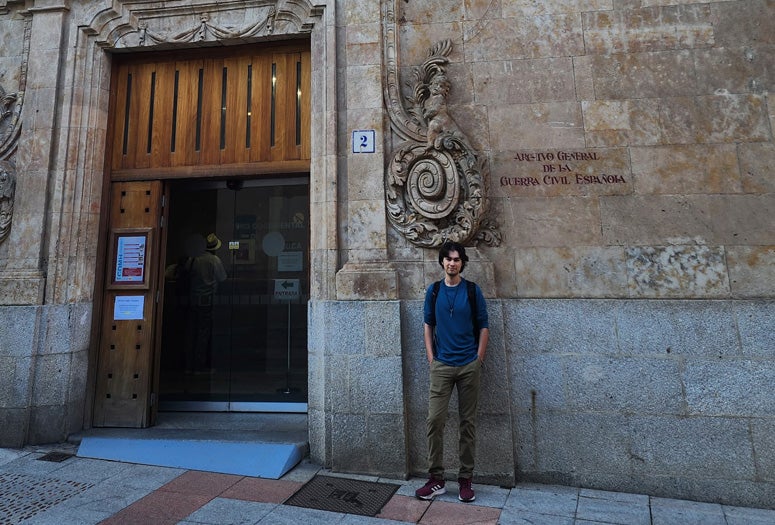
Michael Garcia came to Rice University planning to study politics. He will leave in May as a historian, having spent months in archives reconstructing the lives of agricultural workers in the Rio Grande Valley including stories that echo his own family history.
“I feel really proud that I’m here,” Garcia said. “I feel really grateful for the opportunities that I’ve had now that I am here.”
Now a senior majoring in history and business with a minor in politics, law and social thought, Garcia will present his thesis at the upcoming Humanities and Arts Festival, where students from across disciplines will showcase original research and creative work. His project examines labor in the Rio Grande Valley with a focus on agricultural workers during and after the Bracero Program.
Garcia grew up in South Texas near the U.S.-Mexico border. Encouraged by a high school counselor, he applied to Rice without expecting admission. His acceptance, Garcia said, reshaped the trajectory of his life. At Rice, he found not only a place to study history but a place to practice it.
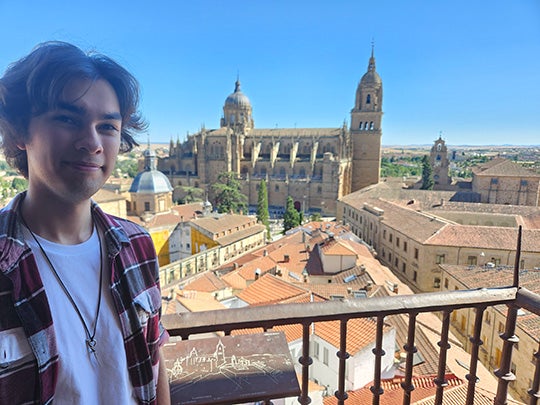
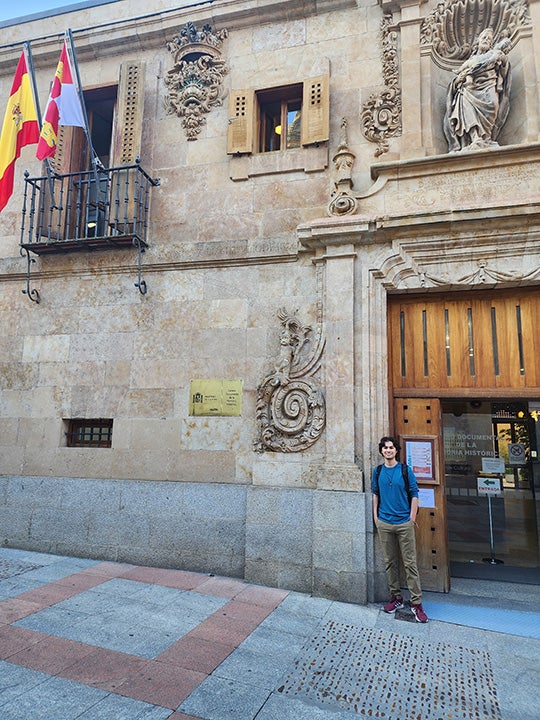
Garcia’s research journey began with the Elizabeth Lee Moody Undergraduate Research Fellowship in the Humanities and the Arts, which allowed him to travel to Spain to study Mexican volunteers in the Spanish Civil War. Working in archives, Garcia uncovered letters, hospital records and commendations that documented lives often excluded from dominant historical narratives.
“We tend to forget that this was a war happening in Spain, and yet Latin American voices are almost entirely absent from the way it’s discussed,” Garcia said.
That experience laid the foundation for his senior thesis, which brought him closer to home. Garcia turned his focus to the Rio Grande Valley, a region he said has been overlooked in broader historical conversations about Texas and the United States.
The project centers on agricultural labor during the Bracero Program, a binational agreement established in 1942 that allowed millions of Mexican men to work temporarily in the United States to address wartime labor shortages. Though the program ended in 1964, its effects on labor systems and migration patterns persisted long after. Garcia’s research examines those continuities, asking how systems of labor extended beyond the program’s official timeline and how workers navigated those realities.
“My job was to really analyze the archives,” Garcia said. “It was to go back into those libraries, back into those boxes and boxes and boxes of paperwork and really get to see what their lives were like.”
To do that, he spent months working in regional archives, including the Museum of South Texas History in Edinburg and special collections at the University of Texas Rio Grande Valley. Those days often meant hours combing through letters, pamphlets and county records.
“I spent about three hours or so just poring over a random letter, a random pamphlet, sometimes maybe a couple records or memo minutes,” Garcia said.
The process reflects a hallmark of humanities research at Rice: Students are trained not just to consume knowledge but to produce it. Garcia credits the history department with preparing him for that work, even though he did not initially plan to pursue the discipline.
“I would absolutely say my history courses trained me for this,” Garcia said.
Faculty mentorship also played a central role in that development, particularly guidance from Laura Correa Ochoa, assistant professor of history and one of Garcia’s advisers.
“Michael is such a brilliant and thoughtful student,” Correa Ochoa said. “Ever since he took my first class several years ago, I’ve been so impressed by his intellectual rigor, curiosity and work ethic. His enthusiasm for archival research and historical analysis has been wonderful to see. He works so hard and cares deeply about everything he works on.”
That connection is rooted in family history. Garcia’s parents worked as field laborers in the same region he now studies, a realization that has shaped both his research questions and his sense of purpose.
“All I can think of is my parents,” Garcia said. “All I can think of is my sister and my brother and myself and realize that (the braceros), in so many more ways than I can possibly know, are like me.”
The work also carries urgency beyond the archive.
“I think that in today’s political climate, it’s so important to uncover these stories of endurance and durability and survival because we need those too,” Garcia said.
His thesis, like many projects featured in the Humanities and Arts Festival, highlights the scope and impact of undergraduate research in the humanities. Students are not only engaging with historical questions but contributing new insights to ongoing scholarly conversations.
“My job was to really uncover the history of these laborers, to find out what brought them to here,” Garcia said. “Why did they stay here? Did they leave? Did they have families here?”
Whether examining international conflicts or local labor histories, Garcia’s work centers on voices that have been overlooked or underrepresented. As he prepares to present his research, Garcia is also preparing to graduate, carrying with him both the skills and the perspective shaped by his time at Rice.
“I’m happy to really get into the weeds of things and to pull out these stories from what feels like the depths of some backroom archive filing cabinet,” Garcia said.
At the Humanities and Arts Festival, those stories will move from archive boxes to a broader audience, offering a glimpse into the kind of research that defines the humanities at Rice and the students who bring it to life. Learn more about the event on the festival’s webpage.