
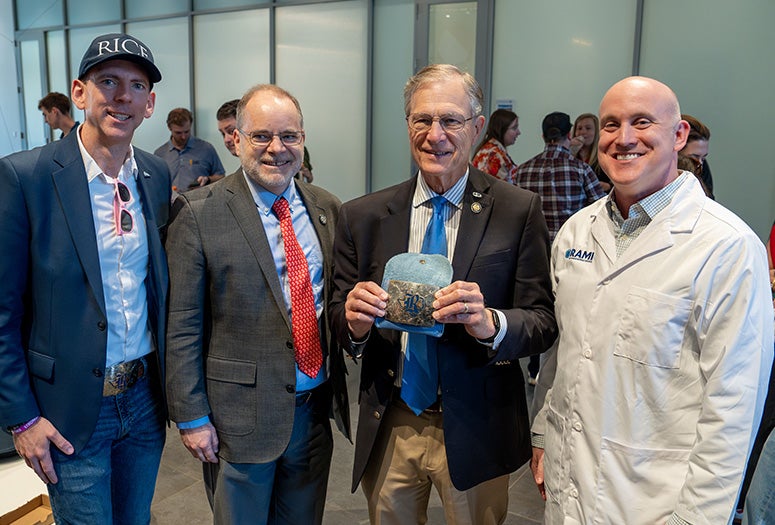
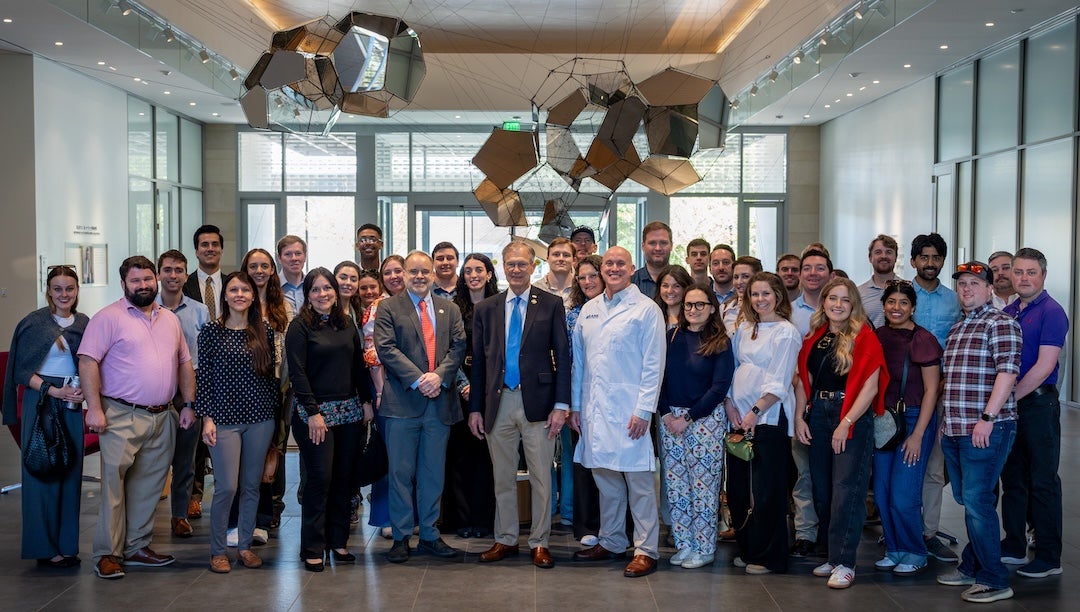
U.S. Rep. Brian Babin (R-Woodville), chairman of the House Committee on Science, Space and Technology, visited Rice University March 20 with a delegation of congressional staff to tour research facilities and learn about areas of focus across the university.
The delegation was welcomed by David Sholl, Rice’s executive vice president for research, who greeted the guests in the lobby of the Ralph S. O’Connor Building for Engineering and Science, the largest research facility in the university’s core historic campus. Sholl noted that the university’s strategic vision and research enterprise are closely aligned with national priorities, including around critical materials, energy autonomy, health care innovation and artificial intelligence.
“You’ll get a sense of those things as we walk through the labs today,” Sholl said. “It’s really great to have you here.”
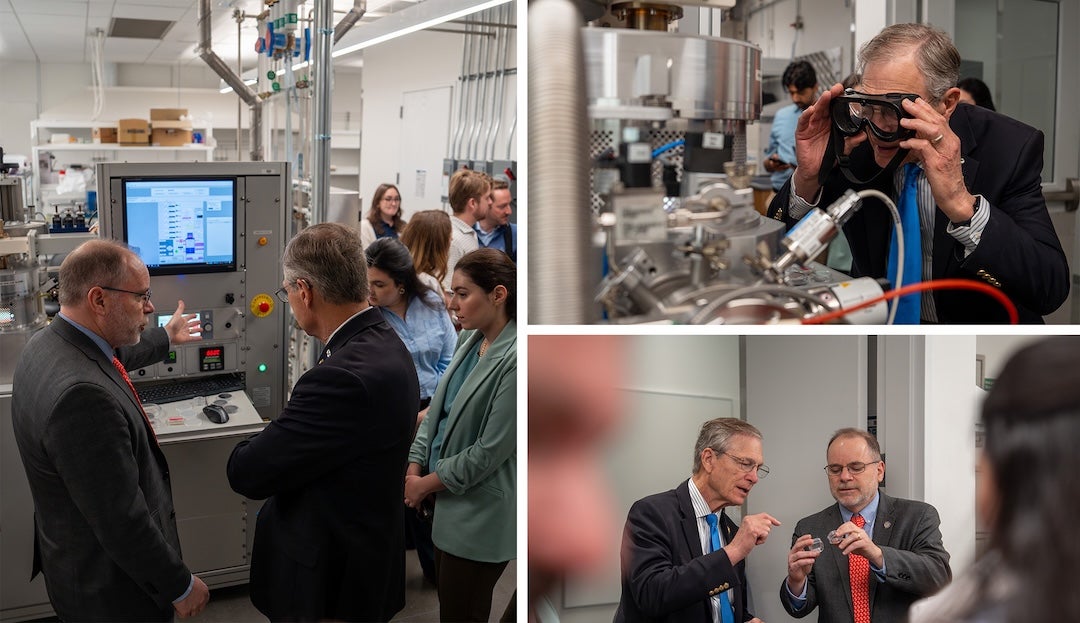
The itinerary offered a sample view of research spanning advanced materials, energy and wireless systems. Stops included the labs of Lane Martin, Pulickel Ajayan, James Tour and Edward Knightly.
“What we’ve seen here on this tour today is nothing short of fantastic,” Babin said. “I’m glad to have my staff here to see this firsthand, talk to the experts and learn about the applications and economic advantage derived from some of this research. I’m so proud of what’s going on right here in Houston, Texas, at Rice University.”
In Martin’s lab, part of the Rice Advanced Materials Institute, visitors moved through a sequence of spaces where materials are designed, produced, studied and tested. Martin, who directs the institute, leads a group focused on studying functional materials that can be engineered at the atomic scale. The tour traced that process from synthesis — where thin films are grown using high-energy deposition systems — to characterization with X-ray and nanoscale tools, and into clean room environments where materials are fabricated into devices. The work centers on designing materials that can combine multiple properties for applications in electronics, sensing and systems that operate in demanding conditions.
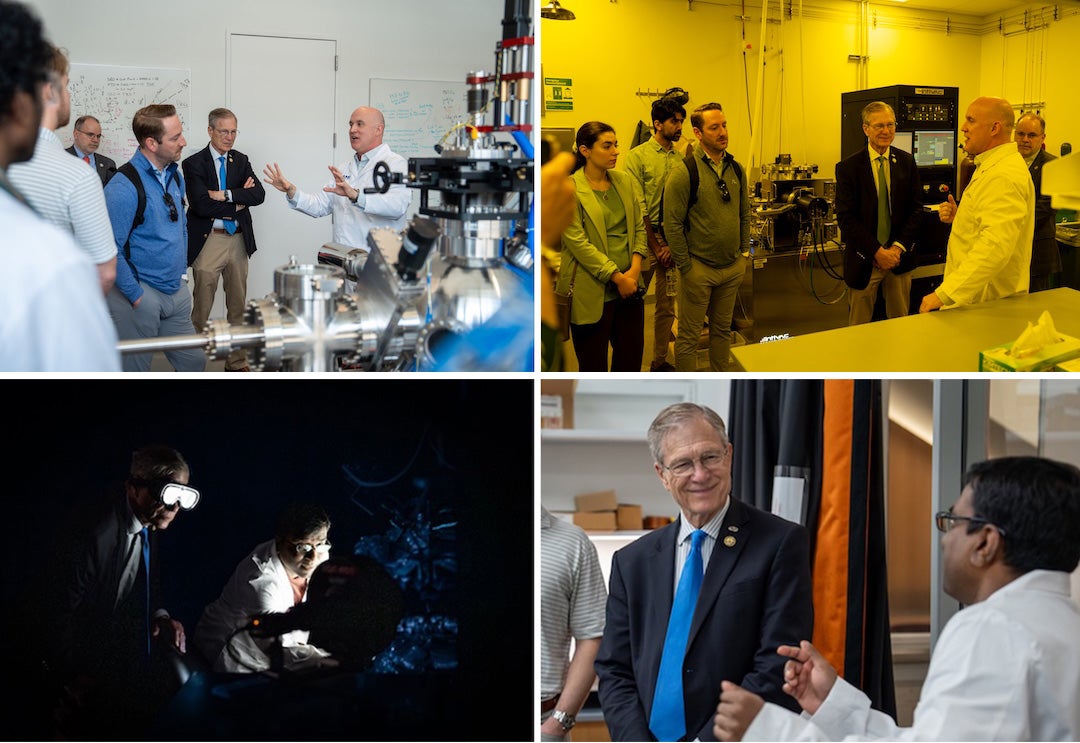
In another lab, Ajayan’s team highlighted work in advanced nanomaterials, including diamond and boron nitride. Researchers demonstrated how thin films are produced using pulsed-laser deposition, creating coatings with precise control over thickness and composition. The materials are valued for their thermal conductivity, chemical stability and durability with applications ranging from electronics cooling to aerospace and protective coatings.
At Tour’s lab, visitors put on protective eyewear to observe a flash heating process that converts carbon-based materials into graphene, a single atom-thin layer of carbon atoms arranged in a hexagonal lattice that is incredibly strong and conductive, useful in enhancing the performance of other materials and composites, often making them lighter, stronger and more efficient. The technique uses rapid, high-temperature pulses to transform materials — including industrial feedstocks and waste — into high-value carbon structures in milliseconds. Researchers also described related efforts to recover rare earth and critical minerals from discarded electronics, pointing to implications for supply chains and energy technologies.
Tour stressed his group’s commitment to actualize the impact of research discoveries through commercialization, noting several companies have been built around techniques and processes discovered in the lab. One notable example Tour called out was Flash Metals USA, which is based in Babin’s own district in Anahuac, Texas, where the Rice spinoff company is translating lab-scale metal extraction technology into multiton-per-day recovery of critical metals.
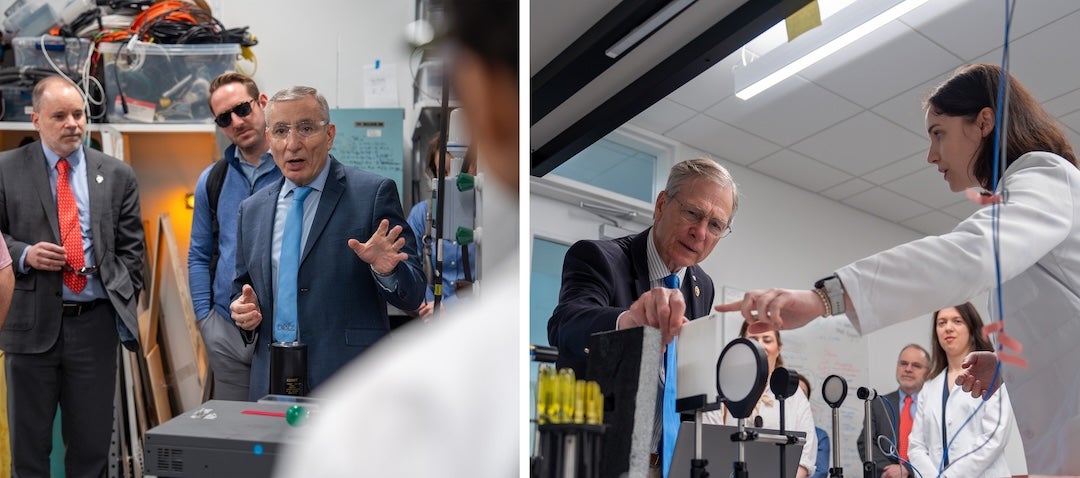
Caroline Spindel and Dora Zivanovic, doctoral students in the Knightly research group, presented research on next-generation wireless systems. The team is developing high-frequency communication technologies that can deliver faster data transmission and enable new sensing capabilities. Demonstrations focused on methods to guide and redirect signals to curve around obstacles using engineered surfaces, as well as emerging approaches to sensing and countersurveillance using wireless signals.
Babin said his goal as chairman is to ensure the U.S. emerges as the uncontested leader in global arenas such as lunar exploration, quantum supercomputing and fusion, and he noted that a qualified workforce is critical for reaching that goal.
“What Rice is doing is critical to keeping America not just competitive but out in front,” he said.
- Access associated media files:
-
Video:
https://www.youtube.com/watch?v=1XuNN7ZPlbg
Video by Jorge Vidal/Rice UniversityPhotos:
https://photos.app.goo.gl/4NpnQufZp43pE5LL6
Photos by Jorge Vidal/Rice University