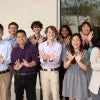
Rice University’s George R. Brown School of Engineering has inaugurated the Diversity, Equity and Inclusion Outreach Center dedicated to improving recruitment, retention and support for student populations historically excluded from STEM.
A groundbreaking three-year study has found evidence that ocean warming can trigger outbreaks of viruses that attack the symbiotic algae inside corals.
Rice University’s Danielle King, an assistant professor of psychological sciences and a member of the faculty since 2018, has won a coveted National Science Foundation (NSF) CAREER Award. The accolade includes a five-year grant that will support her research on preventing and overcoming race-based threats and how employers can improve workplace experiences for employees who face such threats.
Rice bioscientist James Chappell has won a National Science Foundation CAREER Award to develop RNA programming methods that can improve human health and the environment.
Rice University materials scientist Muhammad Rahman has won a National Science Foundation grant to develop a sustainable, low-cost coating to extend the shelf life of fruits and vegetables.
Lane Martin has been appointed director of the new Rice Advanced Materials Institute and Welch Professor of Materials Science and NanoEngineering in the George R. Brown School of Engineering.
Rice U. bioengineers have developed an upgraded tumor model that houses bone cancer cells beside immune cells inside a 3D structure engineered to mimic bone and, through research using the model, found that the body’s immune response can make tumor cells more resistant to chemotherapy.
Rice University bioengineer Omid Veiseh and collaborators found that lipid deposition on the surfaces of medical implants can play a mediating role between the body and implants, knowledge that could help scientists develop biomaterials or coatings for implants that could reduce malfunction rates.
Rice physicists have found experimental evidence that magnetism helps bring about the intriguing type of electronic order they discovered in a quantum material last year.
Rice U. representatives discussed the vision guiding the university’s research agenda during a panel discussion at CERAWeek, the leading annual energy conference taking place in Houston this week.
With the $1.8 million in support, Mechanical Engineering's Lillehoj looks to develop a CRISPR-Cas13-based rapid HIV-1 test and a serological test for detecting Chagas.