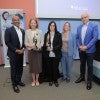
Lydia Kavraki and Rebecca Richards-Kortum are the first two faculty members in Rice history to be elected to all three U.S. national academies — the National Academy of Sciences, National Academy of Engineering and National Academy of Medicine.
Rice psychological scientist recognized with early career award for distinguished contributions to research methods research, practice, education and service.
Two Rice research teams have received Phase I awards through the U.S. Department of Energy’s Genesis Mission, a national initiative harnessing artificial intelligence and advanced computing to accelerate scientific discovery.
Published in the journal Information Systems Research and co-authored by Jing Zhou, the Mary Gibbs Jones Professor of Management at Rice Business, the paper explores “augmented learning,” a process in which people and AI actively adjust to each other across creative tasks, gradually improving what they can produce together.
Over the course of seven days, Rice’s presidential delegation crossed two countries and held meetings with many prominent universities, research institutions and government leaders.
As part of the Defense Advanced Research Projects Agency’s Bio-attribution Challenge, a team of Rice University computer scientists is building a computational tool to screen environmental DNA samples for pathogens.
A student-founded health care startup is fixing the busiest and most overlooked part of a dental clinic: the front desk. For co-founder and Rice University junior Adhira Tippur, it all started at her mother’s clinic in Texas’ Rio Grande Valley.
Researchers at Rice and The University of Texas MD Anderson Cancer Center have developed a compact, artificial intelligence-powered imaging device that could transform how clinicians detect cancer.
Today, the big questions surrounding religion and science are about responsibly building and managing new scientific technologies, how they can shape what the world should be and what it could become — questions Rice’s Boniuk Institute for the Study and Advancement of Religious Tolerance will try to answer in partnership with the University of California, San Diego thanks to a new $2.9 million grant from the Templeton Religion Trust.
Parthasarathy Ranganathan, vice president and engineering fellow at Google, discussed the rapid evolution of artificial intelligence and the technical and societal challenges shaping its future during the second annual Raleigh White Johnson Jr. Lecture at the George R. Brown School of Engineering and Computing.