
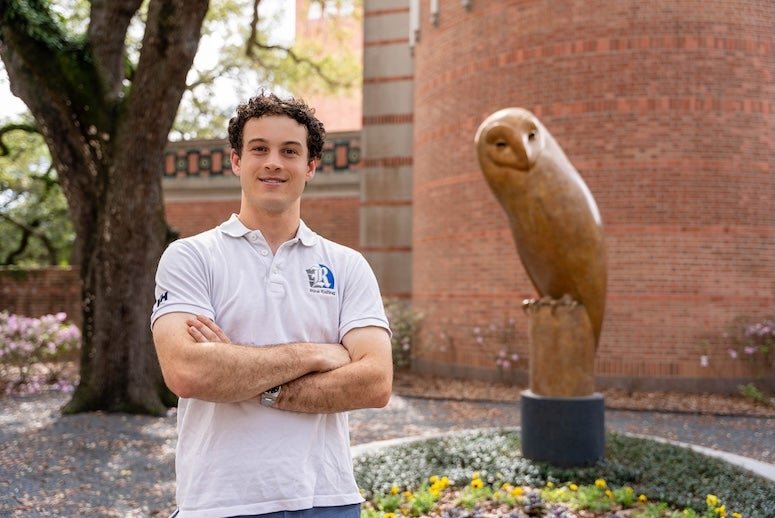
For Rice University senior Leo Marek, engineering is about finding the small changes that make big systems run better.
Whether he is redesigning computer processors, developing artificial intelligence tools to keep massive GPU systems online or leading Rice’s sailing team to national competitions, Marek gravitates toward complex systems — and the challenge of improving them.
A student in electrical and computer engineering and computer science from Duncan College, Marek will graduate this spring before returning to Rice for one additional semester to complete a master’s degree in electrical and computer engineering.
Much of Marek’s academic work focuses on the hidden infrastructure that powers modern computing. At Rice, he conducts research on a Very Large Instruction Word processor architecture built on the open-source RISC-V platform, a rapidly growing instruction set used in everything from embedded devices to large-scale computing systems.
Instruction sets define how processors understand and execute code — essentially the language computers use internally. Working with a team of researchers, Marek is designing processor architecture optimized for real-time signal processing, the kind of computation used in technologies such as cameras, audio systems and autonomous devices.
“We’re exploring how microprocessors can interact with real-time signals faster without making the hardware more complicated,” he said. “The goal is to keep things low power, low cost and efficient.”
Marek also gained industry experience last summer during an internship with NVIDIA, where he worked on infrastructure supporting the company’s GPU engineering teams.
Modern chip design involves thousands of engineers submitting changes through complex testing and verification pipelines. Even small bottlenecks can slow development. At NVIDIA, Marek helped develop an AI-enabled system designed to keep those pipelines running smoothly.
“I got to explore how engineering changes move through these systems and where things can get stuck,” Marek said. “I helped build AI tools to keep those systems running at full capacity.”
The experience sparked a broader interest in how AI can improve engineering workflows.
“I’m really interested in how AI agents can help engineering organizations identify bottlenecks and improve development cycles,” Marek said. “I’ve been exploring the idea of building a startup around that concept, though it’s still in the early stages.”
Outside the lab, Marek spends many weekends on the water as captain of Rice’s sailing team.
He first learned to sail around age 12 while growing up in the San Francisco Bay Area, where competitive sailing is common. When he arrived at Rice, however, the club team was not very active.
In the years since, Marek and his teammates have helped rebuild the program into a competitive group that travels across the country for regattas. The team now includes about a dozen active sailors who regularly compete against well-funded varsity programs across the country. The team’s determination paid off last year when Rice won the Inter-collegiate Sailing Association Regional Teams Championship in Chicago, a national event for top collegiate club sailing programs.
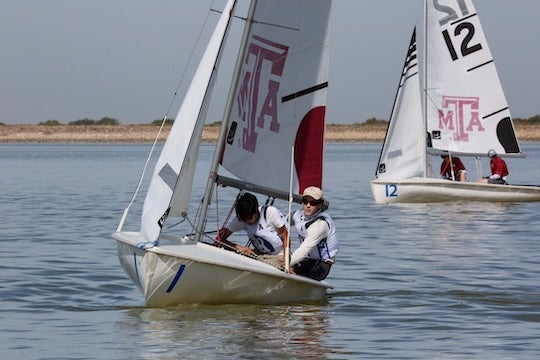
As captain, Marek takes particular pride in mentoring new sailors.
“We’ve had people join the team who had never sailed before,” he said. “Now they’re traveling with us and competing at the highest level.”
Marek’s leadership extends beyond athletics. He serves as president of Rice’s IEEE student chapter, helping organize events that connect students with major technology companies.
“As president, I help represent electrical and computer engineering students and their interests,” Marek said. “We host recruiting events and bring companies like Google, Apple and Texas Instruments to campus, so students can learn about their work and build professional connections.”
He has also worked as a teaching assistant for multiple electrical and computer engineering courses, helping students navigate topics such as programming, embedded systems and signal processing. In addition, he serves as a lab assistant in Rice’s Oshman Engineering Design Kitchen, where student teams build prototypes and experimental devices.
Marek first discovered Rice almost by accident. While researching colleges, he learned about the university through a family connection and began speaking with alumni.
“I tried to talk to anyone my family or friends knew who had gone to Rice,” he said. “I didn’t hear any bad things.”
A campus visit sealed the decision.
“It was raining the whole time,” Marek recalled with a laugh. “But people still looked like they were having a great time.”
The university’s residential college system ultimately made the biggest impression.
“Rice is a really special place,” Marek said. “The residential college system gives you a home away from home.”
At Duncan College, he found friendships that shaped his college experience.
“I met friends who will be my friends for the rest of my life,” Marek said. “We’ll be in each other’s weddings and going on trips together years from now.”
Rice’s unique environment also helped him thrive academically.
“The professors here really care about undergraduate teaching,” he said. “Even though Rice is such a strong research university, undergraduates still get incredible opportunities to work closely with faculty.”
Before finishing his master’s degree, Marek plans to return to NVIDIA this summer, where he hopes to continue working on large-scale computing infrastructure.
“My role will probably become more specialized over time,” he said. “But having a broad foundation in electrical and computer engineering really helps you understand the problems you’ll run into.”
Wherever his career takes him, from AI-driven engineering systems to advanced processor design, Marek remains focused on the principle that first drew him to computer architecture.
“It’s all about improving systems,” he said. “When you make systems faster, more efficient or easier to use, that impact scales everywhere.”