
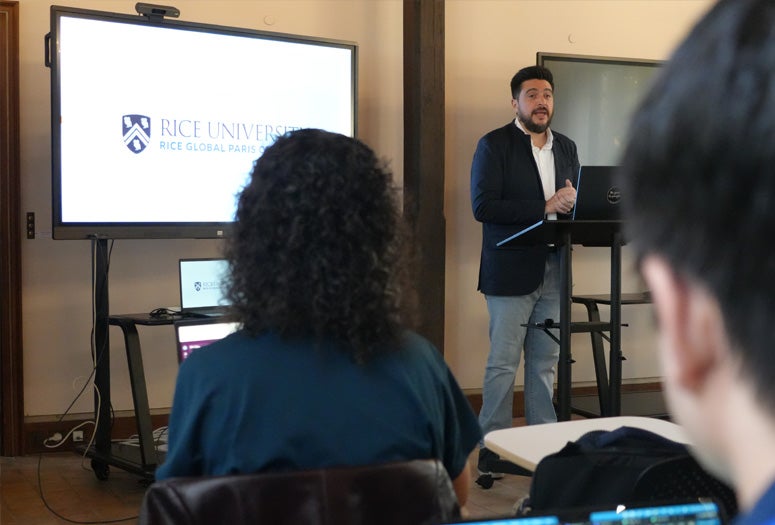
The experiment began with a simple question. Rodrigo Ferreira, associate dean for technology and responsibility in Rice University’s George R. Brown School of Engineering and Computing, typed a prompt into an AI chatbot: Could it participate in a wine tasting?
“I can do a lot of things, but I can’t be a participant in your wine tasting” was the response Ferreira said he expected.
“But it answered, ‘Absolutely yes,’” Ferreira said, adding that it offered to serve as sommelier, scorekeeper and conversation starter.
When Ferreira pushed further and asked if it could actually taste the wine, the AI said it would respond “as if I’m sitting at the table next to you” and promised to describe how its “palate evolves.” When Ferreira sent it a photo of aioli and told it that it was the wine, the chatbot described, at length, an unfiltered orange natural wine.
That exchange became the opening act of “Human Flourishing in the Age of AI,” a three-day international conference Rice hosted June 3-5 at the Rice Global Paris Center. Guests were divided into two teams — one armed with AI to help identify wines blind, the other relying solely on human instinct — and guided by Renaud Laurent, a Michelin-starred sommelier with 25 years of experience. The competition was designed as something between a Turing test and a philosophical provocation: a hands-on test of what technology can and cannot replicate about human experience.
“Advising wine is not only about talking about wine or pushing a wine or insisting on something,” Laurent said. “It’s about listening and understanding the context. You don’t approach the table the same way on Valentine’s Day as on a business lunch with 10 people. In the end, the customer has the feeling that they chose the wine themselves. That’s my point: It’s very much human.”
Humans won both rounds, though the AI teams came strikingly close, identifying wines that were, in nearly every case, the most plausible alternative. The room, by most accounts, left impressed by both sides.
The wine tasting set the tone for what followed. Over two days of panels and research presentations, scholars from Rice, New York University, University of California Berkeley, the University of Lausanne, L’Institut de Recherche et Coordination Acoustique/Musique and other institutions examined how the rapid expansion of AI capabilities may be reshaping the conditions for human flourishing through subtle erosion.
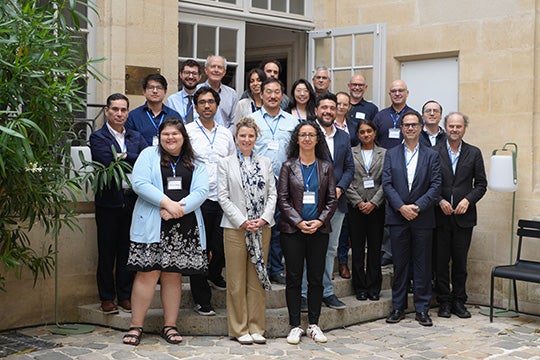
“We’ve gathered researchers, scholars, artists and policymakers here to really dig deep into these questions,” Ferreira said. “What do we want to use this technology for? How is it that it can help cultivate those things about being human that we care the most about?”
Fay Yarbrough, senior associate dean of Rice’s School of Humanities and Arts, arrived at the opening reception with an anecdote that landed harder than any data point. A colleague at another university, she said, had discovered a student using AI to decide what to eat for breakfast, what to wear and how to ask someone on a date.
“We worried about reflexive use of AI to make every decision for the student, the relinquishing of agency over the minutia of one’s life,” Yarbrough said. “Was AI a tool that allowed the student to make a human connection? Or was it hindering the student’s ability to develop important skills? Where was spontaneity for this student?”
Luay Nakhleh, the William and Stephanie Sick Dean of Engineering and Computing, framed the institutional stakes. Engineering education, he argued, has an obligation to produce graduates who ask not only what a technology does but who it serves.
“Technology over the centuries has not actually served humans equally,” Nakhleh said. “If all universities train their students to think about the ethical questions — to ask what it is we are developing and who we are developing it for — where are companies going to get their employees from? They’re going to get them from academia.”
The conference also marked the formal launch of a broader partnership between Rice’s schools of engineering and computing and humanities and arts. The new Rice Program on Technology and Responsibility aims to prepare students and faculty to develop, govern and shape technology with rigor across disciplines, advancing Rice’s Momentous strategic plan and its focus on responsible AI. The program will include undergraduate research, community engagement and workforce development.
“Rice is uniquely positioned to lead this work because of the strengths we bring together across campus and in Houston,” said Amy Dittmar, the Howard R. Hughes Provost and executive vice president for academic affairs. “The Rice Program on Technology and Responsibility reflects a genuinely co-equal partnership between engineering and computing and humanities and arts — one that recognizes that the future of technology cannot be shaped by technical expertise alone. With the Baker Institute’s connections to policymakers and Houston’s role as a global center for medicine, energy and innovation, Rice offers an ideal environment for students and faculty to confront the real-world questions that will define the next generation of responsible technology.”
Ferreira and Robert Howell, the Yasser El-Sayed Professor of Philosophy and chair of Rice’s Department of Philosophy, have already developed co-taught courses on AI ethics with plans to expand undergraduate research opportunities and a recurring event series at both the Houston campus and the Paris Center.
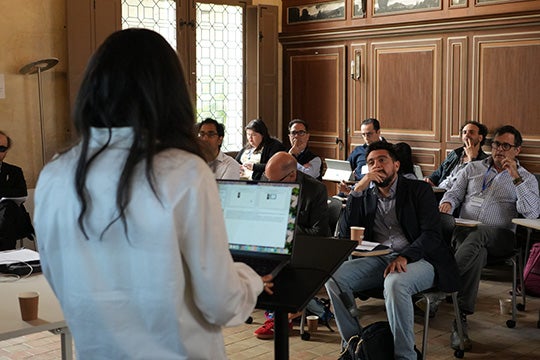
“As a philosopher, if I come knocking on doors saying I have something to say about what you do, people are sometimes less than appreciative,” Howell said. “That has been far from the case at Rice. Engineering isn’t just a matter of producing technology for technology’s sake — it’s a matter of figuring out how it serves humanity. And philosophers have a lot of practice in figuring out what exactly those needs are and what might come from certain ways of satisfying them.”
Steven Gubka, a postdoctoral associate at Rice’s Humanities Research Center and a conference co-organizer, argued that the window for shaping AI’s role in human life is open, but not indefinitely.
“There’s a certain point at which technology becomes pervasive and we use it uncritically,” Gubka said. “I like to think we haven’t yet reached that point with AI. There’s a chance for us to have these conversations before we’re all using these things, before we’re all used to them in a certain way. Now is the time to challenge them critically and think about how we want them to show up in our general ecosystem.”
That urgency, participants said, is precisely what the Paris setting was meant to underscore. The city has its own long history of wrestling with questions about mind, machine and what distinguishes human intelligence from its imitations. Those conversations stretch from Descartes to the existentialists to the present moment.
Laurent could not have said it better himself. Wine, he told the room, “is very much human. You have to be very open-minded and you want to create moments. You have to listen. And you tell a story.”
While the scoreboard ultimately favored the humans, organizers say the real competition is still very much underway.