
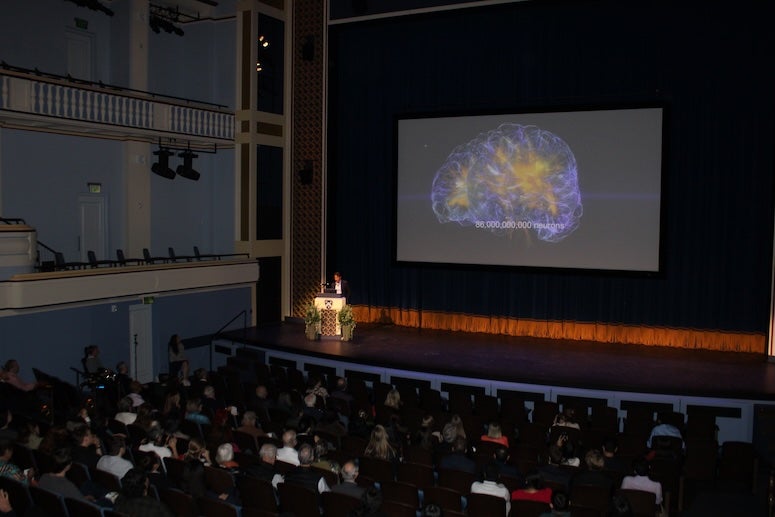
Neuroscientists, artists, educators and policymakers gathered at Rice University for the De Lange Conference March 12-14 to explore questions at the center of everyday life: how the brain works and what that means for society.
“The most complex and miraculous thing we’ve ever found in our universe,” neuroscientist, alumnus and bestselling author David Eagleman ’93 said of the brain as he opened the conference, setting the tone for the event.
Returning to campus to deliver the public keynote, Eagleman invited the audience to consider both the progress scientists have made in understanding the brain and the mysteries that remain.
Advances in artificial intelligence, neurotechnology and brain imaging are allowing researchers to observe the brain with increasing precision, offering new insight into how people process language, memory, emotion and decision-making.
But those discoveries also raise deeper questions about how that knowledge will be used.
For Simon Fischer-Baum, associate professor of psychological sciences at Rice and co-organizer of the conference, those broader questions are exactly why the event exists.
“We are learning more about the brain at an incredible pace,” Fischer-Baum said. “But understanding what those discoveries mean for society requires more than neuroscience alone. It requires conversations across disciplines.”
The De Lange Conference, a biennial event hosted by Rice’s Scientia Institute, convenes scientists, engineers, artists and policymakers to examine how research connects to real-world challenges.
“For more than three decades, the De Lange Conference has brought together leading thinkers from across disciplines to explore some of the most consequential issues facing society,” Rice President Reginald DesRoches said. “What makes this gathering special is the breadth of perspectives in the room.”
This year’s theme, Brains in Society, comes at a time of rapid scientific progress and growing public need.
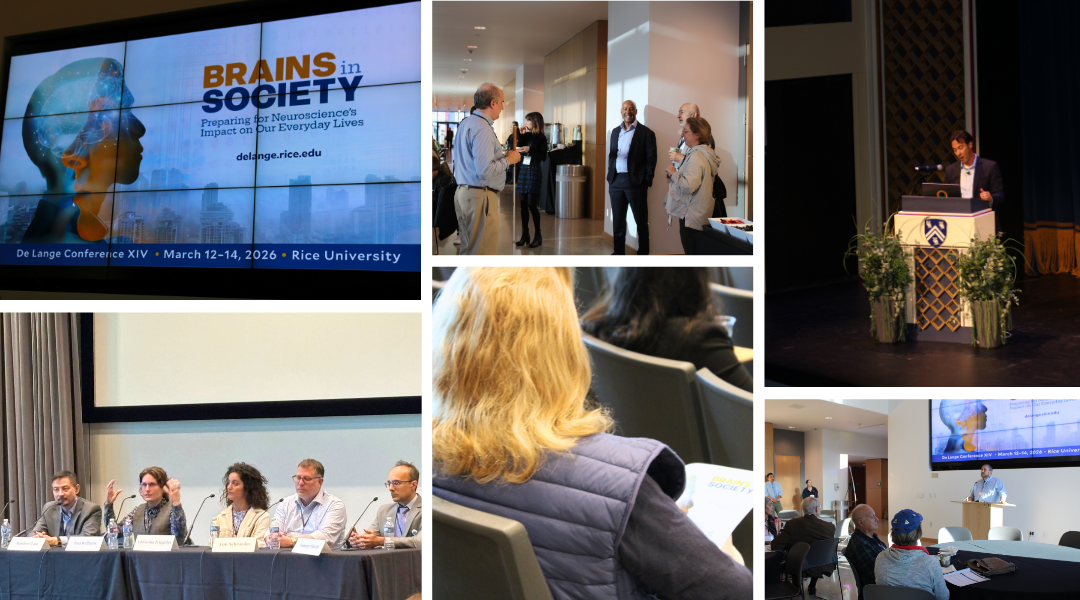
“We are living through an extraordinary moment in neuroscience,” said Amy Dittmar, the Howard R. Hughes Provost and executive vice president for academic affairs. “Advances in neurotechnology, artificial intelligence, imaging and computational tools are expanding what we know about the brain. But they also raise important questions.”
Those questions extend beyond the lab.
From neurodegenerative diseases to how people learn, speakers emphasized the need to connect scientific discovery with real-world impact. Texas voters recently approved $3 billion in funding for the Dementia Prevention and Research Institute of Texas, signaling urgency around brain health.
“Rice is poised to be a leader in a new wave of neuroscience and brain health research,” Dittmar said.
Unlike many academic conferences, the De Lange Conference is designed to engage the broader community.
“The audience is not just academics but policymakers, civic leaders and members of the general public,” Dittmar said. “The event is free and open to the public, reducing barriers for broad engagement.”
That openness reflects a central idea of the conference: Understanding the brain requires multiple perspectives.
“The goal is to take on a topic of broad societal importance and bring together different perspectives, then invite everyone to the table,” Fischer-Baum said.
Speakers also challenged traditional ways of thinking about the brain, emphasizing that biology alone does not tell the full story.
“Brains are shaped by culture on every possible level,” said Cristine Legare, professor of psychology at the University of Texas at Austin. “The fundamental job of our brain is to allow us to learn and develop and be thriving members of particular cultures.”
That perspective was reflected in sessions on education, mental health, aging and creativity.
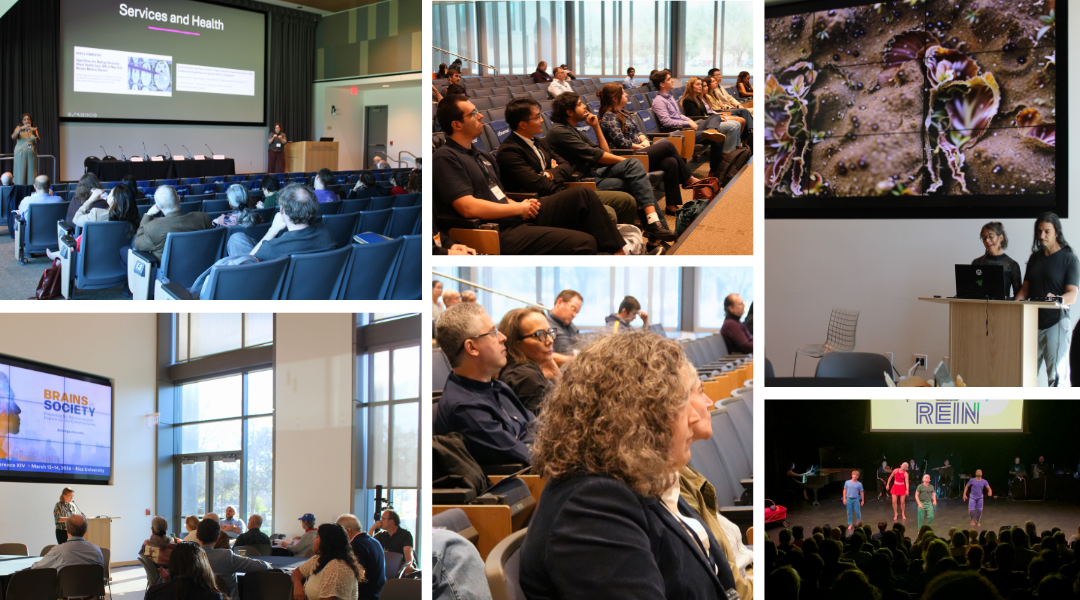
One of the conference’s most visually striking moments blended science and art in a collaboration between Shepherd School faculty composer Anthony Brandt, choreographers Andy and Dionne Noble, University of Houston bioengineer Andrew Nordin and neuroscientist Anna Abraham from the University of Georgia. During the live “Free Rein” performance, dancers wore wireless brain-monitoring devices that recorded neural activity as they alternated between choreographed and improvised movement.
“We’re able to collect this brain data to distinguish what’s happening when you’re improvising versus performing something that’s been created for you,” Fischer-Baum said.
The caps captured continuous recordings of faint electrical signals, offering a level of detail that could help answer questions about creativity that have been difficult to study in traditional lab settings.
“That level of detail opens the door to questions we haven’t been able to answer before,” Fischer-Baum said.
The performance pointed to a larger takeaway.
“The problems that we’re facing are not problems one discipline can solve independently,” Legare said.
For Rice, those conversations are part of a broader effort to turn discovery into action.
“I hope the public takes away that neuroscience can have an impact on the world and that they are an important part of that conversation,” Fischer-Baum said.