
A student-founded health care startup is fixing the busiest and most overlooked part of a dental clinic: the front desk. For co-founder and Rice University junior Adhira Tippur, it all started at her mother’s clinic in Texas’ Rio Grande Valley.
The region is one of the most rural and medically in the country. For many families there, the nearest clinic is the closest thing to dependable health care for miles, which places a significant burden on the staff. Tippur witnessed this firsthand for years. She saw her mom’s front desk staff try to schedule patients, verify insurance, calm down walk-ins, chase cancellations and handle the occasional emergency, often all in the same 10 minutes.
“What stuck with me was how much of someone’s access to care comes down to whether a phone gets answered,” Tippur said. “If you grow up in a place like the valley, you understand that a missed call isn’t a small thing. Sometimes it’s the only call that person was going to make.”

That early view of health care shaped how she thinks about the problem today. Tippur is quick to point out that the front desk is not a side detail in a clinic. It is the first thing a patient experiences and often the reason they never come back.
“People assume the hard part of health care is the medicine,” she said. “But for a lot of patients, the system fails them before they ever sit in the chair. If you can’t get through the door, none of the rest matters.”
As a biosciences and finance student at Rice, Tippur kept circling back to that idea. She eventually teamed up with junior Sanjana Kavula, a neuroscience student, and the two started building the system they wished her mom’s clinic had been able to use. They named it Kairos Health.
Kavula approached the problem from a different angle. Where Tippur saw it through the clinic she grew up in, Kavula focused on what the technology actually had to do to earn a place in a busy practice.
“What we realized is that the front desk isn’t just answering phones,” Kavula said. “They’re doing five jobs at once.” That insight became the blueprint for the project.
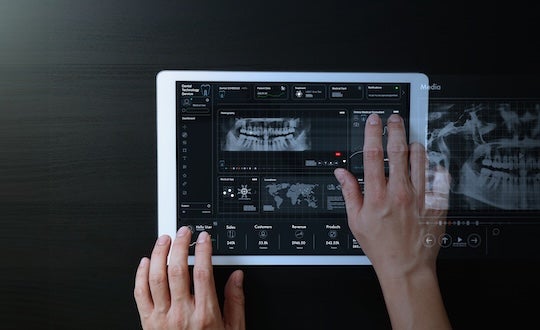
Kairos Health is an end-to-end patient intake platform built specifically for dental clinics. It answers calls and books appointments around the clock, verifies insurance and flags problems before a patient ever walks in, and it contacts inactive patients to fill open slots. Clinics keep full visibility into every interaction and can shape the system around their own scheduling rules, communication style and the languages their patients speak.
The student founders also see Kairos as a way to hand clinics back something they rarely have enough of. “Most of the staff we talk to are stretched so thin that they’re reacting all day instead of actually running the practice,” Kavula said. “If we can take the repetitive work off their plate, they finally get to focus on the patient in the room.”
Tippur said she wanted that to happen quietly. “Clinics already have enough screens to stare at, and the last thing they need is one more,” she said. “We built Kairos to handle the work in the background, so the team can look up and actually talk to the person in front of them.”
Early validation for the project has come fast. Tippur and Kavula won both the Klaus Startup Challenge along with a $150,000 investment, and America’s Startup, a national competition hosted by America250 and Draper University, beating out hundreds of teams to win $25,000 in front of an investor panel that included Rosie Rios (former U.S. treasurer), Sarah Friar (CFO of OpenAI) and Chris Larsen (co-founder of Ripple). They were selected for Rice’s Summer Venture Studio with $15,000 in funding, placed third out of 120 teams at the Napier Rice Launch Challenge for $22,000 while also taking home the Audience Choice and Undergraduate Business awards, and they earned a spot in the selective MassChallenge program.
The results behind the company are just as real. Since launching in March, the team has served more than 2,100 patients, managed 58 hours of patient calls, run more than 100 discovery calls and signed 23 letters of intent with active pilots across the Rio Grande Valley, Dallas and Nashville.
Both founders also bring outside experience with backgrounds spanning life sciences consulting, venture capital and biotech, and they have a group of advisors with decades of work in clinical dentistry, HIPAA compliance and dental technology.
Tippur and Kavula are just getting started. Of the roughly 200,000 dental practices in the United States, the founders estimate about 60,000 are understaffed and heavily dependent on phone-based intake. Those are the clinics Kairos is built to serve first, and the company plans to start in dental shortage areas before expanding to larger practices later this year.
For Tippur, beginning there is not a business decision so much as a personal one. It keeps the company close to the kind of clinic where she first saw the problem.
“I keep coming back to the patients who never made it onto the schedule,” Tippur said. “Nobody ever counts them, because by definition they’re the ones who slipped through. If Kairos exists for anyone, it’s for them.”
More information about Kairos Health is available on LinkedIn.