
By Raji Natarajan,
Special to Rice News
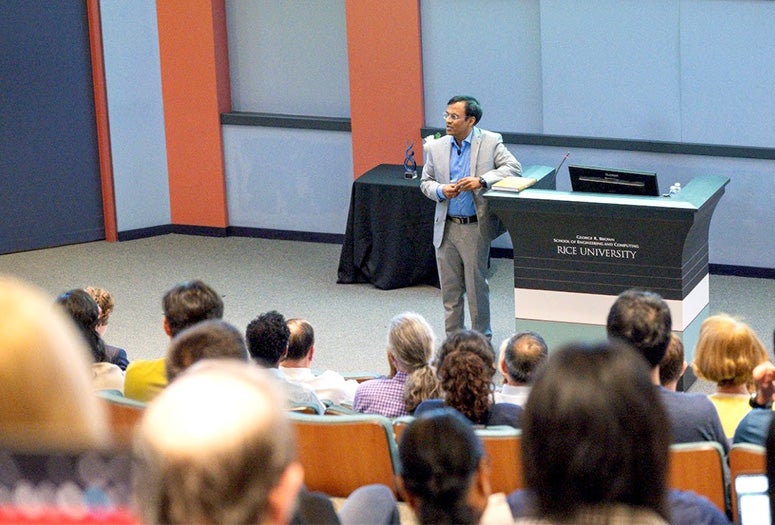
Parthasarathy Ranganathan, vice president and engineering fellow at Google, discussed the rapid evolution of artificial intelligence and the technical and societal challenges shaping its future during the second annual Raleigh White Johnson Jr. Lecture at Rice University’s George R. Brown School of Engineering and Computing on April 9.
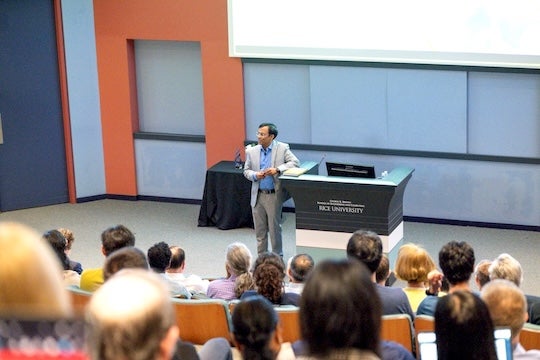
Established in 2025 in memory of a prominent Houston businessman and philanthropist, Raleigh Johnson, the endowed lecture series brings leading voices in engineering and computing to Rice and the Houston community to explore pressing issues at the intersection of technology and society.
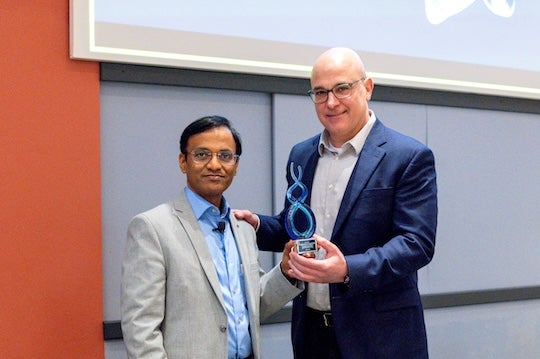
“We’re excited to welcome an outstanding alumnus as this year’s Raleigh White Johnson Jr. Lecture speaker,” said Luay Nakhleh, the William and Stephanie Sick Dean of Engineering and Computing. “We’re extremely proud of Partha and his accomplishments. His success exemplifies the caliber of our alumni.”
Ranganathan, a Rice graduate who now leads innovations in next-generation AI applications and ecosystems at Google, has helped shape widely adopted technologies used by billions around the globe and is a recognized leader in AI, authoring more than 100 publications, co-inventing more than 125 patents and receiving an Emmy Award for technical achievement.
“Partha’s current work reimagines the future through responsible, ethical, human-centered intelligent systems — an approach that closely aligns with our mission of solving for greater good,” Nakhleh said.
In his talk, “From Unicorns to Centaurs: Powering the AI Moonshot,” Ranganathan examined the rapid evolution of AI and what it will take to sustain its momentum. He described a shift from AI as a back-end tool to a true partner in human ingenuity — one that will increasingly influence how we approach discovery, design and decision-making across fields.
“AI is the space race of our time,” Ranganathan said, pointing to the exponential rise in demand for computing power and energy. While advances in computing have historically followed predictable growth patterns, AI is accelerating at a pace that is both technically challenging and environmentally unsustainable.
To address this gap, he emphasized the importance of co-design — developing hardware and software in tandem — as well as rethinking AI systems more holistically. As the field evolves toward closer human-AI collaboration, he noted, innovation will require broader coordination across disciplines and communities.
Ranganathan also highlighted the need for responsible AI systems that operate transparently and ethically alongside the emergence of more autonomous, “agentic” architectures capable of executing complex workflows. Ensuring efficiency across the full AI pipeline, he added, will be critical to sustaining progress at scale.
Ranganathan, who earned his master’s degree in computer engineering in 1997 and doctorate in electrical and computer engineering in 2000 at Rice, concluded by comparing the evolution of AI to the early days of automobiles during the Industrial Revolution. Just as the first Model T resembled a horse-drawn carriage before finding its own form, AI is now moving beyond imitation toward becoming truly “AI-native.”
“We are at the cusp of an intelligence revolution,” he said. “Much like the industrial and information revolutions, this epoch promises to be transformative and will reshape the foundations of modern society.”
Watch a video of the lecture.