Nameless Sound musicians performed an original score on Nanibah Chacon’s interactive installation following Danza Azteca Macuilxochitl's activation of...
Three Rice faculty members from the Department of Earth, Environmental and Planetary Sciences have recently been honored with career awards, showcasin...
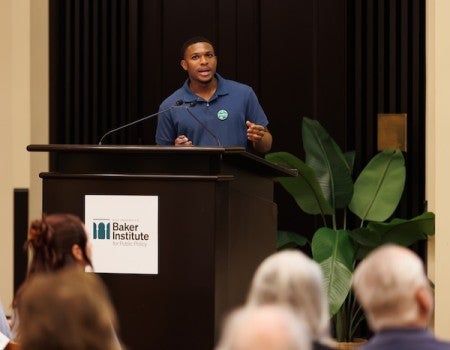
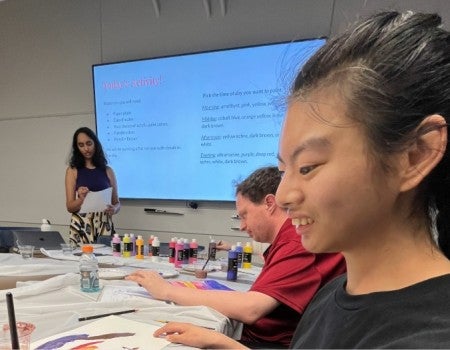
The Science and Technology Policy Program at Rice’s Baker Institute for Public Policy hosted a “science cafe” Oct. 13 to bring research to reality and...
The Doerr Institute for New Leaders at Rice has launched CoachRICE: Team Coaching, a new professional education program designed to help coaches, mana...
Scholars, curators and filmmaker Daphne Di Cinto gather at Rice to explore Black histories from Renaissance Italy to medieval Africa and Islamic world...
For the sixth fall in a row, Rice welcomed a new group of researchers to STaRT@Rice, giving emerging researchers both the skills and the support to gr...
Rice and the Houston Methodist Research Institute have signed a memorandum of understanding with LSE Health at the London School of Economics and Poli...
A recent study from Indiana University-Purdue University and the University of Oklahoma suggests Americans who “strongly embrace Christian nationalism” — which, the authors note, is nearly 25% of the U.S. population and growing — are also much more likely to refuse COVID-19 vaccination.
Live concerts with in-person audiences have been practically nonexistent over the past year, but after months of planning and practice, Rice Shepherd School of Music composition students presented five unique works written during the COVID-19 pandemic at a March 21 concert.
When the COVID-19 pandemic forced education online about a year ago, more than one in five families lacked internet access or digital devices for their students to learn online.
Lovetteers enjoy a superhero flick on the lawn outside Lovett College during one of the many outdoor movie nights organized for the students this semester by Lovett associate Travis Alexander, a postdoctoral fellow in the School of Humanities
A Sidizen makes use of the new soundproof study booth on the ground floor of the new Sid Richardson College tower. The acoustic pod, the size of a phone booth, completely dampens all external noise but still allows in plenty of light. (
Rice University Police Chief Clemente Rodriguez has been elected secretary of the board of the Houston Area Police Chiefs Association, which includes city, county, state, school district, federal, university and transit police departments.
The right-wing conspiracy movement QAnon reportedly has started peddling anti-Chinese rhetoric. It’s the latest in a troubling trend of anti-Asian sentiment, on the rise across America, as addressed by Rice President David Leebron in a recent message to the Rice community.