
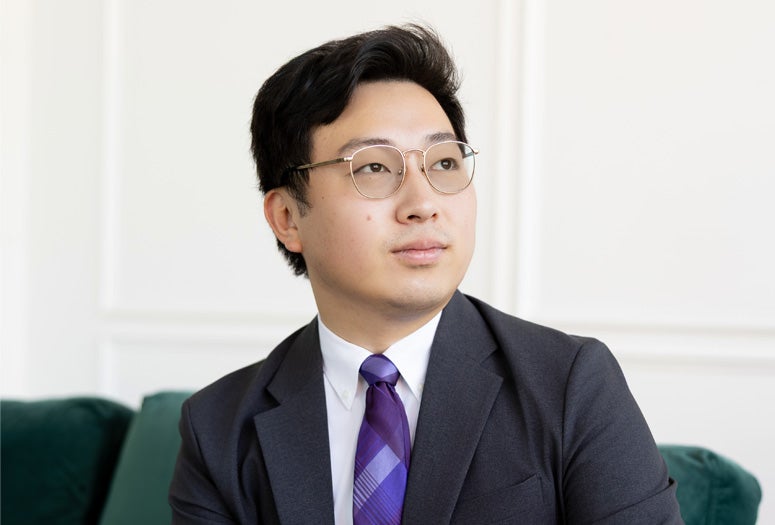
Sean Terada Yang went to college as an undergrad to become a doctor. These days his prescriptions run more toward Chopin and Liszt.
Yang, a doctoral student at Rice University’s Shepherd School of Music studying under professor Jon Kimura Parker, was selected as a 2026 Young Artist in Residence with Performance Today, the American Public Media program that ranks as the most popular classical music show on American radio. The residency culminated in his own episode recorded in Minnesota Public Radio’s Maud Moon Weyerhaeuser Music Studio. It aired June 15 and paired Yang’s performances with conversation alongside host Valerie Kahler.
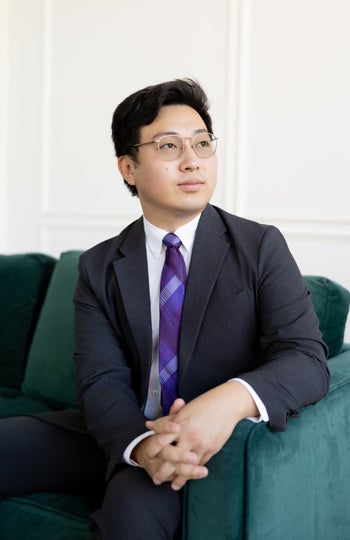
“The folks at Minnesota Public Radio made me feel at home throughout our time together,” Yang said. “The host of the show Valerie Kahler was a marvelous partner in music-making, and the producer Meghann Oglesby went out of her way to organize venues throughout the Twin Cities that resonated with my ambition to connect music with medicine.”
That ambition has deep roots. Growing up in Memphis, Tennessee, Yang played on his high school band’s drumline, but science held equal claim on his attention. When he arrived at Vanderbilt University in Nashville, he double-majored in piano and neuroscience while preparing for medical school.
The two tracks refused to stay separate. As an undergraduate, Yang began joining research projects that put musicians under the scientific lens, including a study of human movement that observed pianists of varying skill levels to understand why some perform better or more consistently than others. Yang served as the liaison between the pianists and the researchers, translating between the language of the lab and the keyboard.
The project that Yang said left the deepest mark was a pilot program called Therapeutic Systems, which brought personalized live music to patients in the intensive care unit. There was nothing abstract about the delivery method: Yang would roll an upright piano into a patient’s room and play at the bedside. Researchers measured how patients responded to the music, tracking heart rate among other indicators, to gauge whether live performance could improve quality of life in one of a hospital’s most stressful settings. Yang stayed with the program for three years.
The experience reshaped how he thinks about performance itself. Rather than asking audiences to come partway to the music, Yang said, he wants to carry it directly to their doorsteps. Music, in his view, works the way medicine does: It can heal, help people feel better and allow them to experience life more fully.
Listeners who tuned in June 15 heard that philosophy reflected in repertoire that ranged across centuries and continents. Yang’s residency performances included two Chopin etudes, Toru Takemitsu’s “Rain Tree Sketch II” written in memory of composer Olivier Messiaen, Isaac Albeniz’s “Triana” from “Iberia,” Robert Schumann’s “Eintritt” from “Waldszenen,” Minako Tokuyama’s “Musica Nara” and Franz Liszt’s Hungarian Rhapsody No. 4 in E-flat major.
“First and foremost, Sean Terada Yang is a communicative and thoughtful young artist,” Parker said. “In his first year as a piano major in our rigorous doctoral program, he brought light and joy to Grieg’s Holberg suite, illuminated the tragic elements of the Janacek Sonata, and blazed brilliantly and stylistically through Hungarian Rhapsodies of Liszt. Sean is also an exceptional lecturer and has imbued his spoken introductions of his performances with clarity and insight.”
The residency joins a resume that has been gathering momentum since Yang made his concerto debut at 16, performing Prokofiev’s Piano Concerto No. 3 with the Germantown Symphony Orchestra in Tennessee. He has since appeared with the Tennessee All-State, Nashville Symphony, Vanderbilt University, Chautauqua Symphony and Chautauqua Music Festival orchestras. Over the past two years, he has won top prizes at international competitions including the National Federation of Music Clubs, Seattle International, Frances Walton, Memphis International, Chautauqua SAI Concerto and Beardsley piano competitions, and he was a Piano Gold Medalist in the 2026 Young Texas Artists Music Competition.
Yang holds master’s degrees in piano performance and chamber music from the University of Michigan. He is now pursuing his Doctor of Musical Arts at the Shepherd School under the mentorship of Parker, whom Yang credits along with the school for supporting him throughout the residency.
“An important feature of The Shepherd School of Music is the weekly one-on-one interaction that professors and students experience and I look forward to every lesson with Sean as he is fully engaged in seeing his artistry grow,” Parker said.
Yang’s residency continued a strong run for the Shepherd School on the program’s airwaves. In April, senior harpist Lily Primus led the Shepherd School Chamber Players in a concert performance of William Grant Still’s “Ennanga,” recorded at Brockman Hall for Opera on the Rice campus. The chamber work for harp, piano and strings channels the sound of its namesake, an African trough zither, weaving the spirit of Central and East African folk music into a Western chamber setting.
Yang, who regularly performs around Houston, will host a solo recital Nov. 9 at the Shepherd School. Until then, you can watch his full episode from Performance today here.