
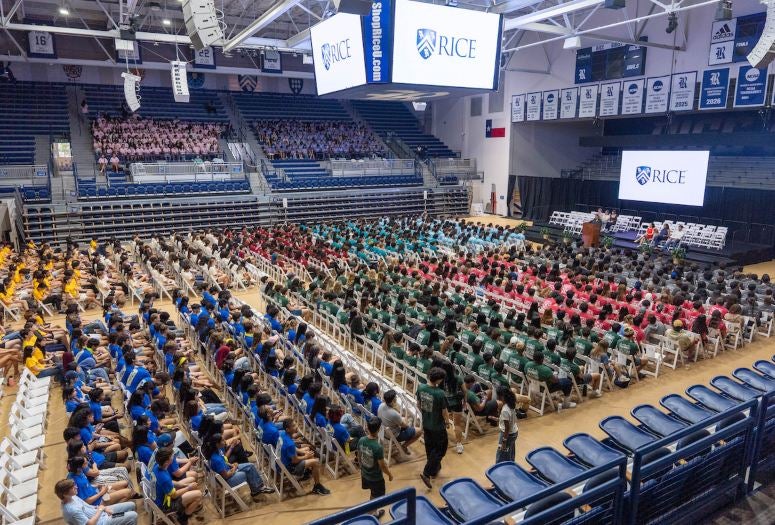
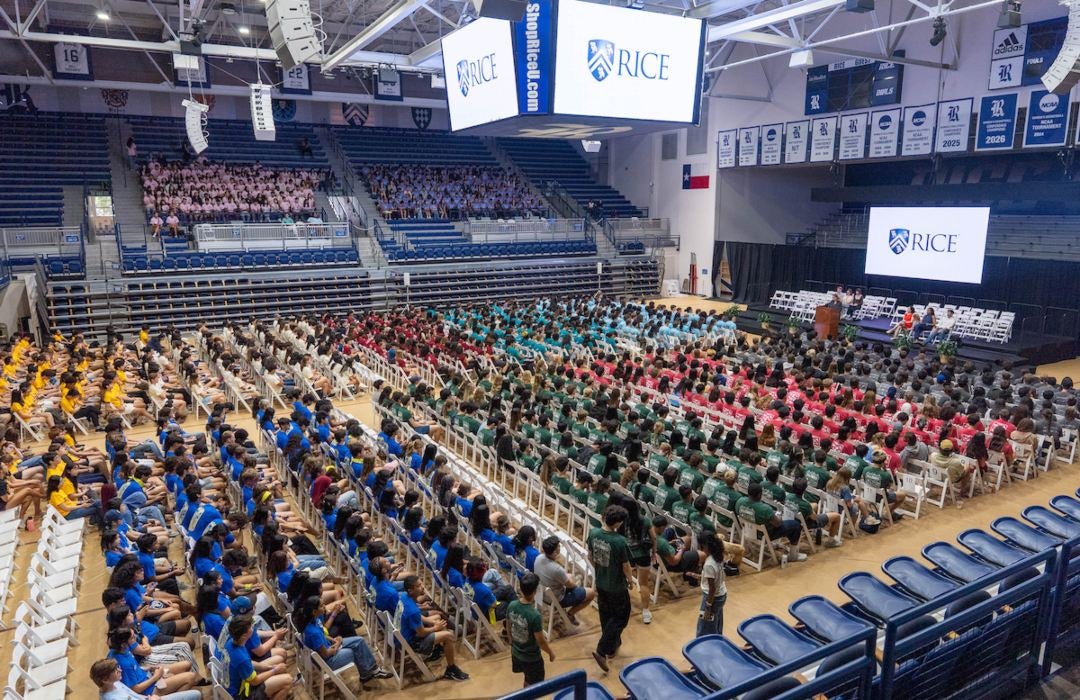
On the second morning of O-Week, Rice University’s incoming Class of 2030 gathered at Tudor Fieldhouse to hear three faculty members share lessons from their research, careers and experiences — and offer advice for making the most of their time on campus.
Through short, TED Talk-style presentations, the professors encouraged students to explore unfamiliar interests, challenge assumptions, take risks and build a culture of compassion. The address also served as a prelude to academic orientation sessions designed to introduce students to Rice’s fields of study.
Bridget Gorman, dean of undergraduates and vice provost for student life, opened the program by encouraging students to approach their academic journeys with an open and curious mind.
“Regardless of where you start, there’s a high chance your plans will shift,” Gorman said, sharing her own story of arriving at college unsure of her academic direction before discovering sociology and eventually building a career in population health.
Gorman urged students not to pack their schedules so tightly that they leave no room for unexpected discoveries. Instead, she encouraged them to explore their interests, visit faculty during office hours and ask professors about their research and career journeys.
Amanda Perkins-Ball, associate teaching professor of kinesiology, followed with a lesson about the importance of movement, both physical and metaphorical.
An expert in exercise psychology, motor learning, motivation and confidence, Perkins-Ball began by asking students to stand. She then asked how many had experienced improved mood through physical activity, used movement to clear their minds or gained confidence by mastering a physical skill.
“Movement matters,” she told the class.
Perkins-Ball explained that physical activity can influence mood, stress management, sleep, attention, memory and learning. She also discussed the concept of self-efficacy, or the belief in one’s ability to accomplish a task.
Learning a new physical skill, she said, often involves struggling at first. Students may feel awkward or perform inconsistently before eventually improving. That experience, she suggested, offers a useful lesson for college life: Being bad at something when you begin is not evidence that you cannot succeed.
As students begin their Rice experience, Perkins-Ball encouraged them to “move toward challenges; move toward people and opportunities that help you grow.”
Chin Jou, associate professor of history, then turned students’ attention to the past, using her expertise as a historian to demonstrate how academic disciplines evolve through questioning, debate and discovery.
She began with a message of reassurance for students who might wonder whether they fit at Rice.
“No, the admissions office did not make a mistake in admitting you to Rice,” Jou said. “You belong.”
Whether students are the first in their families to attend college, come from a community that is underrepresented at Rice or simply feel different from their classmates, Jou said, they have a place at the university.
She then offered a glimpse into how historians study the past, using the evolving debate over the relationship between slavery and capitalism in the United States as an example. Jou explained how historians revise and challenge previous interpretations as new sources emerge and scholars reconsider existing evidence.
She also described historian Lawrence Levine’s work examining the evolution of opera in the United States, showing students how historical research can challenge assumptions about what is considered “highbrow” or popular culture.
The broader lesson, Jou said, is that history is an ongoing conversation — one in which Rice students themselves could someday participate.
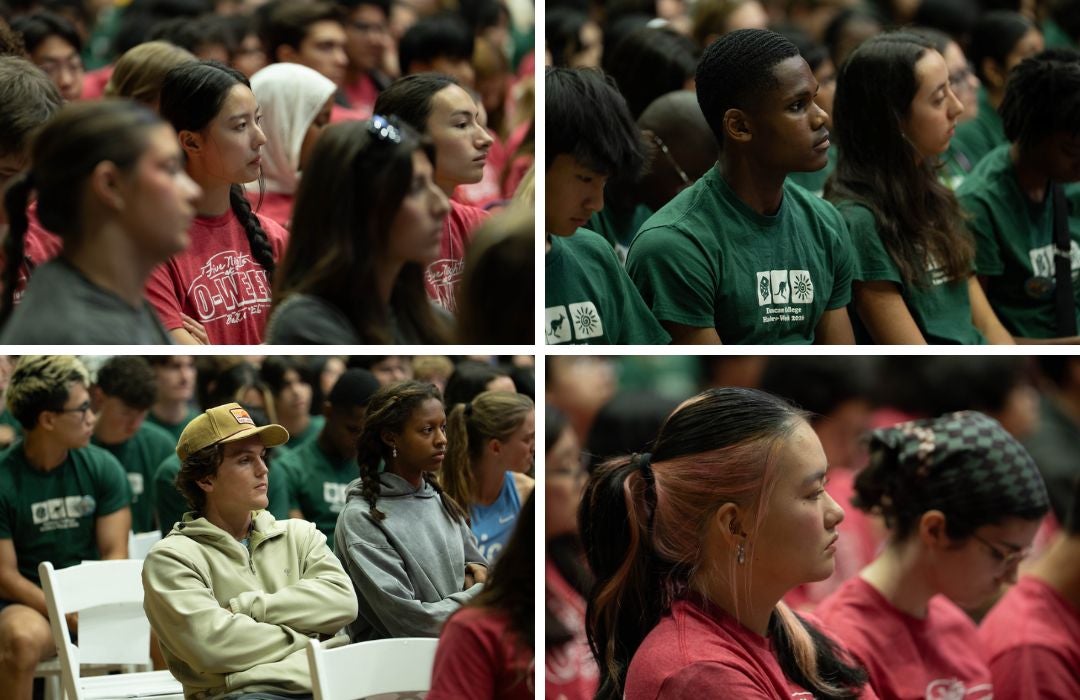
Daniel Preston, assistant professor of mechanical engineering, concluded the address by challenging students to embrace three qualities: curiosity, courage and compassion.
A mechanical engineering professor who directs Rice’s Preston Innovation Laboratory, Preston used examples from his research to demonstrate how curiosity can lead to unexpected discoveries. One example involved “necrobotics,” research inspired by the observation that spiders curl up after they die and the use of hydraulic pressure to create a robotic gripper.
His lab also develops fluidic systems and soft wearable robots, including technologies that could assist human movement without relying on traditional electronic control systems.
Preston then connected research to courage, describing the path from a Rice laboratory invention designed for use in space to Helix Earth, a company founded by alumnus Rawand Rasheed. The technology, originally developed to help filter water droplets from air in spacecraft, is also being explored for applications such as more energy-efficient air conditioning.
For students, Preston said, the story illustrates the potential rewards of taking risks. He encouraged them to consider what risks they might take at Rice — whether starting a company, studying abroad or pursuing an opportunity outside their comfort zones.
His final lesson was about compassion and the importance of building a culture of care.
Drawing on the principles of “radical candor,” Preston encouraged students to combine directness with genuine concern for the people around them. As the new class navigates the unfamiliar first weeks of college, he urged them to “just try to be kind; look out for each other.”
Together, the three presentations offered the Class of 2030 a preview of the intellectual possibilities awaiting them at Rice and a reminder that their education will extend well beyond the classroom.
As students move into the next phase of O-Week and begin exploring Rice’s academic programs, the message from the faculty was clear: stay curious, take chances, embrace challenges and make connections with the surrounding people.