
Good science does not always lead directly to good policy. For Professor Dame Angela McLean, the U.K. government’s chief science adviser, that is not a reason to give up on science advice. It is a reason to make it better.
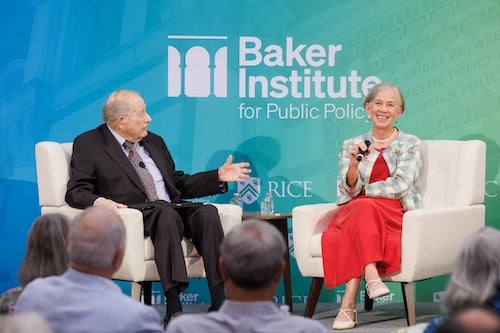
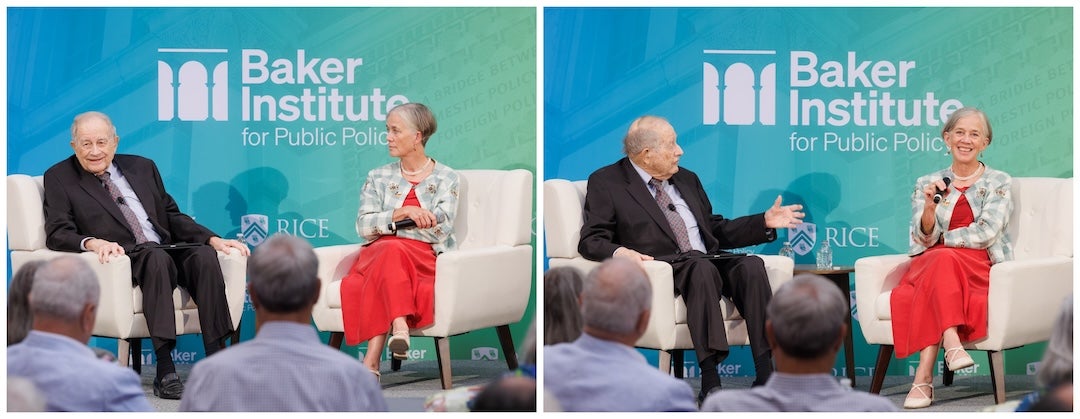
McLean discussed the role of science advice in government during an armchair discussion at Rice University’s Baker Institute for Public Policy, hosted by the Science and Technology Policy Program as part of its Civic Scientist Lecture Series. Baker Institute senior fellow and former White House science adviser Neil Lane moderated the conversation.
“The short version of my job is to make sure that the U.K. government has excellent science advice available when it is making decisions about policy,” McLean said. “I cannot make them use that advice.”
That distinction is central to the job. Scientists can provide evidence and explain what it means, but elected officials ultimately have to weigh that information alongside competing priorities, political considerations, economics and public opinion.
“Fortune favors the persistent,” McLean said, describing one of the most important lessons she has learned as a science adviser. Advice that is rejected one year may eventually be adopted if scientists continue to make the case for it.
McLean’s own experience illustrates the point. Early in her tenure, she was told repeatedly that the U.K. was not doing enough to prepare for the effects of climate change. Rather than accepting that inaction was inevitable, she and colleagues kept pushing the issue onto the government’s agenda.
The effort eventually helped produce a nationally adopted climate adaptation scenario focused on preparing infrastructure for a warmer future, including ensuring that hospitals, schools and transportation systems can continue to function as temperatures rise.
“It took a lot of us to say, ‘Right, we’re going to focus on this thing,’” McLean said.
That kind of persistence is particularly important because policymakers face an overwhelming amount of information. McLean said senior government officials simply do not have time to read everything that lands on their desks. Effective science advice, therefore, is not just about producing a rigorous report. It is about understanding what decision-makers need to know and getting that information in front of the right people.
“Writing the reports is probably about 10% of the work,” she said. “Taking the report to everybody you want to be using it is actually the real work.”
The challenge is even greater when public trust in government institutions is declining. McLean pointed to vaccines and the COVID-19 pandemic as examples of how quickly scientific questions can become politically charged.
During the pandemic, she said, scientists learned to be careful about how they described the relationship between evidence and government decisions. Rather than saying policymakers were “following” scientific advice, McLean preferred the phrase “taking account of” it. Science can inform a decision, but it does not make the decision.
She also emphasized that scientists should not assume that expertise alone gives them credibility with the public.
“We have no right to expect people to believe what we say,” McLean said.
Instead, scientists need to work with people who already have the trust of particular communities. She cited faith leaders and pastors as examples of trusted voices who can help communicate scientific information to people with whom they have established relationships.
The need to build trust will become even more important as emerging technologies reshape science itself. McLean expressed enthusiasm about artificial intelligence’s potential to accelerate research, particularly in the life sciences.
As a mathematical biologist, McLean spent much of her career developing models based on detailed understanding of biological processes. AI offers a very different approach, using large amounts of data to identify patterns that can reveal new insights.
And she said AI is more than a tool for analyzing existing research. It could also help scientists decide what experiments to conduct next.
McLean described visiting a researcher working on AI models of protein binding. Rather than simply using AI to interpret experimental results, the researcher was using the model to identify which experiments would provide the most useful new information. The AI model and laboratory experiments could continually inform one another.
“That really, really helped me understand that this is not just about doing better interpretation at the experiments you do,” McLean said. “It’s about doing better experiments too.”
That promise comes with risks, particularly when AI is applied to biology and could potentially be used for harmful purposes. McLean said governments will need to think carefully about regulation and about how to balance scientific progress with biosecurity.
Across these challenges — from climate change and pandemics to AI and quantum technology — McLean sees international collaboration as essential. Scientists in different countries can learn from one another, share knowledge and develop frameworks that benefit everyone.
“This is not a zero-sum game,” she said. “If you do better, as long as you still talk to us, we do better too.”
The Baker Institute’s Civic Scientist Lecture Series aims to encourage scientists and engineers to engage with society and contribute to public policy. For McLean, that engagement is not simply an added responsibility for scientists. It is an essential part of making sure that governments and the public can benefit from what science has to offer.