


Research explores how faith and work can coexist in increasingly diverse workplace
Rice sociologist's research on faith in the workplace is helping organizations navigate religious diversity and has earned national recognition for its public impact.
UH, UHD, Rice students reimagine Houston's future through art, design and data....
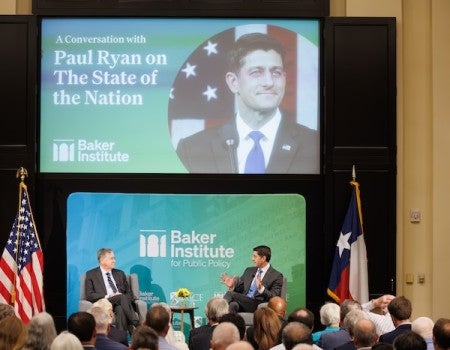
With the 2026 midterm elections approaching, former U.S. House Speaker Paul Ryan joined Rice's Baker Institute for Public Policy for a conversation ab...
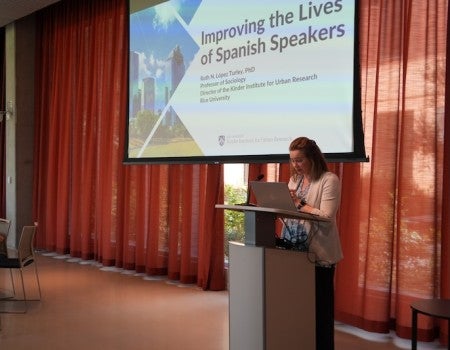
Rice’s Texas-Latin America Social Science Forum on Language and Opportunity brought together scholars from sociology, economics and political science ...
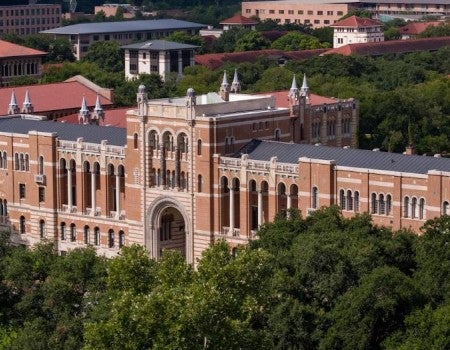
With a May 11, 2027 national deadline for digital accessibility compliance approaching, Rice is accelerating efforts to make its digital environment m...
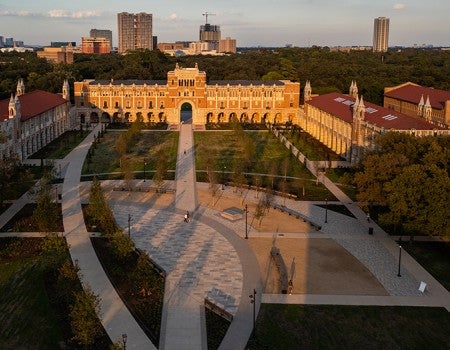
Rice University’s Ken Kennedy Institute will celebrate its 40th anniversary Nov. 9 with a public event on responsible AI leadership. The daylong progr...
Brené Brown was a featured speaker at the 2026 International Symposium on Academic Makerspaces (ISAM) held Oct. 11-13 at Rice....
The annual Texas ETA Conference, organized by Rice MBA students and hosted by Rice Business, brought together aspiring entrepreneurs, investors, busin...
Rice launched AI Week 2026 with a fireside chat focused on how artificial intelligence will shape the university’s future in research, teaching and op...

Rice researchers have developed an ultraporous material capable of pulling several valuable and rare earth elements from complex waste streams, a pote...
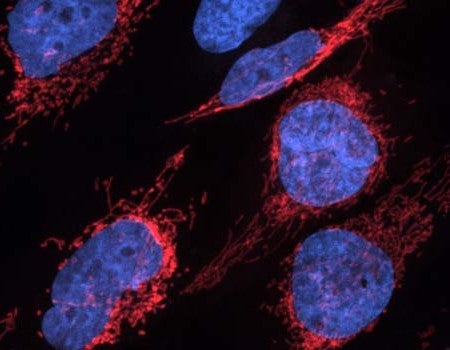
Researchers from Rice and Baylor College of Medicine have secured NIH funding to develop a novel, non-DNA-altering CRISPR gene-tuning therapy designed...
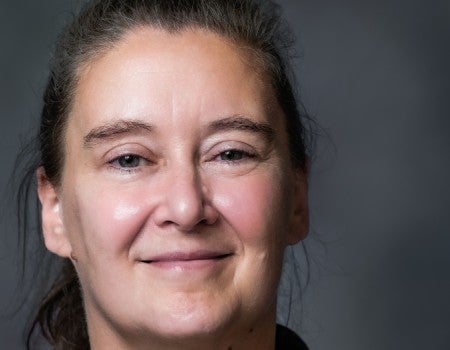
Lisa Basgall, Rice's Emergency Medical Services director, has earned the Chief EMS Officer designation, a professional credential held by fewer than 3...

When geopolitical conflicts disrupt fuel shipments, electricity demand outpaces infrastructure development or critical mineral shortages threaten indu...
Research explores how faith and work can coexist in increasingly diverse workplace
Rice sociologist's research on faith in the workplace is helping organizations navigate religious diversity and has earned national recognition for its public impact.

Graduate students begin a new chapter during housing move-in week
Students arrived from across the country and around the world as staff and graduate resident assistants welcomed more than 450 residents to three Rice graduate housing properties.

A new way to beat jet lag? Engineered cells speed circadian adjustment
Researchers at Rice, with the support of the Rice Biotech Launch Pad and Northwestern University have developed an implantable cell therapy that may help the body adapt more quickly to jet lag.

RUPD youth academy offers behind-the-scenes look at law enforcement
The Rice University Police Department wrapped up another successful Law Enforcement Youth Academy July 27–31, welcoming 20 local students to campus for a week of hands-on learning and positive engagement with law enforcement.
Undergraduate researchers showcase a summer of discovery
Rice’s 2026 class of summer undergraduate researchers gathered at the BioScience Research Collaborative last week for the Summer Undergraduate Research Symposium, hosted by the Office of Undergraduate Research and Inquiry.
Scientists uncover new clue to how protons maintain their identity
New results from the STAR detector at the Relativistic Heavy Ion Collider (RHIC) suggest that gluons, the gluelike particles that hold quarks together inside protons, play a central role in the conservation of baryon number, an essential part of a particle’s quantum identity.

Rice professor advises computational chemistry researchers to prepare for new AI tools
David Sholl, Rice’s executive vice president for research and professor of chemical and biomolecular engineering, recently published an opinion piece in ACS Central Science, where he and co-author Andrew Medford, associate professor of chemical and biomolecular engineering at Georgia Institute of Technology, share their perspective on machine learning tools expected to bring radical changes to the field of computational chemistry.

Rice alumnus earns international honor for decades of software innovation
Rice alumnus Cary Jensen receives an international honor recognizing his decades of contributions to software development, education and technical communication.

Rice researchers show graphene nanowrinkles can reshape electricity
Rice researchers have shown that tiny wrinkles in graphene can change the material’s electrical properties.

Rice’s Huang elected fellow of SPIE for contributions to optics and photonics
Shengxi Huang was elected this month as a fellow of SPIE.