
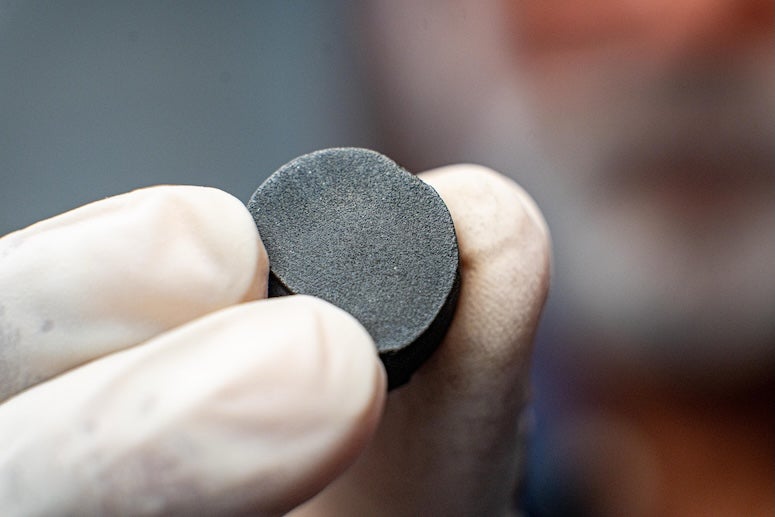
Rice University researchers developed a way to stabilize diamond during high-temperature and low-pressure processing, creating a strong bulk composite and discovering that high-speed collisions can rapidly transform the diamond into graphite. The study was published Aug. 6 in Materials Today.
Diamond is one of the hardest known materials with high thermal conductivity, properties that make it valuable for technologies that operate under extreme conditions. The findings could help researchers design tougher materials for aerospace, defense and other demanding environments by showing how diamond changes and absorbs energy under extreme force.
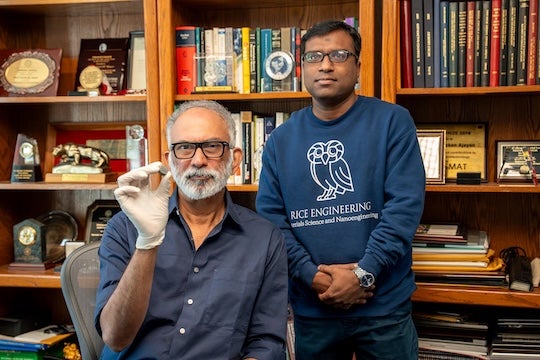
“This was quite an exciting outcome as it is nearly impossible to sinter diamond at lower pressures, and this new process we have developed could lead to the large-scale manufacturing of diamond-based composites,” said Pulickel Ajayan, the lead author of the study and the Benjamin M. and Mary Greenwood Anderson Professor of Engineering.
The challenge of making bulk diamond
Small diamond particles are relatively inexpensive and easy to produce, but turning them into larger diamond structures has proved difficult, Ajayan said.
One way to join those particles into a larger structure is through sintering, a process that uses heat and pressure to form a solid. With diamond, however, the high temperatures can turn it into graphite. High-pressure, high-temperature methods can produce polycrystalline diamond, but they require extreme pressure and limit the size of the samples produced.
To keep diamond stable during processing, the researchers mixed microscopic diamond grains with cubic boron nitride, a material with properties similar to diamond, and cobalt to bind and stabilize the mixture.
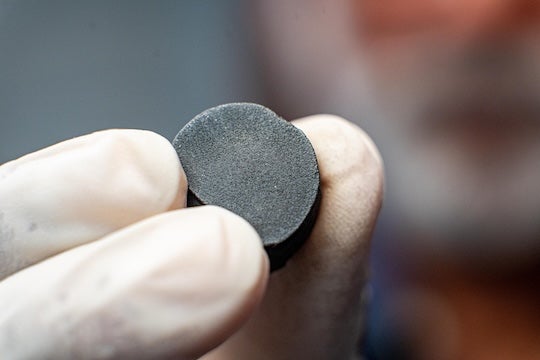
They used spark plasma sintering, a rapid process that applies heat and pressure to turn powders into a solid. The process produced an extremely strong composite with diamond particles embedded in the boron nitride matrix and cobalt distributed throughout.
“The composite made by this process is almost nonmachinable and tough due to the presence of dispersed diamond particles and could help researchers design tougher materials for aerospace, defense and other technologies that face extreme conditions,” said Abhijit Biswas, first author and research scientist in Rice’s materials science and nanoengineering department.
Diamond changes in millionths of a second
The researchers then subjected the composite to high-speed collisions to study how it behaved under extreme force.
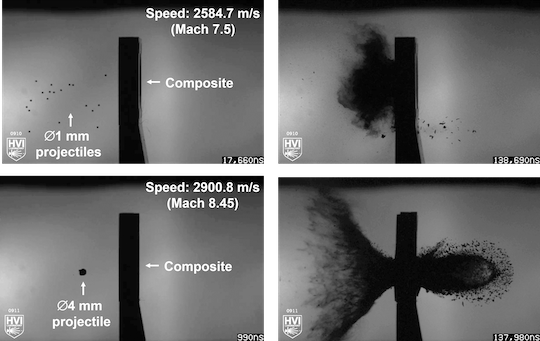
Researchers fired tiny metal projectiles measuring 1-4 millimeters across at the composite at hypersonic speeds, and the material held together when struck by one of the projectiles traveling at more than seven times the speed of sound. A larger projectile traveling even faster caused the composite to break apart.
During the collision, nearly all the diamonds involved in the transformation became graphite within microseconds.
Diamond and graphite are both made of carbon, but their atoms are arranged differently. That difference makes diamond hard and graphite much softer.
“We found that extreme impact can drive diamond to graphite within microseconds, rather than through the slower heat-driven process we normally associate with this transformation,” Biswas said. “That gives us a new view of how diamonds behave under some of the most demanding mechanical conditions.”
Following the transformation
The researchers examined the fractured composite and used molecular dynamics simulations, computer models that track how atoms move and rearrange. Their analysis revealed areas where diamond and graphite met, providing clues to how the transformation occurred.
The study attributes the change to energy from the shock and structural rearrangements that turn diamond into graphite.
The researchers also found that the conversion to graphite helped absorb some of the energy from the collision as the diamond’s atomic structure changed.
The findings offer a closer look at how internal transformations can help toughen materials under severe conditions.
“Understanding how materials change their structure and phase under force, along with their strength and hardness, could help guide the design of future protective materials,” Biswas said.
Other authors include Aniket Mote and Thomas Lacy Jr. of Texas A&M University; Rajib Sahu and Christian Kübel of the Karlsruhe Institute of Technology; Marcelo Lopes Pereira of the University of Brasília; Shuo Yang, Lizhong Lang, Yu Zou and Tobin Filleter of the University of Toronto; Sudaice Kazibwe, Ching-Wu Chu and Liangzi Deng of the University of Houston; Rice’s Jishnu Murukeshan, Raphael Benjamin de Oliveira, Shreyasi Chattopadhyay, Robert Vajtai, Gelu Costin and Jianhua Li; and Guilherme da Silva Lopes Fabris and Douglas Soares Galvão of the State University of Campinas.
The work was supported by the Air Force Office of Scientific Research, the Texas A&M Hypervelocity Impact Laboratory, the Karlsruhe Nano Micro Facility at the Karlsruhe Institute of Technology and the Robert A. Welch Foundation.