
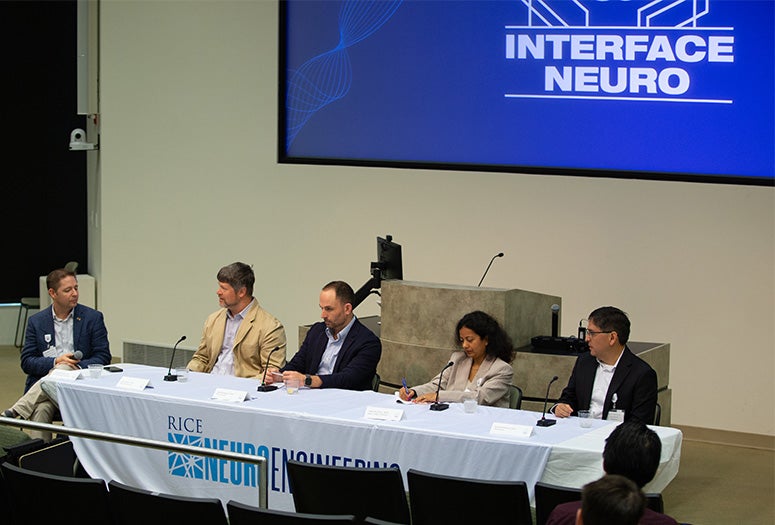
Brain health cuts across many facets of individual life and society as a whole. Advances in neurotechnology, artificial intelligence and translational neurosciences are reshaping approaches to brain health, raising new questions around effectiveness, access and ethical implementation. Those questions shaped InterfaceNeuro 2026, a translational brain research conference held at Rice University May 19-20.

The two-day conference, hosted at Rice’s Bioscience Research Collaborative, convened participants from academia, medicine, industry and government in order to explore potential collaborations, identify roadblocks and chart areas of convergent action. The event also served as a forum to engage on recent policy and governance developments touching on brain health, including the Dementia Prevention Research Institute of Texas, a new $3 billion statewide initiative aimed at accelerating dementia and neurodegenerative disease research.
In opening remarks, Luay Nakhleh, the William and Stephanie Sick Dean of Rice’s George R. Brown School of Engineering and Computing, described neuroengineering at Rice as “interdisciplinary by design” and guided by a commitment to ethical practice and societal impact.
“The bottleneck in brain research is no longer only understanding how the brain works,” Nakhleh said. “It is building the tools that act on that understanding and getting them to the people who need them. … We believe engineering earns its place not by what it can build but by whom it helps. There is no harder test of that than the brain: It’s the most complex object we know of, sitting behind the hardest problems in human health.”
Nakhleh also highlighted recent milestones, including strategic faculty hires and translational successes such as approval by the U.S. Food and Drug Administration for a first in-human clinical trial of a therapeutic brain-computer interface developed by Motif Neurotech, a company founded based on Rice research.
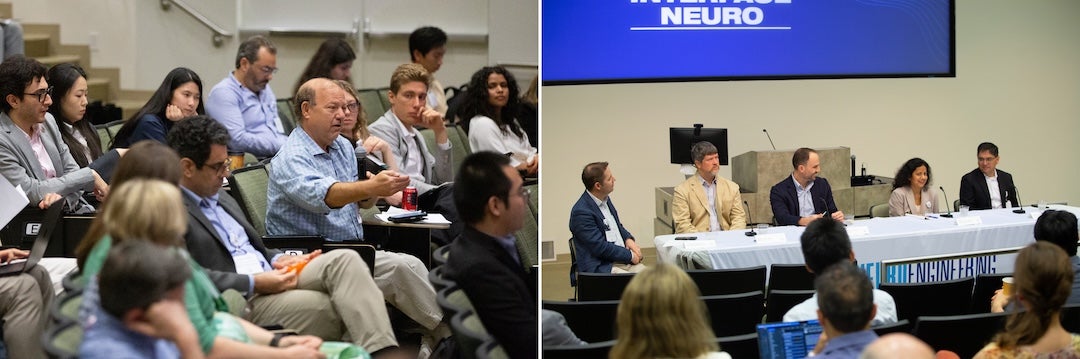
The conference was organized jointly by the Rice Neuroengineering Initiative and the Institute for Neuroscience, Neurotechnology and Society at the Georgia Institute of Technology. The two organizations have entered into an agreement to co-host the event on alternate years.
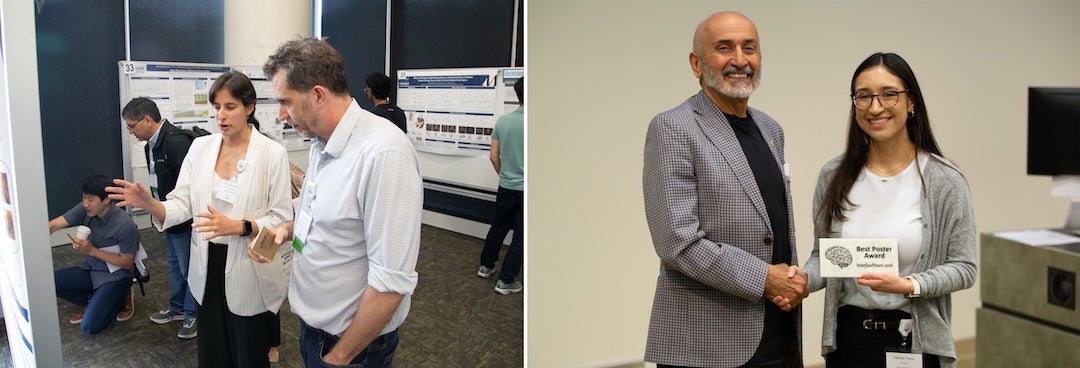
“This conference is a very successful joint initiative with Georgia Tech, and it is a great way to showcase the breadth of expertise in brain science and neuroengineering that we have here at Rice,” said Behnaam Aazhang, co-director of the Rice Neuroengineering Initiative and director of the Rice Brain Institute. “This year, we witnessed a strong synergy among participants and captivating discussions across panels. The attendance, number of posters and overall energy level have all been fantastic.”
The meeting comes amid expanding investment in brain research at Rice. In 2025, the university launched the Rice Brain Institute to unite neuroengineering, neuroscience and brain-and-society research across disciplines while deepening partnerships with the Texas Medical Center. Rice has also expanded dementia and brain health seed grant programs and participates in Project Metis, a regional initiative that aims to position the Houston-Galveston region as a global leader in brain health and the emerging brain health economy.
“We are trying to create an ecosystem where advances in neuroscience, engineering and medicine can move more naturally toward technologies that restore and improve brain function,” Aazhang said. “That only happens when people from different disciplines are in constant conversation with each other.”